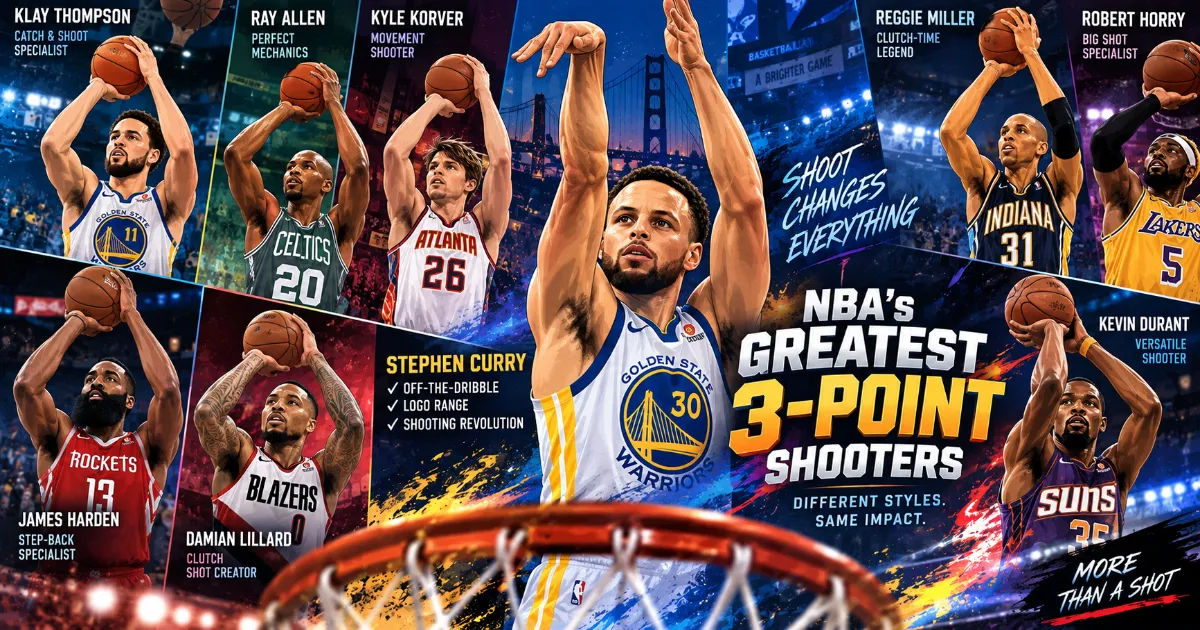
Catch-and-shoot specialists, off-the-dribble shot creators, and logo-range bombers — the different styles of three-point shooting that built the modern NBA
Not every great three-point shooter gets their shot off the same way. Some rely on constant off-ball movement to shake free for a catch-and-shoot look. Others create their own three-point attempt off the dribble, often with a defender draped on them. And a rare few have made shooting from well beyond the actual three-point line a repeatable, reliable weapon. This is a look at the position’s finest shooters grouped by exactly how they get their shot up, plus the longest three-pointers on record.
The Movement Shooters
Klay Thompson. Thompson’s catch-and-shoot efficiency off constant off-ball movement remains among the best the league has ever produced, built on an unusually quick release that minimizes the window defenders have to contest after he comes off a screen. His 14-three-pointer game against Chicago in 2018 remains one of the most statistically dominant single-game shooting performances in league history.
Ray Allen. Before Thompson, Allen set the standard for technically flawless catch-and-shoot mechanics, running off a constant stream of screens throughout Boston and Miami’s offensive sets. His game-tying three-pointer in the 2013 Finals remains one of the most replayed clutch shots in league history, hit under maximum pressure off a genuinely difficult offensive rebound scramble.
Kyle Korver. Korver built an entire career around off-ball movement shooting, rarely creating his own shot but consistently ranking among the league’s most accurate three-point shooters across nearly two decades, a career-long testament to how valuable pure catch-and-shoot reliability can be even without significant shot-creation ability.
The Off-the-Dribble Shot Creators
Stephen Curry. Curry’s ability to pull up from three-point range at full speed, often with minimal space between himself and a defender, represents the clearest evolution of off-the-dribble three-point shooting in league history. Unlike movement shooters who rely on screens to get open, Curry frequently creates his own three-point attempts through pure ball-handling and quick-trigger shooting mechanics.
James Harden. Harden’s step-back three-point shot became one of the most efficient and difficult-to-defend individual scoring moves in the modern game, using a specific, almost unguardable combination of hesitation and lateral movement to create separation before rising into his shot.
Damian Lillard. Lillard’s willingness to pull up from well beyond the three-point line off the dribble, often in late-game situations, has become a signature part of his offensive identity, adding a genuine long-range shot-creation dimension that few off-the-dribble shooters have attempted at his volume.
The Logo-Range Specialists
Stephen Curry. Beyond his off-the-dribble creation, Curry deserves separate mention for effectively creating a new informal shooting category: attempts from 30 feet or further, taken with a frequency and accuracy no player before him approached. What would be considered a desperation heave for most players has become a functional, repeatable weapon in his shot diet.
Damian Lillard. Lillard’s deep-range shooting overlaps meaningfully with the off-the-dribble category above, but his specific willingness to shoot from well beyond the arc in clutch situations places him among the small handful of players who’ve made logo-range shooting a genuine part of their late-game identity rather than an occasional highlight.
The Clutch-Time Specialists
Reggie Miller. Miller built an entire eighteen-year career around elite clutch three-point shooting, delivering some of the most statistically improbable late-game performances of his era, including a legendary eight points scored in nine seconds during a 1995 playoff comeback against New York.
Robert Horry. Nicknamed “Big Shot Rob” for a career built almost entirely around clutch shooting in the biggest possible moments, Horry hit series-altering three-pointers across multiple different championship runs with three different franchises, a postseason clutch reputation matched by very few role players in league history.
The Two-Way Shooters Who Combine Multiple Styles
A handful of players don’t fit neatly into a single category above because they’ve genuinely mastered more than one shooting style within the same career. Stephen Curry appears in three separate categories in this piece specifically because his game combines off-the-dribble creation, logo-range volume, and enough movement-based catch-and-shoot ability off screens to rank among the best at all three simultaneously, a combination that has no real precedent in league history. Kevin Durant similarly blends elements of off-the-dribble creation with movement shooting off screens, using his height to shoot comfortably over contests regardless of which specific mechanism generated his look. This positional flexibility within shooting itself is increasingly common among modern perimeter players, reflecting how thoroughly shooting development has evolved from a single mechanical skill into a broader toolkit players are expected to master across multiple contexts.
International Shooters Who Expanded the Position’s Range
Several international players have made significant individual contributions to how three-point shooting has evolved stylistically. Dirk Nowitzki’s fadeaway jumper, while technically a two-point shot for most of his prime, helped establish that elite shooting touch could be paired with significant size, a foundation that later informed how modern stretch shooters at forward and center positions developed their own three-point range. Luka Doncic’s step-back three-point shot, drawing stylistic inspiration from James Harden’s earlier innovation, represents a more recent example of international talent adopting and refining an existing American shooting style rather than introducing an entirely new one.
The Longest Three-Pointers on Record
Beyond accuracy and volume, a handful of NBA shots deserve recognition purely for distance. Several players have made shots from well beyond half-court in end-of-quarter or end-of-game situations, though these desperation heaves are generally treated as a separate statistical category from repeatable, functional long-range shooting. Damian Lillard’s series-winning shot against Oklahoma City in the 2019 playoffs, released from well beyond the three-point line with the defender backing off to avoid a foul, remains one of the most significant “logo three” shots in postseason history given the stakes attached to it. Stephen Curry has similarly made multiple in-game three-pointers from well beyond 30 feet that weren’t desperation heaves but functional shot attempts within the flow of Golden State’s offense, a distinction that separates his deep shooting from the more common buzzer-beating half-court heave.
Three-Point Shooters Ever — Quick Reference by Style
| Style | Representative Players | Signature Trait |
|---|---|---|
| Movement Shooters | Klay Thompson, Ray Allen, Kyle Korver | Off-ball screening and quick release |
| Off-the-Dribble Creators | Stephen Curry, James Harden, Damian Lillard | Self-created three-point attempts |
| Logo-Range Specialists | Stephen Curry, Damian Lillard | Functional shots from 30-plus feet |
| Clutch Specialists | Reggie Miller, Robert Horry | Late-game and playoff shot-making |
Why Grouping by Style Reveals More Than a Flat Ranking
Separating these shooters by how they actually get their shot off, rather than ranking them on a single flat list, reveals something a pure accuracy-based ranking misses: three-point shooting isn’t one skill, but several distinct ones that happen to result in the same point value. A movement shooter like Kyle Korver and an off-the-dribble creator like James Harden are solving completely different tactical problems, even though both show up in the same statistical category. Recognizing this distinction matters for how teams scout and develop shooters today, since a young player’s shooting mechanics alone don’t determine which of these roles they’re best suited to fill within an actual offensive system.
How Defenses Have Adjusted to Each Shooting Style
Modern defensive schemes have had to develop genuinely different approaches for each shooting archetype discussed above. Movement shooters are typically defended through aggressive screen navigation and “chasing” tactics that prioritize denying the catch entirely. Off-the-dribble creators require containing dribble penetration before the shooter ever gets to their preferred pull-up range. Logo-range specialists have forced some defenses to extend coverage rules to distances that would have been considered unnecessary just over a decade ago, an adjustment directly traceable to Curry and Lillard’s specific shot diets reshaping what “the three-point line” functionally means for defensive positioning purposes.
How Shooting Coaches Have Adapted Their Teaching Methods
The rise of these distinct shooting archetypes has directly influenced how shooting development is taught at every level below the NBA. Youth and college coaches increasingly teach off-the-dribble shot creation as a distinct skill set from catch-and-shoot mechanics, rather than treating three-point shooting as a single undifferentiated skill to develop generically. Specialized shooting coaches who work individually with NBA players often focus on refining one specific style rather than attempting to build a generic all-purpose shooting motion, reflecting the broader industry recognition that these are genuinely different skills requiring different training emphases, even though they result in the same three-point attempt on a box score.
Final Thoughts
The NBA’s greatest three-point shooters ever didn’t all arrive at their accuracy through the same mechanical or tactical path. Klay Thompson and Ray Allen mastered off-ball movement, Stephen Curry and James Harden mastered self-created shots off the dribble, and Reggie Miller and Robert Horry mastered the specific pressure of delivering in the biggest possible moments. Together, these different styles illustrate that three-point shooting excellence has never been a single, uniform skill, but a collection of related abilities that different players have combined in genuinely distinct ways across the sport’s history.
Frequently Asked Questions
Who is considered the best pure catch-and-shoot three-point shooter in NBA history? Klay Thompson and Ray Allen are the two names most frequently cited, both known for technically flawless mechanics and an unusually quick release off constant off-ball movement.
What is considered the most significant clutch three-pointer in NBA playoff history? Damian Lillard’s series-winning shot against Oklahoma City in the 2019 playoffs and Ray Allen’s game-tying three in the 2013 Finals are the two most frequently cited, given the direct series or championship stakes attached to each.
Is logo-range shooting considered a repeatable skill or just a highlight? For players like Stephen Curry and Damian Lillard, it’s treated as a genuinely functional, repeatable part of their offensive shot diet rather than an occasional desperation heave, a distinction that separates them from most other players who occasionally hit shots from similar distances.
Which players are considered skilled at more than one three-point shooting style? Stephen Curry and Kevin Durant are the two most frequently cited examples, both combining off-the-dribble creation with movement-based catch-and-shoot ability, a rare combination that has helped make each of them uniquely difficult to defend regardless of how a given possession is designed.
🔹🔹 Follow us on Facebook 🔹🔹
Most Points Per Game in NBA History — A Completely Different List Than You’d Expect


One Comment