The Patriots and 49ers headline the greatest NFL dynasties ever, though the 1970s Steelers still claim the best single decade in league history.
What Actually Makes a Dynasty
Not every great team qualifies as a dynasty, and the distinction matters more than casual usage of the word suggests. A dynasty requires sustained excellence across multiple years, not just a single dominant season — genuine roster and coaching continuity through the ups and downs that any team faces over a decade or more. By that standard, only a handful of NFL franchises have ever truly earned the label, and ranking them requires weighing total championships, the length of the championship window, statistical dominance relative to competition, and the sheer difficulty of replicating that success under whatever rules and salary structure existed at the time.
Most Points Per Game in NBA History — A Completely Different List Than You’d Expect
Greatest Running Backs in NFL History: Brown, Payton, Sanders — and the Endless Argument
Tier 1: The Two Giants of the Debate
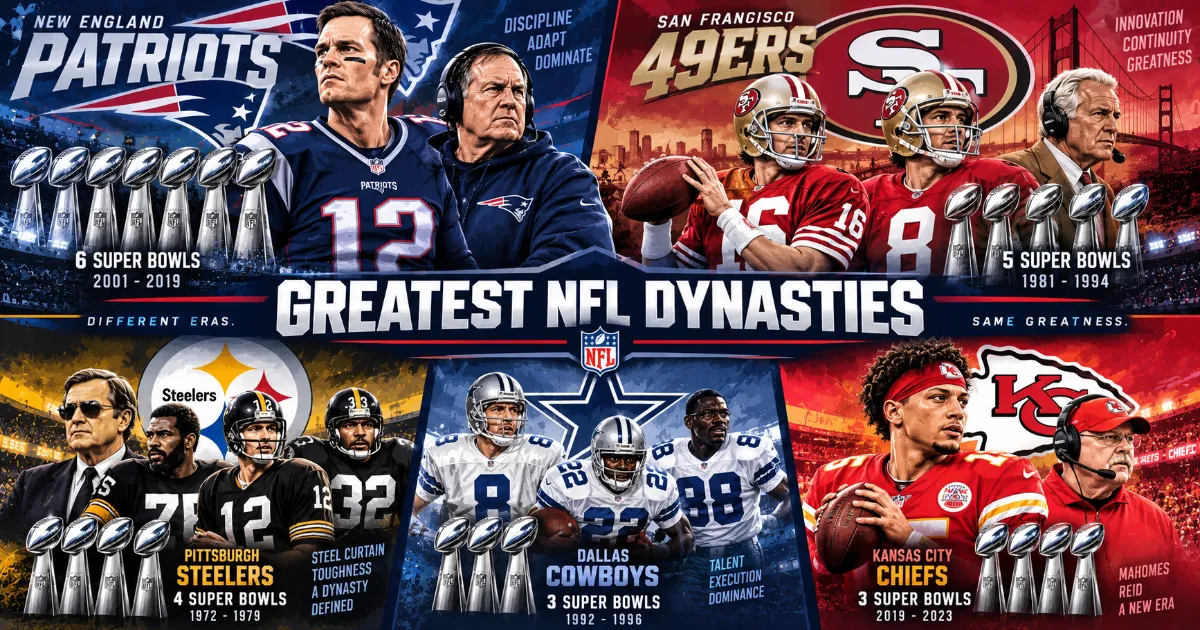
The New England Patriots (2001-2019) represent the longest sustained run of championship-level excellence the Super Bowl era has ever produced. Beginning unexpectedly when Drew Bledsoe’s injury handed the starting job to Tom Brady in 2001, the Patriots won six Super Bowls (XXXVI, XXXVIII, XXXIX, XLIX, LI, LIII), appeared in nine total — both NFL records — and won 17 division titles, including 11 in a row from 2009 to 2019. Statistical models measuring team strength over time (Elo ratings) show the Patriots posting the best five-, six-, nine-, ten-, eleven-, and twelve-year runs of any team in modern NFL history, a level of multi-year sustained dominance no other dynasty on this list has matched.
The San Francisco 49ers (1981-1994) counter with a case built on innovation and quarterback continuity across two Hall of Fame passers rather than one. Bill Walsh transformed a moribund franchise into champions within three seasons of his arrival, and San Francisco went on to win five Super Bowls (XVI, XIX, XXIII, XXIV, XXIX) across 14 seasons, spanning both Joe Montana’s and Steve Young’s tenures at quarterback — a rare case of a dynasty successfully surviving a full changeover at the sport’s most important position. By the same Elo-based measurements that favor New England over longer windows, the 49ers actually post the best seven- and eight-year peak stretches of any team in the merger era, meaning the debate genuinely depends on which time frame you’re measuring.
There’s a personal thread connecting these two dynasties worth noting: Tom Brady grew up in the San Francisco Bay Area idolizing Montana and Young, meaning the player who eventually built the rival dynasty for the title of “greatest ever” spent his childhood admiring the team he’d eventually be compared against.
Tier 1, Continued: The Greatest Single Decade
The Pittsburgh Steelers (1972-1979) occupy a slightly different category from the Patriots and 49ers — rather than the longest or most statistically dominant multi-year run, they’re widely considered to have fielded the single greatest collection of talent for one specific decade in NFL history. Behind team president Dan Rooney, head coach Chuck Noll, and legendary scout Bill Nunn, Pittsburgh assembled a roster that produced 10 Hall of Famers, going a perfect 4-0 in Super Bowl appearances during the decade. Terry Bradshaw won two Super Bowl MVP awards, Franco Harris rushed for over 1,000 yards in eight consecutive seasons, and the “Steel Curtain” defense — anchored by Joe Greene, Mel Blount, Jack Ham, and Jack Lambert — remains one of the most feared units the sport has ever fielded. Many historians still rank the 1970s Steelers as the single greatest decade-specific team ever assembled, even below the Patriots and 49ers on multi-decade measures.
Tier 2: Dominant, But Shorter-Lived
The Dallas Cowboys (1992-1996) built arguably the most talented single roster of the entire 1990s around the “Triplets” — Troy Aikman, Emmitt Smith, and Michael Irvin — winning three Super Bowls in four years (XXVII, XXVIII, XXX) behind a dominant defense and the “Great Wall of Dallas” offensive line. Statistical models actually rate the 1992-95 Cowboys as having the best three- and four-year peak of any team in the merger era, edging out even the Patriots’ and 49ers’ best short stretches. What keeps Dallas out of the very top tier is longevity: head coach Jimmy Johnson left less than two months after the team’s second consecutive title, and despite Barry Switzer guiding the Cowboys to a third championship in Super Bowl XXX, the dynasty collapsed rapidly afterward — Dallas was a 6-10 team just two years after that final title and wouldn’t win another playoff game until 2009.
The Kansas City Chiefs (2019-2023) represent the most complete dynasty of the current era, built around Patrick Mahomes and Andy Reid. In the six seasons since Mahomes took over as starter, Kansas City made six consecutive AFC Championship Game appearances, winning three Super Bowls (LIV, LVII, LVIII) before Philadelphia denied a bid for a historic three-peat in Super Bowl LIX. Whether this dynasty ultimately climbs into the Patriots-49ers tier depends heavily on what comes next — the Chiefs’ collapse to a 6-11 record in 2025, coupled with Mahomes’ torn ACL and LCL, has at least temporarily paused a championship window that looked, as recently as early 2025, like it might eventually rival New England’s own run.
Tier 3: Earlier Eras Worth Remembering
The Green Bay Packers (1961-1967), under Vince Lombardi, won five NFL championships in seven years, including the first two Super Bowls, and remain the last team in NFL history to win three consecutive league titles. Because this run predates the full Super Bowl era and the AFL-NFL merger, it’s sometimes excluded from modern statistical dynasty rankings, but by championship count alone, it stands alongside anything the sport has produced since. The Oakland/Los Angeles Raiders (1967-1985) built a nearly two-decade run of sustained competitiveness across both the AFL and NFL, winning three Super Bowls with a physical, hard-nosed identity that became the franchise’s defining cultural signature. The Miami Dolphins (1970-1974) delivered the only perfect season in NFL history in 1972, going 17-0, and won back-to-back Super Bowls under Don Shula — a shorter but historically unmatched peak. The Cleveland Browns (1946-1955) dominated the All-America Football Conference and then the NFL so completely in the years immediately following World War II that the franchise’s early identity was built almost entirely on sustained championship success, a dynasty often overlooked simply because it predates modern television coverage of the sport.
What Separates the True Greats From “Just a Good Team”
Looking across every dynasty on this list, a few shared traits consistently distinguish real dynasties from teams that simply had one or two great seasons: continuity at head coach and quarterback through multiple championship runs (Patriots, 49ers, Packers), the ability to reload or transition through a changeover at a key position without losing championship-level performance (49ers surviving Montana to Young), and a defining statistical or cultural signature that outlasted the roster itself (the Steel Curtain, the West Coast offense, the Raiders’ outlaw identity). Teams that miss on continuity — like the 1990s Cowboys losing Jimmy Johnson right after back-to-back titles — tend to post the highest short-term peaks on record without matching the longer-run sustained dominance of the true top-tier dynasties.
The Controversies That Shadow the Very Top
No discussion of the modern dynasties is complete without acknowledging the controversies that have followed the two leading candidates. New England’s run was accompanied by two significant league investigations — “Spygate” in 2007, involving improper videotaping of opposing coaches’ signals, and “Deflategate” in 2015, involving under-inflated footballs during an AFC Championship Game — both of which critics cite as an asterisk on an otherwise unmatched run of success. Defenders of the dynasty point out that the Patriots’ sustained excellence both before and after either controversy suggests the underlying success was never dependent on either practice. The 49ers’ dynasty, by contrast, carries no comparable controversy, which some historians cite as a point in San Francisco’s favor when the debate over “greatest ever” specifically weighs the clean legitimacy of the accomplishment rather than the raw scale of it alone.
The Bottom Line
The greatest NFL dynasties of all time ultimately split along the same fault line as most “greatest ever” debates in football: total accumulated success across a long era versus the single most dominant peak stretch anyone’s ever produced. The Patriots’ 2001-2019 run remains the longest sustained championship window the sport has seen, a genuinely unmatched accomplishment under the modern salary cap. The 49ers counter with the best short-to-medium peak of the merger era and the rare distinction of winning across two different Hall of Fame quarterbacks. And the 1970s Steelers, by most historians’ accounts, still fielded the single most talented roster ever assembled for one specific decade, even if their overall run doesn’t stretch as long as New England’s or San Francisco’s. All three cases are genuine. None fully cancels out the others — which is exactly why this remains one of the most rewarding debates in all of professional sports history.
Frequently Asked Questions
What is considered the greatest NFL dynasty of all time? The New England Patriots (2001-2019) and San Francisco 49ers (1981-1994) are the two most commonly cited answers, with the Patriots holding the edge in total championships (6) and the longest sustained run, while the 49ers post the best short-to-medium peak by advanced statistical models.
How many Super Bowls did the Pittsburgh Steelers win in the 1970s? The Steelers went a perfect 4-0 in Super Bowl appearances during the 1970s, a run many historians consider the single greatest decade-specific team performance in NFL history.
Why don’t the 1990s Cowboys rank above the Patriots or 49ers? While the Cowboys posted the best three- and four-year statistical peak of the modern era, head coach Jimmy Johnson left shortly after their second consecutive title, and the team collapsed rapidly afterward, missing the sustained longevity that defines the top-tier dynasties.
Are the Kansas City Chiefs considered one of the greatest NFL dynasties? The Chiefs (2019-2023) built one of the most complete championship windows of the modern era, winning three Super Bowls in five years, though a difficult 2025 season and Patrick Mahomes’ injury have paused further progress toward the very top tier.
What team had the only perfect season in NFL history? The 1972 Miami Dolphins, under head coach Don Shula, finished 17-0, the only perfect season in NFL history, as part of a dynasty that also won back-to-back Super Bowls.
Why is the 1960s Green Bay Packers dynasty sometimes excluded from modern rankings? Because their five championships in seven years occurred before the full Super Bowl era and the AFL-NFL merger, some statistical dynasty models exclude that period, even though the Packers’ championship total stands alongside any dynasty in NFL history.
🔹🔹 Follow us on Facebook 🔹🔹
Most Points Per Game in NBA History — A Completely Different List Than You’d Expect