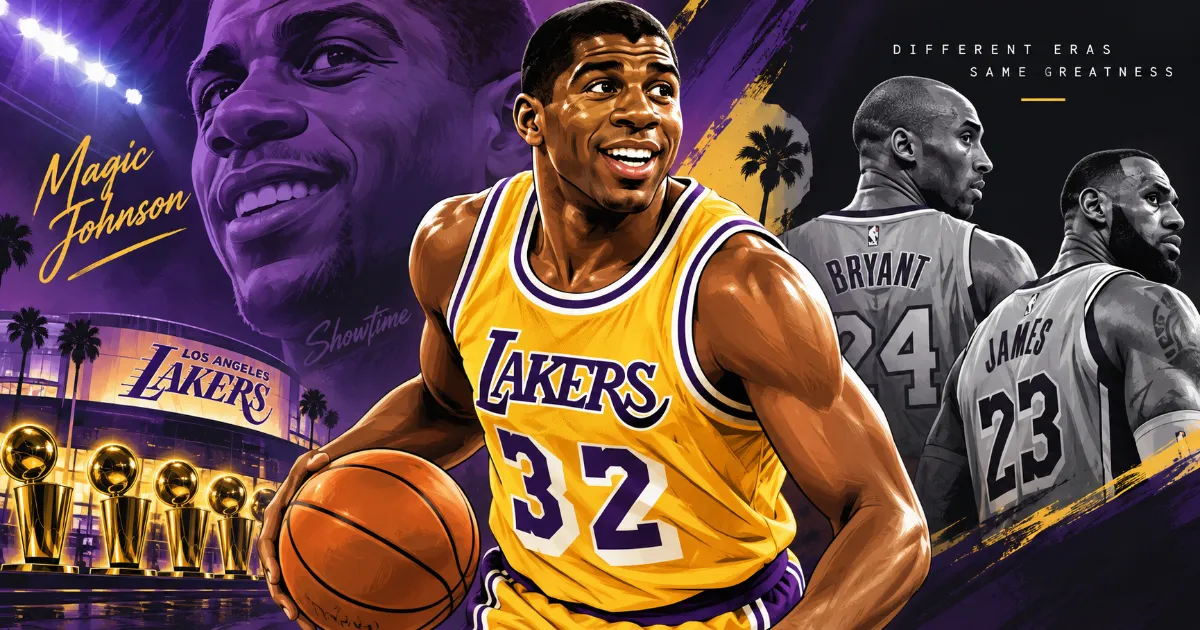
A position-redefining size, a Showtime dynasty, and a premature ending — how Magic Johnson’s Lakers legacy holds up against Kobe Bryant and LeBron James
Magic Johnson’s Lakers Legacy: The Three Things That Made Him Impossible to Replicate
Every Lakers superstar since Magic Johnson has been measured, at least in part, against the standard he set — and the comparison never quite lands the same way twice, because Johnson’s legacy rests on three things that don’t easily separate from each other: a body type nobody had successfully deployed at his position before, a specific team system built to maximize it, and a career cut short at its apparent peak. Here’s how that legacy actually holds up against the two Lakers legends who followed him.
Michael Jordan Career Stats, Records and Six Championships Explained
Kobe Bryant’s Case Among the All-Time Greats, Explained
Pillar One: A Position Nobody Had Seen Before
At 6-foot-9, Johnson played point guard in a league where the position had almost universally belonged to considerably smaller players focused on ball-handling and defense. He didn’t just succeed at the position despite his size — he used it as a weapon, seeing over defenses that smaller point guards couldn’t see over, and rebounding at a rate no traditional point guard before him had approached. His rookie season alone, in which he started at center in place of an injured Kareem Abdul-Jabbar during the 1980 Finals and delivered a 42-point, 15-rebound performance to close out the series, remains one of the most statistically unusual individual Finals games in league history for any position, let alone a rookie point guard.
Pillar Two: A System Built Entirely Around Him
“Showtime” wasn’t just a nickname for an entertaining style of basketball — it was a genuine tactical system built specifically to maximize what Johnson could do that no one else could. Pat Riley’s up-tempo offense relied on Johnson pushing the ball in transition off virtually every defensive rebound, using his size to see the full floor before defenses could get set. This system produced five championships across the 1980s and is widely credited with helping restore the NBA’s national television popularity after a stretch of declining ratings in the late 1970s.
Pillar Three: An Ending That Came Too Early
Johnson’s career was cut short by his 1991 HIV diagnosis, forcing his retirement at just 32 years old — an age where most comparable superstars still had several prime seasons remaining. He returned briefly for the 1996 season, but the bulk of his statistical legacy was locked in at an age when his statistical peers were typically still adding to their résumés. This premature ending is a permanent, unresolvable variable in any comparison of his career totals against players who competed into their late 30s.
The Statistical Anomaly of His Assist Totals
Johnson’s career assist total ranks among the highest in NBA history despite his relatively short thirteen-season career, a statistical fact that becomes more remarkable when measured on a per-season basis against nearly every other name near the top of that list. Most of the players ahead of him in total career assists played five to seven additional seasons to accumulate their totals. On a per-game basis, Johnson’s 11.2 career assists average remains among the highest ever recorded, reflecting that his statistical dominance in this specific category wasn’t a product of longevity the way it was for some other names on the all-time list, but genuine sustained per-game brilliance across his entire career.
How Showtime Reshaped the League’s Offensive Pace
Beyond Johnson’s individual statistics, the Showtime Lakers’ broader tactical influence on the league deserves specific mention. The team’s commitment to pushing pace off every defensive rebound, rather than walking the ball up and running a deliberate half-court set, represented a genuine departure from how most successful teams had operated in the years prior. Other franchises began adjusting their own offensive philosophies throughout the 1980s in response to Showtime’s success, an early example of how a single dominant team’s stylistic approach can reshape league-wide strategic thinking, a pattern that would later repeat itself with Golden State’s three-point-heavy approach decades afterward.
Johnson’s Statistical Peak Season in Detail
His 1986-87 season, in which he captured his first regular-season MVP award, remains a useful statistical snapshot of his complete game at its peak: 23.9 points, 12.2 assists, and 6.3 rebounds per game, shooting an efficient 52.6 percent from the field for a player who spent much of the game facilitating rather than scoring. That combination of high-efficiency scoring alongside league-leading playmaking numbers remains a rare statistical profile even by modern standards, decades before the three-point shooting revolution reshaped what efficient scoring volume typically looks like at the guard position.
Measured Against Kobe Bryant: Two Different Lakers Eras
Kobe Bryant’s Lakers legacy took shape in almost the opposite statistical mold from Johnson’s. Where Johnson’s value came from elevating others — Kareem Abdul-Jabbar’s late-career efficiency, complementary scorers like James Worthy finding easy transition opportunities — Bryant’s value came from individual scoring artistry, an approach built around difficulty and shot creation rather than distribution. Both won five championships with the franchise, but through almost entirely different mechanisms: Johnson as a playmaking hub, Bryant as a primary scorer who happened to also be an excellent teammate.
Where Johnson’s case is stronger is pure statistical anomaly — no player before or since has combined his size with that level of playmaking vision at the position. Where Bryant’s case is stronger is longevity and adaptability across two distinct championship windows, first alongside Shaquille O’Neal and later as the clear franchise leader, spanning twenty seasons compared to Johnson’s thirteen.
Measured Against LeBron James: Playmaking Pioneer vs. Statistical Completeness
LeBron James’s arrival in Los Angeles in 2018 invited direct comparison to Johnson, given that both are oversized players who function as their team’s primary playmaker rather than a traditional shooting guard or small forward. James’s case rests on statistical completeness across an entire career — he’s the NBA’s all-time leading scorer while also ranking among the league’s all-time assist leaders, a combination that extends Johnson’s original template into an even more statistically dominant hybrid.
Johnson’s case against James rests on originality and team success rate: he was doing something genuinely unprecedented for his position in the early 1980s, while James built on a template Johnson had already established. Johnson also won five championships in nine Finals appearances with a single franchise across his entire career, while James’s four championships came across three different franchises, including a 2020 title with the Lakers specifically that drew direct comparisons to Johnson’s own championship runs with the organization.
Head-to-Head Comparison Summary
| Category | Magic Johnson | Kobe Bryant | LeBron James |
|---|---|---|---|
| Lakers Championships | 5 | 5 | 1 |
| Career Length | 13 seasons (career cut short) | 20 seasons | 20+ seasons |
| Signature Trait | Positional size and playmaking | Scoring difficulty and artistry | Statistical completeness |
| Finals MVPs | 3 | 2 | 1 (with Lakers) |
| Regular-Season MVPs | 3 | 1 | 1 (with Lakers) |
Why the HIV Diagnosis Changes Every Comparison
Any statistical comparison involving Johnson has to account for the fact that his career simply stopped at an age when Bryant and James were both still several years from their own statistical peaks. Bryant’s most productive individual scoring seasons came in his late 20s and early 30s; James remained an MVP-caliber player well into his late 30s. Johnson never got the chance to show what his own late-career statistical profile might have looked like, which makes any “what would have happened” exercise inherently speculative — but also means his existing five championships and three MVP awards were compressed into a genuinely shorter window than either of the players who followed him. His brief 1996 comeback, played at age 36, produced solid enough per-minute numbers to suggest he likely could have remained a highly productive, if no longer MVP-caliber, player for several more seasons had circumstances allowed him to continue.
Was Shaquille O’Neal the Most Physically Dominant Center in NBA History?
The Cultural Weight Beyond Basketball
Johnson’s legacy also carries cultural significance that exists somewhat separately from his statistical case. His HIV diagnosis announcement in 1991 became a significant moment in broader public health awareness, at a time when HIV and AIDS carried enormous stigma and public misunderstanding. His willingness to discuss his diagnosis publicly, and his eventual return to competitive basketball, is credited with helping shift public perception during a genuinely difficult period for HIV awareness and education — a dimension of his legacy that neither Bryant’s nor James’s Lakers careers directly parallel.
The 1980 Finals Performance in Full Context
Johnson’s rookie-year Finals performance, filling in at center for an injured Kareem Abdul-Jabbar, deserves more statistical context than a simple point-and-rebound total conveys. He played all five positions at different points during that closing Game 6, a level of positional versatility essentially unheard of in a Finals-clinching game at the time, particularly for a 20-year-old rookie. The performance is frequently cited as the single clearest early evidence that Johnson’s size and versatility weren’t a limitation to be managed around, but a genuine competitive advantage his coaching staff could deploy in almost any game situation the roster required.
Final Thoughts
Magic Johnson’s Lakers legacy rests on three things that don’t fully separate from one another: a body type that redefined his position, a system built specifically to weaponize it, and a career ended earlier than any statistical projection would have wanted. Measured against Kobe Bryant’s scoring artistry and LeBron James’s statistical completeness, his case holds up not through matching their career-total numbers, but through having done something at his position that neither of them, for all their own individual brilliance, were the first to attempt.
Frequently Asked Questions
How many championships did Magic Johnson win with the Lakers? Five championships across nine Finals appearances, all with the Los Angeles Lakers, spanning his entire thirteen-season career.
Why was Magic Johnson’s career shorter than Kobe Bryant’s or LeBron James’s? He retired in 1991 at age 32 following his HIV diagnosis, though he did return briefly for one final season in 1996, well before what would likely have been several more prime playing seasons.
Did LeBron James win a championship with the Lakers like Magic Johnson did? Yes, James won one championship with the Lakers in 2020, compared to Johnson’s five Lakers titles across his career.
Who had more career assists, Magic Johnson or LeBron James? LeBron James holds the higher career assist total in raw terms, largely a product of his significantly longer career, though Johnson’s per-game assist average across his shorter career remains among the highest ever recorded at any position.
🔹🔹 Follow us on Facebook 🔹🔹

One Comment