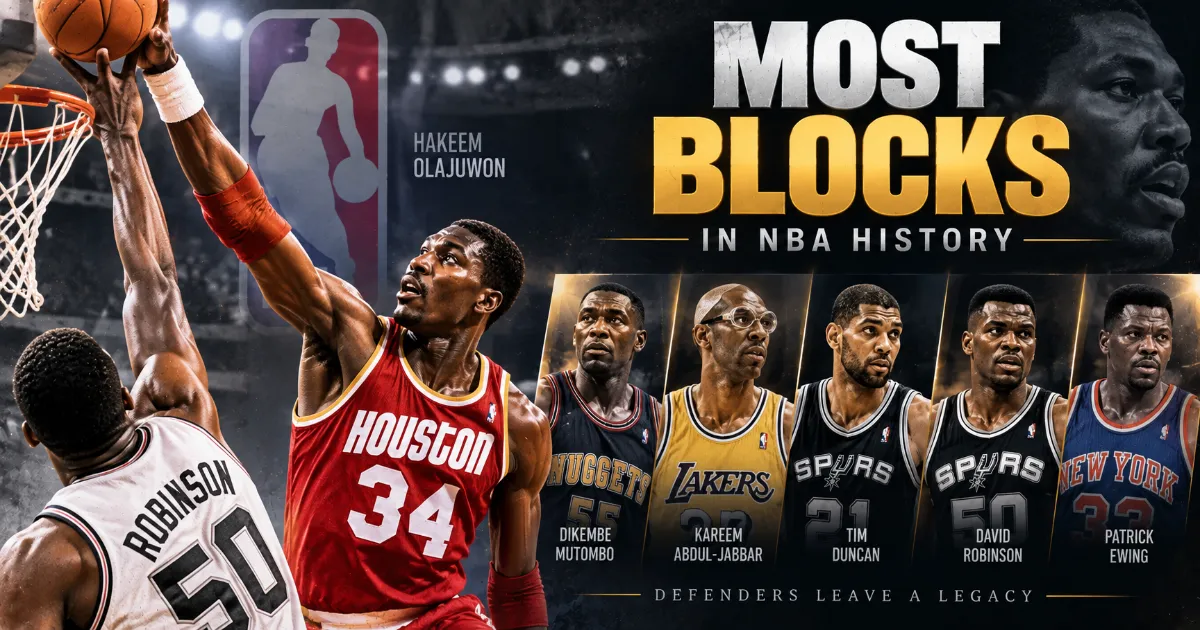
 Hakeem Olajuwon holds the record, but the players chasing him show how shot-blocking dominance has been built throughout Most Blocks in NBA History.
Like steals, blocks weren’t officially tracked by the NBA until the 1973-74 season, meaning this record book excludes any official data from the league’s earliest decades of dominant interior defenders. What remains is a list led by a player better known for his offensive footwork than his shot-blocking, a reminder that individual statistical dominance rarely arrives in a single, predictable package.
The Different Kinds of Great Three-Point Shooters in NBA History
Career Blocks Leaders
| Rank | Player | Career Blocks | Seasons |
|---|---|---|---|
| 1 | Hakeem Olajuwon | 3,830 | 18 |
| 2 | Dikembe Mutombo | 3,289 | 18 |
| 3 | Kareem Abdul-Jabbar | 3,189 | 20 |
| 4 | Mark Eaton | 3,064 | 11 |
| 5 | Tim Duncan | 3,020 | 19 |
| 6 | David Robinson | 2,954 | 14 |
| 7 | Patrick Ewing | 2,894 | 17 |
Olajuwon’s total is particularly notable given that official blocks tracking began only in his rookie season, meaning his full career total is completely captured by the record — unlike several other statistical categories where earlier-era greats are excluded by tracking gaps.
Why Hakeem Olajuwon’s Record Reflects More Than Raw Size
Olajuwon’s shot-blocking dominance came from a genuinely unusual combination for a center: elite footwork and lateral quickness paired with excellent timing, rather than simply overwhelming size. His background in soccer before transitioning to basketball is frequently cited as a contributing factor to his exceptional footwork and body control, skills that translated directly into his ability to recover and contest shots from angles that most centers couldn’t reach in time. This combination made him a threat to block shots even against smaller, quicker perimeter players attacking the rim, not just against other traditional post players.
Dikembe Mutombo’s Case as the Position’s Most Intimidating Presence
Mutombo’s second-place ranking is reinforced by his cultural impact on the sport — his post-block finger-wagging celebration became one of the most recognizable individual gestures in NBA history, and his four Defensive Player of the Year awards remain tied for the most in league history. Unlike Olajuwon’s more footwork-based approach, Mutombo’s shot-blocking relied more heavily on sheer length, timing, and defensive positioning discipline, anchoring elite team defenses across multiple franchises throughout his eighteen-season career.
David Robinson and Tim Duncan: The Spurs’ Defensive Continuity
David Robinson and Tim Duncan’s presence in the top six reflects a specific organizational continuity within the San Antonio Spurs franchise, with Robinson anchoring the team’s interior defense throughout the 1990s before Duncan continued that same defensive identity for nearly two more decades. Robinson’s Defensive Player of the Year award and Duncan’s own reputation as one of the most fundamentally sound post defenders in league history both reflect a shared organizational emphasis on positional discipline and shot-contesting technique rather than pure statistical shot-blocking volume alone, even though both players’ raw block totals rank among the best in NBA history regardless.
Patrick Ewing’s Case Among Elite Defensive Centers
Patrick Ewing’s seventh-place ranking anchored the New York Knicks’ defensive identity throughout the 1990s, a period when the Knicks were widely regarded as one of the most physically imposing defensive teams in the league. Ewing’s shot-blocking, combined with elite post defense, made him a central figure in some of the most competitive playoff series of that decade, even though a championship ultimately eluded him across his entire career. His statistical case is frequently cited alongside the era’s broader defensive physicality, a style of play that has since been significantly restricted by subsequent rule changes around hand-checking and interior contact.
Single-Season Blocks Records
| Rank | Player | Season | Blocks Per Game |
|---|---|---|---|
| 1 | Mark Eaton | 1984-85 | 5.56 |
| 2 | Manute Bol | 1985-86 | 5.00 |
| 3 | Mark Eaton | 1985-86 | 4.85 |
| 4 | Elmore Smith | 1973-74 | 4.85 |
Mark Eaton’s 1984-85 season remains the single-season record, aided significantly by his unusual 7-foot-4 frame, one of the tallest in NBA history, though his career length and offensive limitations kept his overall career impact narrower than most other names on this broader list.
Why Blocks Weren’t Tracked Before 1973-74
Similar to steals, the absence of official blocks tracking before the 1973-74 season means several dominant interior defenders from the league’s earliest decades, most notably Bill Russell, have no official career block total on record despite widespread contemporary accounts describing shot-blocking as a central part of their defensive dominance. Russell in particular is frequently cited by historians as likely the greatest shot-blocker in league history based on game film and eyewitness accounts, even though no official statistic exists to support that claim numerically. This gap is worth keeping in mind whenever this specific record list gets treated as a complete accounting of the sport’s greatest interior defenders.
How Rule Changes Have Affected Shot-Blocking Statistics
The defensive three-second rule, introduced in the 2001-02 season, meaningfully changed how shot-blocking specialists could position themselves defensively, prohibiting defenders from camping in the paint without actively guarding an assigned player. This rule change encouraged more mobile, perimeter-capable shot-blockers rather than pure paint-anchored specialists, a shift reflected in how more recent elite shot-blockers like Rudy Gobert combine traditional rim protection with greater defensive mobility than some of the more stationary shot-blocking specialists from earlier eras on this list needed to develop.
Kareem Abdul-Jabbar’s Overlooked Defensive Statistical Case
Abdul-Jabbar’s third-place ranking often surprises fans who primarily remember him for his offensive skyhook rather than his defensive shot-blocking. His block total, compiled across twenty seasons, reflects sustained defensive anchoring that complemented his offensive dominance for two full decades, a two-way statistical combination matched by very few players in NBA history given how rarely a player sustains elite production in both major statistical categories across such a long career.
Why Manute Bol’s Case Deserves Specific Mention
Manute Bol’s presence on the single-season list, despite a relatively short and statistically limited career overall, reflects one of the most extreme individual physical profiles in NBA history — a 7-foot-7 center whose wingspan and timing made him a historically unique shot-blocking threat during the specific seasons he remained healthy and available. His career, while brief relative to most names on this broader list, remains a frequently cited example of how an extreme physical outlier can produce historically significant single-season statistical peaks even without matching the career-total accumulation of longer-tenured players.
Modern Shot-Blockers and the Position’s Continued Evolution
Beyond the historical names discussed above, modern shot-blockers like Rudy Gobert have continued extending the position’s defensive relevance despite the significantly reduced pace and shot volume of the contemporary league compared to earlier eras on this list. Gobert’s multiple Defensive Player of the Year awards reflect a genuinely modern approach to interior defense, combining traditional rim protection with the mobility and switchability increasingly demanded by today’s more perimeter-oriented offensive schemes. His career trajectory suggests he could realistically climb into the lower portion of this all-time list given continued health and career longevity, representing one of the few active players with a plausible path toward the historical rankings discussed throughout this piece.
Final Thoughts
Most blocks in NBA history rewards a genuinely diverse set of defensive skills, from Hakeem Olajuwon’s footwork-based anticipation to Dikembe Mutombo’s positional discipline to Mark Eaton and Manute Bol’s extreme physical outlier profiles. Unlike some other statistical categories dominated by a single playing style, this list demonstrates that elite shot-blocking has been achieved through multiple genuinely different combinations of size, timing, and athleticism across the sport’s history.
Frequently Asked Questions
Who holds the NBA record for most career blocks? Hakeem Olajuwon, with 3,830 career blocks across eighteen seasons, a total fully captured since official blocks tracking began in his rookie season.
What is the highest single-season blocks average in NBA history? Mark Eaton’s 5.56 blocks per game during the 1984-85 season remains the record, aided by his unusually tall 7-foot-4 frame.
How many Defensive Player of the Year awards did Dikembe Mutombo win? Four, tied for the most in NBA history, reflecting his sustained defensive dominance across an eighteen-season career with multiple franchises.
Why doesn’t Bill Russell appear on the official career blocks list? Blocks weren’t officially tracked by the NBA until the 1973-74 season, after Russell’s career had already ended, meaning his shot-blocking dominance is documented only through game film and contemporary accounts rather than an official statistical total.


One Comment