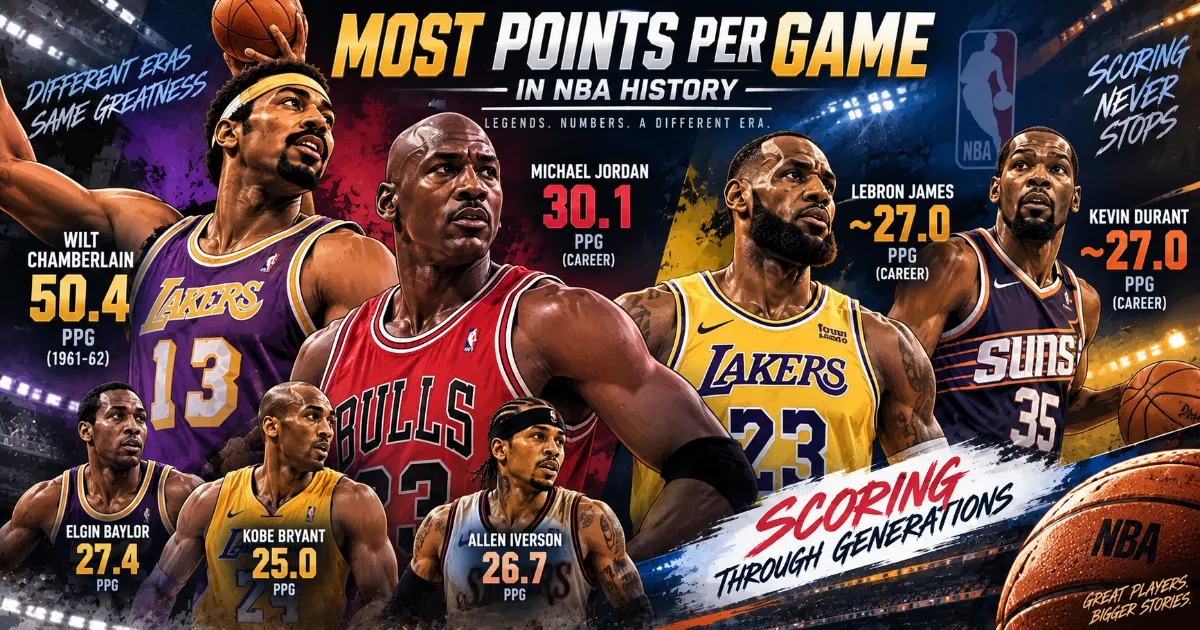
Most Points Per Game in NBA History: Career Leaders and the Single-Season Records That Will Never Be Touched
Points per game and career total points measure two genuinely different things, and nowhere is that distinction more important than at the top of the record book. A player can accumulate the most career points simply by playing long enough; leading the league in scoring rate requires sustained per-game dominance regardless of career length. This breakdown covers both angles separately, since the career leaders and single-season leaders in points per game tell almost entirely different stories.
Career Scoring Average Leaders
| Rank | Player | Career PPG | Seasons |
|---|---|---|---|
| 1 | Michael Jordan | 30.1 | 15 |
| 2 | Wilt Chamberlain | 30.1 | 14 |
| 3 | Elgin Baylor | 27.4 | 14 |
| 4 | LeBron James | ~27.0 | 20+ |
| 5 | Kevin Durant | ~27.0 | 15+ |
| 6 | Kobe Bryant | 25.0 | 20 |
| 7 | Allen Iverson | 26.7 | 14 |
Jordan and Chamberlain are effectively tied at the top of career scoring average, separated by a fraction of a point depending on the specific calculation method used, a statistical coincidence given how differently the two players actually accumulated those numbers — Jordan through efficient, high-volume scoring across a complete offensive game, Chamberlain through a combination of shot volume and interior efficiency in a dramatically faster-paced era.
Single-Season Scoring Average Records
| Rank | Player | Season | PPG |
|---|---|---|---|
| 1 | Wilt Chamberlain | 1961-62 | 50.4 |
| 2 | Wilt Chamberlain | 1962-63 | 44.8 |
| 3 | Wilt Chamberlain | 1960-61 | 38.4 |
| 4 | Michael Jordan | 1986-87 | 37.1 |
| 5 | Wilt Chamberlain | 1963-64 | 36.9 |
Chamberlain’s 1961-62 season, in which he averaged 50.4 points per game across an entire 80-game schedule, remains the single most statistically dominant scoring season in NBA history by a considerable margin. No other player has ever averaged even 40 points across a full season, and only Chamberlain himself has done it more than once.
Why Wilt Chamberlain’s Numbers Require Era Context
Understanding Chamberlain’s single-season records requires acknowledging just how different his competitive environment was from the modern league. The early 1960s NBA played at a dramatically faster pace than today’s game, featured far less sophisticated defensive schemes, and drew from a significantly smaller and less globally developed talent pool. Chamberlain also played an unusual volume of minutes — he famously averaged nearly 48 minutes per game across that 50-point season, meaning he rarely left the floor at all. These factors don’t diminish the achievement, but they do explain why most historians apply meaningful era-adjustment when comparing his single-season numbers directly to modern scorers.
Why Michael Jordan’s Career Average Has Held Up
Jordan’s career scoring average is a genuinely different kind of achievement, sustained across fifteen seasons against a much more competitive, defensively sophisticated league than Chamberlain faced. What makes Jordan’s number particularly durable as a record is that it survived the entire three-point shooting revolution — modern players have access to an offensive weapon that barely factored into Jordan’s own scoring approach, yet none has managed to sustain a higher career scoring rate across a comparable career length.
The Modern Era’s Closest Challengers
Among currently active or recently retired players, LeBron James and Kevin Durant represent the closest approaches to Jordan’s career scoring rate, both sitting in the 27-point-per-game range across significantly longer careers than Jordan’s. Their inability to fully close the gap despite playing in an era with greater three-point volume and looser perimeter defensive rules is frequently cited as evidence of just how statistically unusual Jordan’s per-game efficiency at that scoring volume actually was.
Rookie Season Scoring Rate Records
A separate, less frequently discussed category involves rookie scoring averages specifically. Wilt Chamberlain’s rookie season, in which he averaged 37.6 points per game, remains the highest rookie scoring average in league history by a wide margin, itself a preview of the individual dominance he would sustain throughout his career. Among more modern rookies, players like Michael Jordan and Allen Iverson posted rookie scoring averages in the low-to-mid 20s, respectable by any contemporary standard but nowhere close to Chamberlain’s rookie-year output, reinforcing just how statistically isolated his entire scoring rate profile remains across every subcategory of this record.
How Advanced Metrics Contextualize These Numbers
Modern advanced statistics offer a useful lens for evaluating scoring rate records across such different eras. Metrics like Offensive Rating and True Shooting Percentage attempt to measure scoring efficiency independent of pace, providing some ability to compare Chamberlain’s era-specific dominance against Jordan’s more modern efficiency on a more level statistical footing. Even accounting for pace adjustments, Chamberlain’s single-season peak remains statistically extreme relative to any modern equivalent, while Jordan’s career-long efficiency at high volume continues to rank among the best ever recorded even after normalizing for pace and era.
Positional Breakdown of the Career List
The career scoring average list skews heavily toward wing scorers — shooting guards and small forwards — rather than centers, despite centers historically dominating total career points and rebounding lists. This reflects a specific statistical reality: wing scorers have historically had more direct offensive touches and shot attempts per game relative to their minutes than traditional centers, whose offensive role even in dominant eras often involved more offensive rebounding and second-chance opportunities than primary shot creation.
How Minutes Played Affects These Rankings
A subtle but important factor behind these rankings is how many minutes each player averaged while compiling their scoring rate. Chamberlain’s near-48-minute-per-game average during his record season means he had almost no rest during games, maximizing his scoring opportunities relative to any player who came off the bench for meaningful stretches. Modern players, by contrast, typically play 34 to 38 minutes per game even in MVP-caliber seasons, reflecting decades of accumulated sports science suggesting reduced minutes preserve performance and health across an 82-game season. This means a modern player’s scoring rate, even when historically excellent, is being generated across meaningfully less court time than Chamberlain had available to him, adding yet another layer of era-adjustment to any direct comparison.
Why the Three-Point Era Hasn’t Produced a New Leader
Given how dramatically three-point volume has increased league-wide over the past decade, it might seem surprising that no modern high-volume scorer has surpassed Jordan’s career scoring average. Part of the explanation is that three-point shots, while valuable, are worth only one additional point compared to a two-point attempt, meaning a player would still need extraordinarily high field-goal efficiency across a high volume of both shot types to meaningfully exceed Jordan’s per-game rate. Modern superstars like Kevin Durant and Luka Doncic have come closer than most, but the combination of volume and efficiency required to actually surpass Jordan’s specific number has proven durable even in an offensive environment specifically designed to maximize scoring opportunities.
How Minutes Played Affects These Rankings
A subtle but important factor behind these rankings is how many minutes each player averaged while compiling their scoring rate. Chamberlain’s near-48-minute-per-game average during his record season means he had almost no rest during games, maximizing his scoring opportunities relative to any player who came off the bench for meaningful stretches. Modern players, by contrast, typically play 34 to 38 minutes per game even in MVP-caliber seasons, reflecting decades of accumulated sports science suggesting reduced minutes preserve performance and health across an 82-game season. This means a modern player’s scoring rate, even when historically excellent, is being generated across meaningfully less court time than Chamberlain had available to him, adding yet another layer of era-adjustment to any direct comparison.
The Load Management Era’s Effect on Career Averages
Modern load management practices, in which star players are strategically rested during select regular-season games, also complicate direct comparisons to earlier eras when players like Chamberlain and even Jordan rarely missed games by choice. A player’s career scoring average is calculated only across games actually played, meaning strategic rest doesn’t directly lower the average, but it does mean today’s stars accumulate their career totals across a meaningfully different games-played pattern than the iron-man workloads common in earlier decades, a scheduling and health-management difference worth acknowledging even though it doesn’t directly distort the per-game average calculation itself.
Final Thoughts
Most points per game in NBA history splits cleanly into two separate records that shouldn’t be conflated: Michael Jordan’s career average, achieved through sustained efficiency across a complete fifteen-season body of work in a highly competitive era, and Wilt Chamberlain’s single-season peaks, achieved through a combination of individual talent and a dramatically different competitive and pace environment that no longer exists. Both records have stood for decades, and given how differently each was achieved, both appear likely to remain unmatched for the foreseeable future.
Frequently Asked Questions
Who has the highest career scoring average in NBA history? Michael Jordan and Wilt Chamberlain are effectively tied at the top, both around 30.1 points per game for their careers, though calculated through very different playing styles and eras.
What is the highest single-season scoring average ever recorded? Wilt Chamberlain’s 50.4 points per game during the 1961-62 season remains the record by a significant margin, with no other player ever averaging even 40 points across a full season.
Why hasn’t a modern player matched Michael Jordan’s career scoring average? Despite access to greater three-point volume and looser perimeter defensive rules than Jordan’s era allowed, no modern player has sustained his combination of scoring volume and efficiency across a comparably long career.
Did Wilt Chamberlain ever come close to his own scoring record in a later season? Yes, his 1962-63 season produced a 44.8 points-per-game average, still the second-highest single-season mark in NBA history, though well short of his own 1961-62 record.
🔹🔹 Follow us on Facebook 🔹🔹






2 Comments