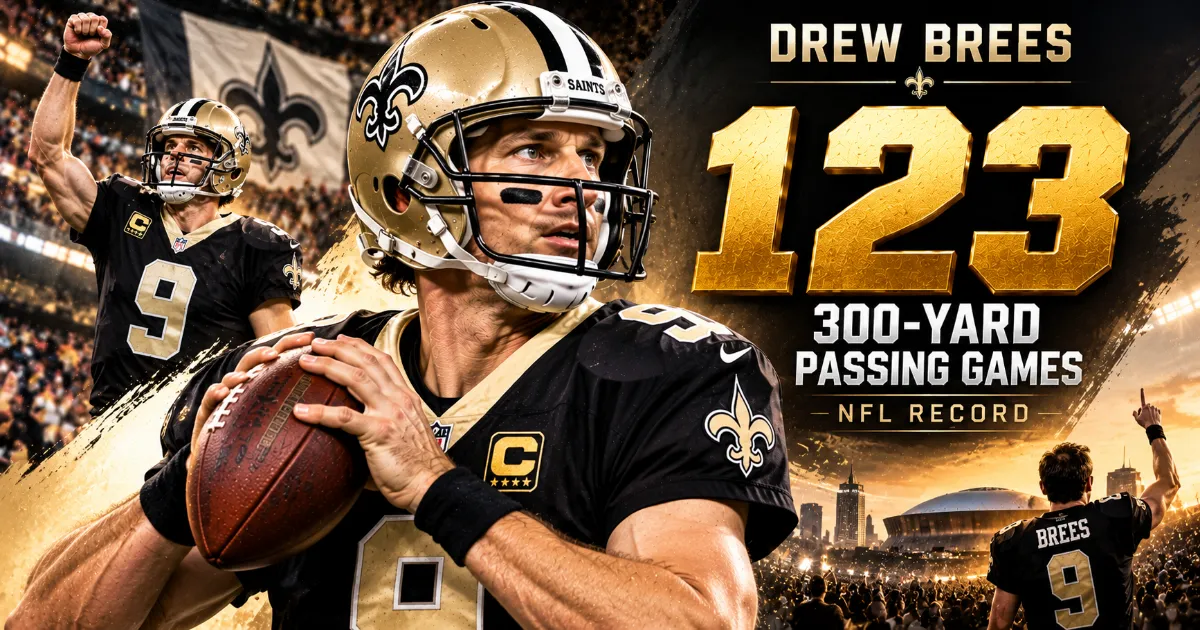
Drew Brees leads the Most 300-Yard Passing Games in NFL History leaderboard with 123, a record built on two decades of consistent passing production.
Drew Brees holds one of the NFL’s most remarkable passing records, having thrown for at least 300 yards in 123 regular-season games. His achievement reflects two decades of consistent production, exceptional accuracy and an offensive system that regularly put the football in his hands. Although Tom Brady and Peyton Manning also built impressive totals, Brees finished his career at the top of this leaderboard.
A 300-yard passing game is often considered a sign of a productive performance, but reaching that mark repeatedly over a career requires more than a strong throwing arm. Quarterbacks need consistent playing time, a reliable group of receivers and an offense that creates opportunities to pass. Brees benefited from those factors throughout his career, particularly during his long spell with the New Orleans Saints.
Manning vs. Montana vs. Rodgers vs. Marino vs. Elway vs. Young
Presidents Cup 2026 Results: USA Completes Epic Comeback
His record also illustrates how passing statistics have evolved in the NFL. As offenses have increasingly relied on the passing game, more quarterbacks have reached 300 yards in individual games. Yet Brees’ career total remains a benchmark for sustained passing production.
Drew Brees Holds the Record With 123 Games
Drew Brees recorded 123 regular-season games with at least 300 passing yards during his NFL career. He played for the San Diego Chargers and New Orleans Saints between 2001 and 2020, spending the final 15 seasons of his career in New Orleans.
His partnership with head coach Sean Payton was central to his statistical success. The Saints regularly used short passes, intermediate routes and spread formations to move the ball through the air. Brees’ quick release and ability to read defenses made him particularly effective in that system.
The result was a remarkable run of passing production. Brees frequently exceeded 300 yards without needing an unusually high number of deep throws. His accuracy and ability to distribute the ball among multiple receivers helped New Orleans maintain a productive offense across several seasons.
Brees also played in numerous high-scoring games, where both teams relied heavily on their quarterbacks. These situations created additional opportunities to accumulate passing yards, although they did not always result in victories.
His career total is a combination of individual ability, availability and offensive circumstances. The record is not simply about throwing for 300 yards once; it is about reaching that threshold repeatedly over a 20-season career.
Most 300-Yard Passing Games in NFL History: Career Leaders
The all-time leaderboard features quarterbacks from different generations, including prolific passers from the 1980s and 1990s and modern quarterbacks who played in increasingly pass-oriented offenses.
Drew Brees finished with 123 career regular-season 300-yard passing games, while Tom Brady also surpassed the 100-game milestone. Peyton Manning held the record before the two eventually moved past his total.
The following table provides historical context for the leading quarterbacks. Exact totals for players beyond the leading names should be checked against an updated statistical database before publication.
Quarterback | Career 300-yard passing games |
|---|---|
Drew Brees | 123 |
Tom Brady | 109 |
Peyton Manning | 93 |
Philip Rivers | 85 |
Aaron Rodgers | 75 |
Matt Ryan | 72 |
Matthew Stafford | 70 |
Dan Marino | 63 |
Brett Favre | 62 |
Warren Moon | 49 |
Note: The figures above are historical leaderboard figures supplied for this article and should be verified against an official NFL or established statistical database before publishing, particularly for active players and any differences in regular-season counting methods.
Brees’ lead over Brady is a significant part of the record’s story. Brady’s career lasted longer, but Brees finished with more games reaching the 300-yard threshold. Manning’s total of 93 was the benchmark before the two later-era quarterbacks moved past it.
The list also demonstrates how the passing environment changed over time. Marino and Moon produced high passing totals in eras when many teams relied more heavily on running plays, while later quarterbacks benefited from offenses that frequently prioritized passing.
Tom Brady’s Pursuit of the Record
Tom Brady is one of the most prolific passers in NFL history, and his career included more than 100 regular-season games with at least 300 passing yards.
Brady reached the 100-game milestone during the 2021 season with the Tampa Bay Buccaneers. He continued adding to his total before retiring after the 2022 season, but he did not catch Brees’ final mark.
The comparison between the two quarterbacks is interesting because their careers followed different paths. Brady played 23 seasons and appeared in 335 regular-season games, while Brees played 20 seasons. Brady’s longevity allowed him to accumulate enormous career totals in passing attempts, completions and yards.
Brees, however, was especially consistent at reaching the 300-yard threshold. His time in New Orleans provided a sustained period in which the passing game was a central feature of the offense.
Brady’s record in other statistical categories shows why career leaderboards should be considered individually. A quarterback can lead one category without necessarily leading another, because each statistic measures a different aspect of performance.
Peyton Manning Previously Held the Career Record
Peyton Manning was another defining quarterback of the modern NFL passing era. He played for the Indianapolis Colts and Denver Broncos and finished his career with 93 regular-season games of at least 300 passing yards, according to the historical figures used here.
Manning’s offensive approach relied heavily on preparation and pre-snap adjustments. He frequently changed plays after reading the defensive alignment, allowing his offense to exploit mismatches and find open receivers.
His career included five NFL MVP awards and two Super Bowl titles. Manning was also known for directing high-scoring offenses, particularly during his years in Indianapolis and his record-setting 2013 season in Denver.
Manning’s total of 93 300-yard games stood as the career benchmark before Brees and Brady surpassed it. That progression reflects how passing volume and career longevity have continued to shape NFL records.
It also illustrates why long-standing records are difficult to evaluate without considering the era in which they were established. Manning played during a period when passing offenses were becoming increasingly central to the league, helping create more opportunities to reach 300 yards.
Drew Brees’ Record-Breaking 2011 Season
Brees’ career record was supported by several extraordinary individual seasons. His 2011 campaign is particularly notable: he threw for 5,476 yards, setting an NFL single-season passing-yardage record at the time, and recorded at least 300 passing yards in 13 regular-season games.
That level of consistency meant Brees reached the 300-yard threshold in most of New Orleans’ games that season. His performance helped the Saints finish 13–3 and reach the playoffs.
Brees worked with a deep group of offensive weapons, including tight end Jimmy Graham and receivers such as Marques Colston and Lance Moore. Their ability to create separation and gain yards after the catch helped turn accurate passes into productive plays.
The season also demonstrated how a quarterback’s individual production can reflect an entire offensive system. Brees’ accuracy was essential, but the coaching strategy, protection from the offensive line and performance of his receivers all contributed to his success.
His 2011 campaign remains an important part of the story behind his career 300-yard record.
Why the 300-Yard Milestone Matters
Passing for 300 yards is a useful benchmark because it represents substantial passing production in a single game. However, it is not a complete measure of quarterback performance.
A quarterback can throw for 300 yards and still lose because the opposing offense scores more points, the defense struggles or turnovers change the game. Another quarterback might finish with fewer than 300 yards while making several crucial plays that help secure a win.
The statistic also does not account for passing efficiency. A quarterback who throws for 300 yards on 30 attempts has reached the same yardage threshold as one who needs 45 attempts, but their efficiency differs considerably.
To understand a quarterback’s performance more fully, it helps to consider 300-yard games alongside:
Passing yards per attempt: Measures how many yards a quarterback generates per pass attempt.
Completion percentage: Shows the proportion of attempts completed.
Touchdown passes: Indicates how often a quarterback finishes passing drives with touchdowns.
Interceptions: Records passes caught by the opposing team.
Wins and losses: Provides team-result context, although wins depend on all three phases of the game.
These statistics provide a broader picture of how a quarterback produced his passing numbers and how those performances affected the team.
Why a 300-Yard Game Does Not Guarantee a Win
Brees’ career included many 300-yard games in both victories and defeats. That is not unusual for a quarterback who played in high-volume passing offenses for so long.
When a team falls behind, its offense often passes more frequently to try to catch up. Those additional attempts can help a quarterback reach 300 yards, even if the team ultimately loses.
This is one reason passing yardage should not be used on its own to judge a quarterback’s performance. A large total may reflect a productive offense, but it can also reflect a game in which a team spent much of the second half chasing the score.
Brees’ time in New Orleans included seasons with highly productive offenses and others in which the defense struggled to consistently prevent opponents from scoring. In some games, the Saints needed Brees to keep throwing deep into the contest.
His 300-yard record therefore reflects not only offensive success but also the variety of game situations he encountered throughout his career.
How the Modern Passing Era Has Changed the Record
The NFL’s passing environment has changed significantly over the past several decades. Offensive schemes have evolved, and rule changes designed to protect quarterbacks and limit certain types of contact on receivers have influenced how teams attack defenses.
Many modern offenses use quick throws, spread formations and short passing routes to create favorable matchups. These approaches can help quarterbacks accumulate completions and passing yards, especially when paired with an effective running game that forces defenses to respect multiple options.
However, the rise of passing production does not mean every modern quarterback will approach Brees’ record. A player must remain a starter for many seasons and consistently reach the 300-yard mark to accumulate a comparable total.
Career records also span different offensive environments. Marino and Moon produced impressive passing numbers before the modern game reached its current level of passing volume. Their presence on historical leaderboards shows that prolific passing existed well before the latest era of offensive football.
Can an Active Quarterback Break Drew Brees’ Record?
Brees’ total of 123 games creates a demanding target for current quarterbacks. To challenge it, a player needs both a long career and a high rate of 300-yard performances.
A quarterback who averages eight 300-yard games per season would need more than 15 seasons at that pace to reach 123. A player who records fewer such games each year would need an even longer career.
Matthew Stafford and Aaron Rodgers have accumulated substantial passing statistics over their careers, but their eventual totals depend on their playing time and production in the seasons ahead. Younger quarterbacks have more years available to build their numbers, although injuries, changes in offensive systems and team circumstances can affect their progress.
Patrick Mahomes has produced multiple high-volume passing seasons, but his career total must be evaluated in the context of his years as a starter and the number of games he has played. It is too early to determine whether any active quarterback will eventually surpass Brees.
For now, the record remains a notable example of sustained production over a long NFL career.
The Bottom Line
Drew Brees’ 123 career 300-yard passing games stand as a remarkable milestone in NFL history. His record reflects consistent passing production, a long career and an offensive system that regularly placed the football in his hands.
Tom Brady and Peyton Manning also established impressive totals, but Brees finished ahead of both. His 2011 season, in which he threw for 5,476 yards and recorded 13 games with at least 300 passing yards, provides a clear example of the consistency behind the record.
Ultimately, 300-yard passing games measure only one part of quarterback performance. When considered alongside efficiency, touchdowns, turnovers and team results, however, they help explain how Brees became one of the most productive passers the NFL has seen.
🔹🔹 Follow us on Facebook 🔹🔹