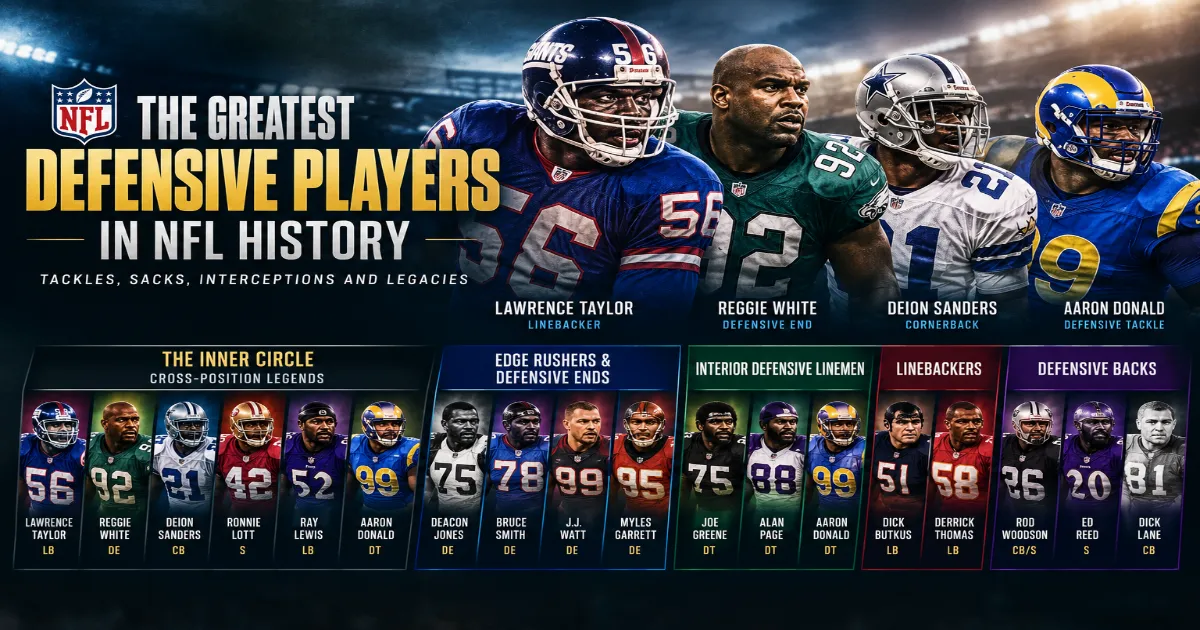
From pass rushers to shutdown corners, here’s how the greatest defensive players in NFL history stack up across every position on the field.
Why Defense Resists a Single Ranking More Than Any Other Unit
Ranking the greatest defensive players in NFL history is a fundamentally different exercise than ranking quarterbacks, receivers, or running backs. Offense produces clean, countable statistics — yards, touchdowns, completions — that make cross-era comparison at least somewhat manageable. Defense doesn’t offer that same courtesy. A shutdown cornerback who allows almost nothing to be thrown his way can finish a season with modest interception totals precisely because he did his job too well to be tested. A dominant interior lineman can occupy two blockers on nearly every snap without a single sack to show for it. That’s why this list is organized by position first, and cross-position legacy second — because comparing a pass rusher to a safety requires acknowledging they were never solving quite the same problem.
Week 2 Defense Rankings Fantasy Football: Best D/ST Starts & Streamers
Fastest NFL Players Ever: Separating Combine Legends From Game-Day Burners
The Inner Circle: Defense’s Cross-Position Legends
A small handful of defenders have built cases so complete that they transcend their own position group entirely. Lawrence Taylor sits alone at the top of nearly every serious ranking of this kind. The Giants outside linebacker didn’t just dominate — he forced the entire sport to redesign offensive line technique and permanently elevated the value of the left tackle position specifically to counter him. He won three Defensive Player of the Year awards, a mark matched only by J.J. Watt decades later, and remains the only defensive player to win NFL MVP since 1971, taking home the honor in 1986.
Reggie White, “The Minister of Defense,” is the most common answer to “who’s second” in this conversation. He retired with 198 career sacks (second all-time officially, though researchers believe several dominant pre-1982 pass rushers may have actually produced more before the league began formally tracking the statistic), was a 13-time Pro Bowler, and produced a three-year stretch from 1986 to 1988 in which he recorded 57 sacks in just 44 games — one of the most sustained peak stretches any pass rusher has ever put together.
Deion Sanders remains the standard-bearer at the sport’s most difficult defensive position. “Prime Time” didn’t just cover receivers — he made entire sides of the field disappear from opposing game plans, finishing his career with 53 interceptions, 1,331 interception return yards (still among the best ever), and 22 total defensive and return touchdowns. Ronnie Lott built his Hall of Fame case on rare positional versatility, transitioning from cornerback to safety while maintaining elite production at both, and remains one of the most feared hitters the position has ever produced. Ray Lewis anchored Baltimore’s defense for 17 seasons, combining rare tackling production with vocal leadership that helped deliver two Super Bowl championships. Aaron Donald, the most recent addition to this tier, built a case in just eight seasons that many evaluators already consider historic — three Defensive Player of the Year awards and a level of interior pass-rush disruption that’s forced a wholesale reconsideration of how valuable a dominant defensive tackle can be in the modern game.
Lawrence Taylor’s Own Top Five
In a genuinely fun wrinkle to this debate, Taylor himself was asked to name his personal top five defensive players of all time during a 2023 podcast appearance. His list: Taylor himself at No. 1, followed by Reggie White, Deacon Jones, Deion Sanders, and Ronnie Lott. Notably absent was Aaron Donald, a name modern rankings increasingly include in any top-five conversation — an omission host Brandon Marshall specifically pressed him on, with Taylor eventually conceding, half-joking, that he’d add Donald “if y’all want me to.” It’s a small moment, but a telling one: even the man most consider the greatest defensive player ever draws his own personal line differently than the current statistical consensus does.
The Statistical Blind Spot That Complicates Everything
Any honest ranking of defensive greatness has to reckon with a structural problem that doesn’t affect offensive statistics nearly as much: the NFL didn’t begin officially tracking sacks until 1982, and several other key defensive statistics were recorded far less rigorously in the league’s earlier decades. This means players like Deacon Jones, who dominated throughout the 1960s and early ’70s, have their signature statistical achievement — a number he’s credited with literally naming — reduced to researcher-reconstructed estimates rather than an official league record. It’s a genuine and unresolved problem for cross-era comparison at nearly every defensive position, and it’s part of why so many “greatest ever” rankings lean as heavily as they do on awards, championships, and reputation among contemporaries rather than pure statistical accumulation alone — for a meaningful stretch of NFL history, the full statistical picture simply doesn’t exist in the way it does for the sport’s passing and rushing records.
Greatest Edge Rushers and Defensive Ends
Beyond White, Deacon Jones deserves recognition as the position’s founding legend — he’s credited with literally coining the term “sack,” and researchers have reconstructed his career total at roughly 173.5 sacks, a number that would rank second all-time if the NFL recognized pre-1982 statistics officially. Bruce Smith holds the actual official career sacks record at 200, built across 19 seasons with Buffalo and Washington. In the modern game, J.J. Watt matched Taylor’s three Defensive Player of the Year awards across an injury-shortened but statistically dominant career, while Myles Garrett has emerged as the position’s active standard, setting the single-season sack record with 23 in 2025 before a June 2026 trade to the Los Angeles Rams.
Greatest Interior Defensive Linemen
Aaron Donald ranks as the clear modern standard at defensive tackle, but he built on a foundation laid by several earlier greats. Joe Greene, the anchor of Pittsburgh’s legendary “Steel Curtain” defense, helped power the Steelers to four Super Bowl championships in the 1970s through pure physical dominance and intimidation, even in an era with far less comprehensive individual statistical tracking. Alan Page became the first defensive player ever to win NFL MVP, in 1971, doing so from the interior defensive line — a genuinely unusual accomplishment for the position that remains unmatched. Bob Lilly and Randy White both anchored Dallas’s defensive front across different eras of the franchise’s history, each helping to define what disciplined, disruptive interior line play could look like.
Greatest Linebackers
Taylor sits alone atop this group, but the depth behind him is considerable. Dick Butkus is frequently cited as the most purely feared tackler the position has ever produced, a nine-year Chicago Bears career built on a level of physical violence that became the archetype for the position for decades afterward. Ray Lewis, discussed above, combined tackling production with leadership that few linebackers in history have matched. Derrick Thomas brought a pass-rushing dimension to the linebacker position that predated the modern hybrid edge-rusher archetype, recording seven sacks in a single game in 1990 — still an NFL record.
Greatest Defensive Backs
Beyond Sanders and Lott, Rod Woodson built one of the most complete cornerback résumés in history, later transitioning to safety and continuing to produce at an elite level well into his late 30s. Ed Reed redefined what a ball-hawking safety could do, leading the NFL in interceptions three times and finishing with 64 career picks, built on a level of pre-snap read and anticipation that teammates and coaches alike have called nearly impossible to teach. Dick “Night Train” Lane remains a name every serious historian insists belongs in this conversation — his 14 interceptions as a rookie in 1952 remains an NFL record over 70 years later, and his 68 career interceptions still rank fourth all-time.
The Active Case-Builders
A handful of currently active defenders are already building résumés serious enough to enter this broader conversation. Myles Garrett’s single-season sack record and sustained double-digit-sack production across eight of his nine seasons give him the strongest active case among pass rushers. T.J. Watt has produced at a level matching or exceeding his brother J.J.’s own historic peak, while Micah Parsons has combined edge-rushing and off-ball linebacker versatility in a way that echoes Taylor’s own genre-defining hybrid role, though none of these players is yet within realistic range of unseating the position-group legends discussed above.
What Actually Separates the Tiers
A few criteria consistently distinguish the very top of this list from the rest: era-defining scheme impact (Taylor, Donald), sustained statistical dominance relative to position (White, Sanders, Reed), positional versatility (Lott, Woodson), and the specific, harder-to-quantify quality of forcing opposing coordinators to build entire game plans around avoiding a single player (Taylor, Sanders, Donald). Very few defenders check every one of these boxes simultaneously, which is precisely why the very top of this list — Taylor, White, Donald, Sanders, and Lott or Lewis — remains so consistent across nearly every serious ranking, even when the order between them shifts depending on which specific criteria a given evaluator weighs most heavily.
The Bottom Line
The greatest defensive players in NFL history don’t reduce neatly into a single countdown the way offensive skill positions often do, because defense has never rewarded a single, universally comparable statistic. Taylor’s case rests on having single-handedly changed how the sport is coached. White’s rests on sustained sack production that’s stood for decades. Sanders’ rests on defenses so complete that opponents simply avoided testing him. Donald’s rests on redefining what an undersized interior lineman can accomplish through pure disruption. Every position on defense has produced its own version of this argument — which is exactly why, unlike some of football’s more settled debates, this one shows no sign of resolving itself anytime soon.
Frequently Asked Questions
Who is considered the greatest defensive player in NFL history? Lawrence Taylor is almost universally regarded as the greatest defensive player ever, having won three Defensive Player of the Year awards and the 1986 NFL MVP, a feat no defensive player has repeated since.
Who is considered the greatest pass rusher in NFL history? Reggie White is the most commonly cited answer, with 198 official career sacks, though Bruce Smith holds the all-time official record at 200, and researchers believe Deacon Jones may have actually recorded more sacks before the statistic was officially tracked before 1982.
Who is considered the greatest cornerback in NFL history? Deion Sanders is the most widely cited answer, based on his combination of shutdown coverage ability, 53 career interceptions, and 22 total defensive and return touchdowns.
Did Lawrence Taylor name his own top five defensive players? Yes — in a 2023 podcast appearance, Taylor listed himself first, followed by Reggie White, Deacon Jones, Deion Sanders, and Ronnie Lott, notably leaving Aaron Donald off the list.
Who is the strongest active defensive player among the all-time greats conversation? Myles Garrett is generally considered the strongest active case, having set the NFL’s single-season sack record with 23 in 2025 and sustained elite production across most of his career.
Who was the first defensive player to win NFL MVP? Alan Page, an interior defensive lineman for the Minnesota Vikings, won NFL MVP in 1971 — the first defensive player to do so. Lawrence Taylor remains the only other defensive player to win the award since.
🔹🔹 Follow us on Facebook 🔹🔹
Greatest NBA Players of the 2000s — The Stars Who Defined a Transitional Era