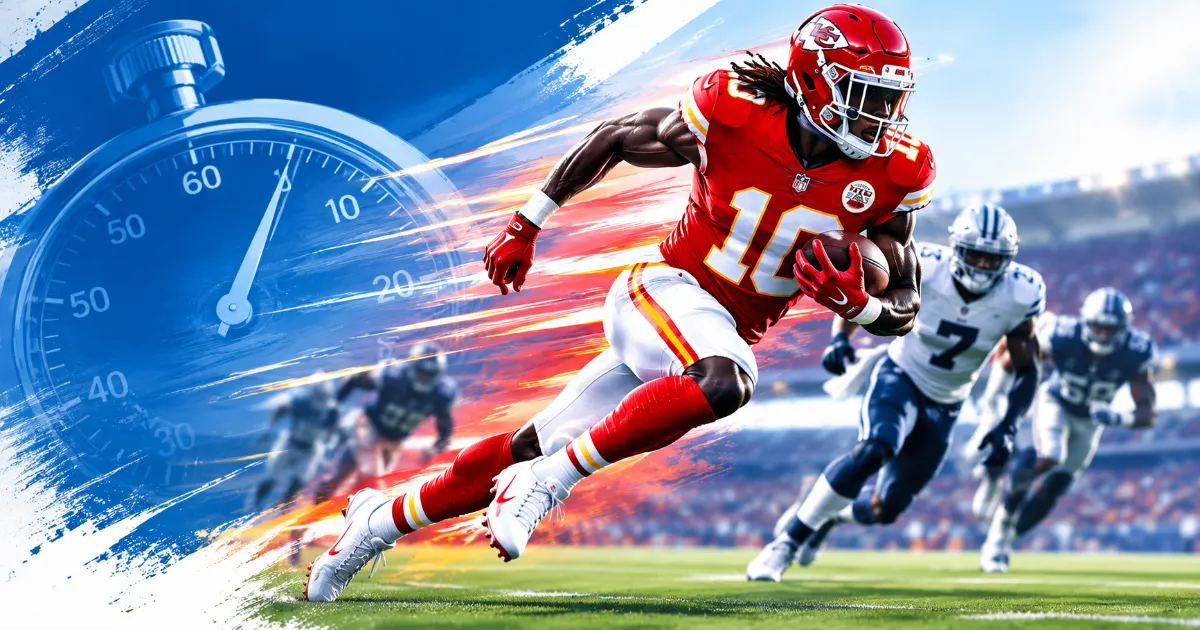
Speed Is One Thing Everyone Can See
Football fans can argue about almost anything.
Quarterback rankings. Offensive schemes. Defensive coverage. Whether a player is a product of his system. Those conversations can go on forever.
Speed is different.
When a receiver gets behind a defender and suddenly has five yards, then 10, then 20, you don’t need a spreadsheet to understand what you’re watching. The player is just gone.
That’s what makes the debate over the fastest NFL players so much fun. There are numbers to back it up, but those numbers don’t all measure the same thing.
A 40-yard dash tells us how quickly a player can sprint in a controlled setting. Next Gen Stats tells us how fast someone actually gets moving during an NFL game.
And those two lists look surprisingly different.
The Combine Has Its Own Speed Kings
The 40-yard dash is probably the most famous test at the NFL Scouting Combine. It’s also one of the simplest.
Run 40 yards as fast as possible.
There are no defenders, no pads, no football and no pressure beyond knowing that every scout in the building is watching. Still, the test has become one of the clearest ways to put a number on raw athleticism.
For years, Chris Johnson owned the benchmark.
Johnson ran 4.24 seconds at the 2008 combine, a number that became part of his identity. A year later, he backed it up on the field with one of the greatest seasons by a running back in NFL history, rushing for 2,006 yards and earning the nickname “CJ2K.”
Then came John Ross.
At the 2017 combine, Ross ran 4.22 seconds and finally knocked Johnson’s mark off the top of the leaderboard.
That record lasted seven years.
In 2024, Texas receiver Xavier Worthy changed it again. Worthy ran 4.21 seconds, setting the current combine record and giving NFL fans a new benchmark for pure straight-line speed.
The current top 10, based on official NFL combine results, looks like this:
| Rank | Player | Position | Time | Year |
|---|---|---|---|---|
| 1 | Xavier Worthy | WR | 4.21 | 2024 |
| 2 | John Ross | WR | 4.22 | 2017 |
| 3 | Kalon Barnes | CB | 4.23 | 2022 |
| T-4 | Chris Johnson | RB | 4.24 | 2008 |
| T-4 | Rondel Melendez | WR | 4.24 | 1999 |
| T-6 | DJ Turner | CB | 4.26 | 2023 |
| T-6 | Dri Archer | RB | 4.26 | 2014 |
| T-6 | Tariq Woolen | CB | 4.26 | 2022 |
| T-6 | Jerome Mathis | WR | 4.26 | 2005 |
| T-10 | Henry Ruggs III | WR | 4.27 | 2020 |
There are a couple of interesting things hiding in that list.
For one, receivers and defensive backs dominate it. That’s not surprising. Those positions are built around speed.
The other thing is more important: running a ridiculous 40 doesn’t guarantee a great NFL career.
Chris Johnson obviously made the most of his speed. Others on the list never came close to matching their combine numbers with long-term NFL production.
That’s the first reason the fastest-player debate gets complicated.
Then There’s Game Speed
The combine gives us a controlled sprint.
NFL games are anything but controlled.
Next Gen Stats, which began tracking NFL players in 2016, gives us a much better look at what happens when speed has to work against actual defenders, football equipment, changing angles and the chaos of a real play.
And when it comes to the fastest recorded speed of the Next Gen Stats era, one player sits at the top.
Tyreek Hill.
Hill reached 23.24 mph on a kickoff return during his rookie season in 2016. The return was eventually wiped out by a penalty, but the tracking data still counts.
It’s an incredible number, and Hill has repeatedly shown that it wasn’t some random one-off.
He has appeared on the NFL’s fastest-play lists over and over again. During the 2023 season, he recorded three of the six fastest ball-carrier speeds in the league.
That’s the kind of consistency that makes the “Hill is the fastest player” argument so compelling.
He’s not simply fast in a laboratory.
We’ve seen it happen against NFL defenders.
Raheem Mostert Has a Pretty Strong Case, Too
Hill’s 23.24 mph remains the overall Next Gen Stats mark, but Raheem Mostert owns another important distinction.
Mostert reached 23.09 mph on an 80-yard touchdown run in 2020, giving him the fastest recorded speed on a play from scrimmage.
That distinction matters.
A kickoff or punt return can give a player a running start before he even has the ball. A running back hitting top speed during a play from scrimmage has a different challenge.
Mostert’s number is especially impressive because of how often Miami has produced these kinds of speed freaks.
In 2023, Hill and rookie running back De’Von Achane both appeared among the league’s fastest ball carriers, with Mostert joining them near the top.
For one offense to have that much speed on the field at the same time was almost unfair.
DK Metcalf Makes the Size Argument Interesting
Speed becomes even more impressive when the player carrying it doesn’t look like a traditional speedster.
That’s where DK Metcalf comes in.
Metcalf weighed around 235 pounds when he entered the league, yet he ran a 4.33-second 40 at the 2019 combine.
That alone was impressive.
Then, in 2022, Metcalf chased down Arizona’s Budda Baker after an interception and reportedly reached 22.64 mph.
The play went viral because of what it looked like: a huge receiver running down a much smaller defensive player in open space.
It’s one thing for a 175-pound cornerback to run fast.
It’s another thing entirely when a 235-pound receiver is moving like that.
That combination of size and speed is a big part of why Metcalf remains one of the most memorable athletes of the modern NFL.
Why the Fastest 40s and Fastest Game Speeds Don’t Match
This is where the debate usually gets mixed up.
A 4.21-second 40 and a 23-mph game speed sound like they should be measuring the same thing.
They aren’t.
The 40-yard dash is about acceleration and straight-line speed over a short, controlled distance. Players are rested, wearing minimal clothing and aren’t dealing with anyone trying to tackle them.
Game tracking is different.
A player may have to change direction, fight through contact, catch the ball, accelerate after the catch or build speed over a much longer distance.
Those differences matter.
Someone can be phenomenal over the first 40 yards without necessarily being the fastest player once he gets into the open field.
And that’s part of why Tyreek Hill is such an interesting case.
Hill never ran an official combine 40. He entered the NFL as a fifth-round pick out of West Alabama, and his reputation as one of the fastest athletes in football was built largely through what people saw on the field.
In other words, he didn’t need a stopwatch at the combine to tell everyone he was fast.
They could see it.
The Rare Big-Body Speedsters
There’s something especially memorable about a big player who can move like a much smaller athlete.
Only two players weighing at least 225 pounds have reportedly broken 4.4 seconds in the combine era: DK Metcalf and Antonio Gibson.
Metcalf is the obvious example.
His size made his 4.33 even more impressive, but his game speed is what really cemented his reputation. The chase-down of Baker showed that his combine performance wasn’t just a number produced on one afternoon.
That distinction matters when teams evaluate athleticism.
A 4.26-second cornerback is impressive because corners are supposed to be fast.
A receiver built like a power forward running in the same neighborhood is something people remember.
That’s why unusual combinations of size and speed tend to become some of the NFL’s most memorable athletic stories.
What the Combine Numbers Tell Us About Positions
The combine data also shows just how unusual truly elite speed is.
Between 2003 and 2024, 848 wide receivers ran the 40-yard dash at the combine. Only 10 of them broke 4.3 seconds.
That’s roughly 1.2%.
So even at a position where speed is one of the biggest selling points, a 4.2-second 40 is still an extreme outlier.
Defensive backs are similarly quick, which makes sense given what the position demands. They need to stay with receivers, react to releases and recover when a play goes wrong.
Running backs tend to be slightly slower on average, which is one reason a player like Chris Johnson posting a 4.24 remains such a memorable combine performance.
Then there are the big guys.
Offensive and defensive linemen generally live in a completely different part of the 40-yard-dash spectrum. When one of them produces an unusually fast time, it stands out immediately.
What About the Fastest Players Before Tracking Data?
There’s a problem with trying to create an all-time list.
Modern NFL players have GPS-style tracking data. Players from previous generations don’t.
Next Gen Stats didn’t exist when players such as Deion Sanders, Bo Jackson and Bob Hayes were dominating the league.
So comparing them directly with today’s players isn’t really possible.
Bob Hayes may be the strongest historical case for calling someone a legitimate world-class sprinter who also became an NFL star. Before joining the Dallas Cowboys, Hayes was an Olympic gold medalist and a world-record-setting sprinter. He eventually became a Pro Football Hall of Famer.
Then there’s Deion Sanders, whose speed became a major part of his identity on both sides of the ball.
And, of course, Bo Jackson.
Jackson’s athletic reputation has grown into NFL folklore, and for good reason. His combination of power, size and speed was almost impossible to compare with anyone else of his era.
We can’t give those players a precise Next Gen Stats number.
But pretending they weren’t among the fastest athletes ever to play football would be just as silly.
So, Who Is Actually the Fastest?
It depends on what you mean by “fastest.”
If you’re talking about the fastest official combine 40-yard dash, the answer is Xavier Worthy at 4.21 seconds.
If you’re asking for the fastest recorded ball-carrier speed of the Next Gen Stats era, it’s Tyreek Hill at 23.24 mph.
If you’re narrowing the question to the fastest speed recorded on a play from scrimmage, Raheem Mostert’s 23.09 mph takes the top spot.
And if you’re asking which player has the most convincing combination of elite speed and real NFL production, the conversation gets even more interesting.
That’s why there probably isn’t going to be one definitive answer.
The combine and game tracking are measuring different athletic qualities. One rewards explosive acceleration in a controlled sprint. The other shows what happens when that speed has to survive an actual NFL play.
The Bottom Line
The NFL has never lacked speed, but the way we measure it has changed dramatically.
Xavier Worthy owns the current combine record with a 4.21-second 40. John Ross and Chris Johnson remain two of the most famous names in combine history. Raheem Mostert owns the fastest tracked speed on a play from scrimmage. And Tyreek Hill has probably done more than anyone to make raw speed look completely unfair on an NFL field.
Then there are players like DK Metcalf, whose size makes his speed even more remarkable, and historical stars such as Bob Hayes, Deion Sanders and Bo Jackson, whose best moments happened long before tracking technology could put an exact number on them.
So maybe the fastest-player debate doesn’t need one winner.
If you want the fastest combine sprint, take Worthy.
If you want the fastest player we’ve actually tracked in an NFL game, take Hill.
And if you just want to watch someone leave everyone else standing still, there are plenty of names worth putting on the list.
By Alex Carter | NBA Writer & Basketball Analyst
The Fastest NBA Players Ever: Who Really Owns the Open Court?





One Comment