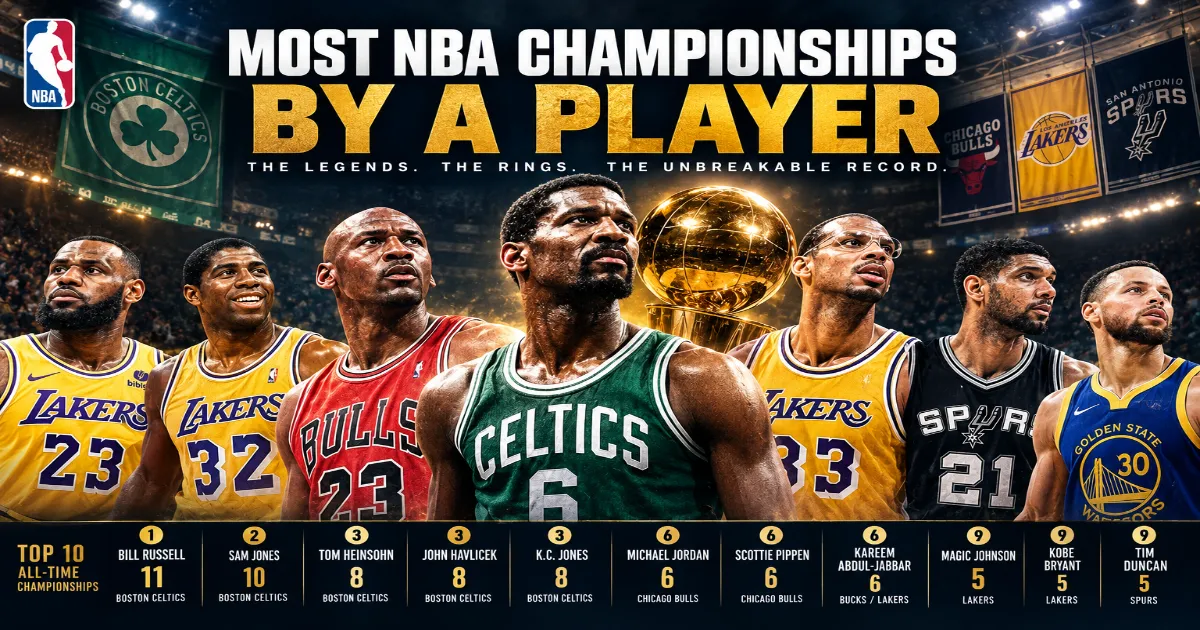
One player still holds a mark that will likely never be broken — a full ranking of most NBA championships by a player across every era of the league
Individual scoring records get broken. Assist totals climb. Even seemingly untouchable career marks eventually fall to a new generation of talent, better nutrition, and modern sports science. But when it comes to most NBA championships by a player, one number has stood entirely unchallenged for over half a century, and given how radically the league’s roster construction, free agency rules, and competitive balance have changed since it was set, most historians consider it one of the safest records in all of professional sports.
This list isn’t just about counting rings, either. It’s a window into how team-building, era-specific talent distribution, and individual leadership have combined differently across NBA history to produce genuinely historic winning careers.
Most Points in NBA History — The Full List, Explained
Who Has Made the Most Three-Pointers in NBA History? A Complete Breakdown
The Complete All-Time Rankings
1. Bill Russell — 11 Championships
Bill Russell’s eleven championships across thirteen NBA seasons with the Boston Celtics remains, by a wide margin, the most dominant championship résumé in the history of American professional team sports. Russell’s Celtics won eight consecutive titles from 1959 to 1966, an achievement so statistically improbable under today’s competitive landscape that most analysts consider it essentially impossible to replicate given modern free agency movement, salary cap rules, and the sheer depth of talent now distributed across thirty franchises rather than concentrated in a smaller league. Russell’s individual dominance as a defender and rebounder anchored this run, but the sheer volume of sustained team success remains the defining feature of his legacy.
2. Sam Jones — 10 Championships
Sam Jones, a teammate of Russell’s throughout the Celtics dynasty, won ten championships of his own, the second-most in NBA history. Jones’s scoring ability and clutch shooting made him a crucial complementary piece to Russell’s defensive dominance, and his championship total remains a reminder of just how deep and sustained that particular Celtics roster’s success truly was across more than a decade of near-total conference and league dominance.
3. Tom Heinsohn and John Havlicek (Tied) — 8 Championships
Both Tom Heinsohn and John Havlicek won eight championships, also as key contributors to the Celtics dynasty spanning the late 1950s through the 1960s and, in Havlicek’s case, extending into the early 1970s as the roster transitioned to a new generation of stars. Havlicek in particular bridged two distinct championship eras for the franchise, contributing to titles both during Russell’s playing days and after his retirement, a level of sustained franchise success across changing rosters that few players in league history can match.
4. K.C. Jones — 8 Championships
K.C. Jones, another key contributor to the Celtics dynasty, also won eight championships during his playing career before going on to a successful coaching career that added two more titles from the sideline, giving him one of the most complete winning résumés, combining playing and coaching success, in NBA history.
5. Michael Jordan — 6 Championships
Michael Jordan’s six championships across two separate three-peats with the Chicago Bulls represent the most celebrated championship résumé of the modern era, distinguished by a perfect 6-0 Finals record and Finals MVP honors in every single title run. While Jordan’s total trails the Celtics dynasty players significantly, his championships came during an era of much greater league-wide parity and talent distribution, making his perfect Finals record a frequently cited counterpoint to simply comparing raw ring totals across different eras.
6. Scottie Pippen — 6 Championships
Scottie Pippen won all six of his championships alongside Michael Jordan on those same dominant Chicago Bulls teams, and his two-way excellence as a versatile forward capable of guarding multiple positions made him one of the most complete complementary stars in NBA history, arguably the most important second option on any championship roster of the modern era.
7. Kareem Abdul-Jabbar — 6 Championships
Kareem Abdul-Jabbar won six championships across two distinct eras of his career, one with the Milwaukee Bucks early in his career and five more with the Los Angeles Lakers, spanning both the “Showtime” era alongside Magic Johnson and an earlier championship-winning stretch. Abdul-Jabbar’s ability to remain a winning cornerstone across nearly two full decades reflects a rare combination of individual dominance and sustained team success.
8. Magic Johnson — 5 Championships
Magic Johnson won five championships as the transformative centerpiece of the Lakers’ “Showtime” dynasty throughout the 1980s, becoming Finals MVP three times and helping popularize an up-tempo, fast-break offensive style that defined the era and helped grow the league’s national television popularity significantly.
9. Kobe Bryant — 5 Championships
Kobe Bryant won five championships across two distinct stretches with the Los Angeles Lakers, three alongside Shaquille O’Neal in the early 2000s and two more as the clear franchise cornerstone in 2009 and 2010, giving him a championship résumé that spans both a co-star-driven dynasty and a stretch of individual franchise leadership.
10. Tim Duncan — 5 Championships
Tim Duncan’s quiet, fundamentally sound two-decade career with the San Antonio Spurs produced five championships spread across nearly fifteen years, from 1999 to 2014, a remarkably long championship window that reflects the Spurs’ unusually stable organizational culture and Duncan’s own sustained individual excellence well into his late 30s.
Most NBA Championships by a Player — Top 10 Table
| Rank | Player | Championships | Primary Team(s) |
|---|---|---|---|
| 1 | Bill Russell | 11 | Boston Celtics |
| 2 | Sam Jones | 10 | Boston Celtics |
| 3 (tie) | Tom Heinsohn | 8 | Boston Celtics |
| 3 (tie) | John Havlicek | 8 | Boston Celtics |
| 3 (tie) | K.C. Jones | 8 | Boston Celtics |
| 6 (tie) | Michael Jordan | 6 | Chicago Bulls |
| 6 (tie) | Scottie Pippen | 6 | Chicago Bulls |
| 6 (tie) | Kareem Abdul-Jabbar | 6 | Milwaukee Bucks, LA Lakers |
| 9 (tie) | Magic Johnson | 5 | Los Angeles Lakers |
| 9 (tie) | Kobe Bryant | 5 | Los Angeles Lakers |
| 9 (tie) | Tim Duncan | 5 | San Antonio Spurs |
Why Bill Russell’s Record Is Considered Unbreakable
Understanding why most NBA championships by a player remains dominated so heavily by 1960s Celtics players requires understanding just how different the league’s competitive structure was during that era. The NBA had far fewer teams during Russell’s playing career than exist today, meaning championship-caliber talent was concentrated among a much smaller pool of franchises rather than spread across thirty teams as it is now. Free agency as modern fans understand it didn’t meaningfully exist, meaning rosters remained far more stable year over year, allowing dominant cores to stay intact for a decade or more without the roster turnover that defines almost every modern championship team.
Modern parity, salary cap rules designed specifically to prevent long-term dynasties, and the sheer difficulty of keeping a championship-caliber core together across free agency cycles make it exceedingly unlikely that any modern or future player will approach Russell’s total of eleven championships, let alone match his eight consecutive titles from 1959 to 1966.
How Modern Stars Compare to This Historical Standard
When most NBA championships by a player conversations shift to include modern stars, the framing usually changes from “who has won the most” to “who has won the most given today’s much more difficult competitive landscape.” LeBron James’s four championships across three different franchises, for instance, are frequently cited as reflecting a level of adaptability and roster-building success that simply wasn’t required of players competing in a league with far less parity and free agency movement. Similarly, Stephen Curry’s four championships as the offensive centerpiece of a single organization’s homegrown core are viewed within the context of the modern salary cap and luxury tax rules specifically designed to prevent the kind of extended dynasty Russell’s Celtics were able to sustain.
Team Success vs. Individual Legacy
An important nuance within the most NBA championships by a player discussion involves separating pure championship volume from individual statistical dominance and cultural impact. Sam Jones, Tom Heinsohn, K.C. Jones, and John Havlicek all rank extremely high on this specific list, yet none of them are typically included among the very top tier of individual greatest-of-all-time conversations, since their championship success came primarily as key contributors within a historically dominant team system rather than as the clear, singular best player driving that success on a nightly basis. This distinction matters significantly when evaluating what this particular record actually measures — sustained team success and championship-level contribution, rather than pure individual statistical dominance, which is better captured by entirely different metrics and rankings.
The Role of Coaching and Front Office Continuity
Part of what allowed the Boston Celtics dynasty to dominate the most NBA championships by a player list so thoroughly was the remarkable continuity of the franchise’s coaching and front office leadership during that stretch. Red Auerbach’s steady presence as both coach and later general manager provided a level of organizational stability that allowed the Celtics to retain their core talent year after year without the disruptions that modern coaching changes and front office turnover regularly create for today’s championship contenders. Auerbach’s ability to identify and retain complementary talent around Russell, rather than constantly reshuffling the roster, is frequently cited by historians as a critical, if often underappreciated, factor behind the dynasty’s unprecedented sustained success.
Comparing Eras: Depth of Competition
Another important consideration when evaluating most NBA championships by a player involves the depth and quality of competition each era’s championship teams actually had to overcome. The NBA of the 1960s featured fewer teams and a comparatively shallower overall talent pool than the modern thirty-team league, meaning Russell’s Celtics, while extraordinarily dominant, faced a narrower field of legitimate championship contenders in any given season. Modern players like Michael Jordan, LeBron James, and Stephen Curry have had to navigate a far more expansive and globally talented pool of competing rosters, a factor that many analysts weigh heavily when discussing how directly championship totals should be compared across such different competitive eras.
Why This Record Still Matters Today
Even as modern basketball fans increasingly weight individual statistical dominance and advanced metrics more heavily than raw championship totals, most NBA championships by a player remains one of the most frequently cited records in any greatest-of-all-time conversation, precisely because winning has always represented the sport’s ultimate collective achievement. Russell’s record serves as a permanent reminder that team success, sustained over time, remains one of the rarest and most difficult achievements in professional sports, regardless of how much individual scoring, playmaking, or efficiency records continue to shift with each new generation of talent.
Final Thoughts
The list of most NBA championships by a player remains dominated overwhelmingly by a single Boston Celtics dynasty that operated under competitive conditions no modern team will ever experience again. Bill Russell’s eleven championships stand as perhaps the safest individual record in all of professional sports, a testament to both his own individual dominance and an era of basketball where sustained roster continuity was simply more achievable than it is today. Modern stars like Michael Jordan, LeBron James, and Stephen Curry have built championship résumés that, while numerically smaller, are frequently evaluated within the context of a far more competitive and difficult era to sustain sustained team success in.
Frequently Asked Questions
Who has won the most NBA championships as a player? Bill Russell holds the record with eleven championships across thirteen seasons with the Boston Celtics, including eight consecutive titles from 1959 to 1966.
Is Bill Russell’s championship record likely to ever be broken? Most analysts consider it extremely unlikely given modern free agency rules, salary cap restrictions, and league-wide parity, all of which make sustaining a dynasty on the scale of Russell’s Celtics essentially impossible under today’s competitive structure.
How many championships did Michael Jordan win? Michael Jordan won six championships across two separate three-peats with the Chicago Bulls, maintaining a perfect 6-0 record in NBA Finals appearances.
🔹🔹 Follow us on Facebook 🔹🔹

4 Comments