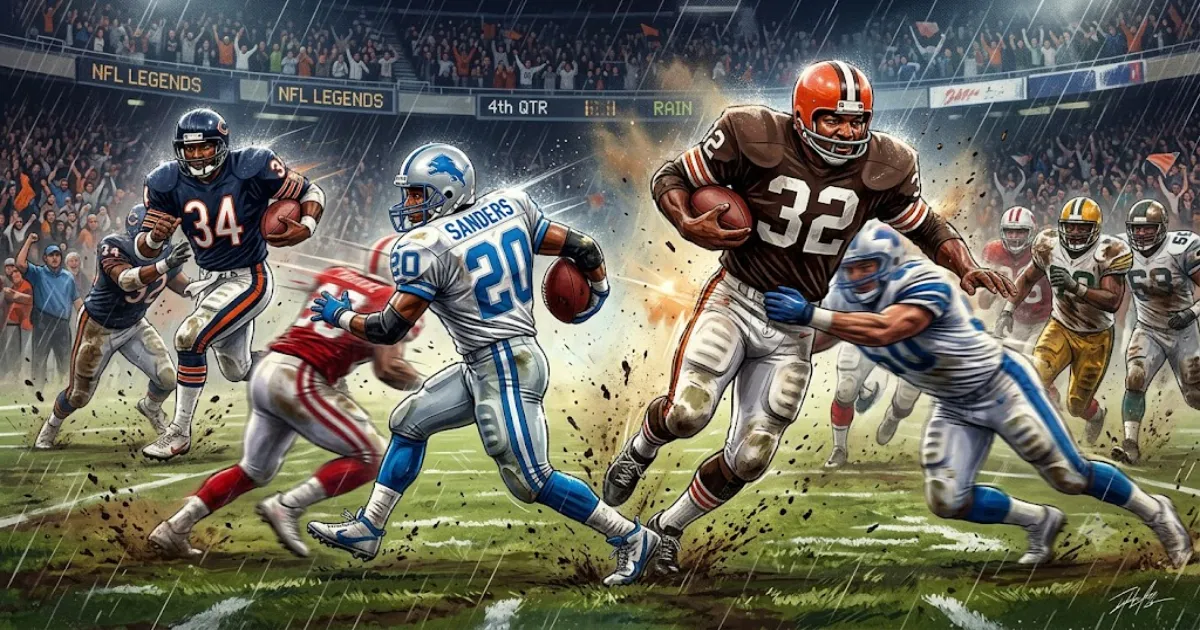
Jim Brown, Walter Payton, and Barry Sanders headline the greatest running backs in NFL history, and the order between them still sparks real debate.
A Position Measured by More Than Yards
No position in football has a messier relationship with its own record book than running back. Career rushing totals reward longevity in a way that can flatten genuinely different kinds of greatness — a decade of unmatched per-carry dominance doesn’t always look as impressive on a leaderboard as fifteen years of steady volume, even when the shorter career was, by most eye-test standards, the more talented one. Ranking the greatest running backs in NFL history properly means weighing peak dominance, career production, championship impact, and pure physical difficulty to tackle all at once — which is exactly why this list resolves into tiers rather than a single, tidy countdown.
Tier 1: The Inner Circle
Jim Brown remains, for a large share of football historians, the cleanest answer to “who was the greatest running back ever,” even though he retired after just nine seasons. Brown led the NFL in rushing in eight of his nine seasons, won three MVP awards, and averaged 104.3 rushing yards per game for his career — a mark that, remarkably, still hasn’t been matched by anyone who’s played since. He retired with 12,312 career rushing yards, a total that looks modest next to the modern leaders only because he walked away voluntarily at the height of his powers to pursue an acting and activism career, leaving one of the great “what if” questions in NFL history permanently unresolved.
Walter Payton built the most complete résumé of any running back in NFL history, a rare combination of power, speed, receiving ability, and pass-blocking that made him a genuine three-down weapon decades before that became the modern standard. “Sweetness” retired as the NFL’s all-time rushing leader with 16,726 yards, won NFL MVP in 1977, and helped anchor Chicago’s Super Bowl XX championship team. He missed just two games in a 13-year career, and stories of his toughness — including a 40-carry performance while playing through a 101-degree fever — have become as central to his legend as the statistics themselves.
Barry Sanders produced what many evaluators still consider the single most electrifying body of work any runner has ever put on film. Every carry carried the possibility of something no other back in the league could replicate — jump cuts, spin moves, and full-speed direction changes that routinely left entire defenses tackling air. He rushed for at least 1,000 yards in all 10 of his NFL seasons, won the 1997 MVP after a 2,053-yard season, and averaged 5.0 yards per carry for his career — then retired at 30, still near his statistical peak, leaving the same kind of unresolved “what if” that surrounds Brown’s own early exit.
The Sanders vs. Smith Debate
No running back rivalry has generated more recycled conventional wisdom than Barry Sanders vs. Emmitt Smith, and it’s worth addressing directly rather than treating Smith’s record as the final word. Smith retired as the NFL’s all-time rushing leader with 18,355 yards across 15 seasons, adding three Super Bowl championships and a Super Bowl XXVIII MVP award that Sanders never got the chance to chase behind a comparably talented roster. Sanders retired with 15,269 yards in just 10 seasons — a pace that, projected out to a career of similar length to Smith’s, would have plausibly carried him past the record, though such projections inevitably assume no decline, an assumption no running back in NFL history has fully avoided.
Stripped of exaggeration, the two split the decade’s rushing titles evenly, four apiece, and Sanders holds a real efficiency edge (5.0 yards per carry to Smith’s 4.2). Smith holds the far larger edge in the category that separates them most clearly: postseason production, where his 1,586 playoff rushing yards and 21 touchdowns dwarf Sanders’ modest postseason output. Perhaps most tellingly, Smith himself has been reported saying he considers Sanders the best running back of all time — a genuinely rare concession from the record-holder in a debate most assume he’d want to claim outright.
Tier 2: Generational Talents With a Case for No. 1 in Any Other Era
Emmitt Smith, as established above, holds the all-time rushing record and the most rushing touchdowns in NFL history (164), backed by three championships that neither Brown nor Sanders ever secured. LaDainian Tomlinson rounds out most versions of the sport’s top five, combining elite rushing production with receiving ability that made him one of the most complete offensive weapons of the 2000s — his 2006 season, in which he set the single-season touchdown record with 31, remains one of the most dominant individual offensive seasons in NFL history.
Eric Dickerson still holds the single-season rushing record at 2,105 yards, set in 1984 on a workload distribution that modern coaching staffs would consider borderline reckless by today’s durability standards. Adrian Peterson combined rare power and breakaway speed across a 15-year career, highlighted by a 2012 season in which he rushed for 2,097 yards, just 9 shy of Dickerson’s record, while recovering from a torn ACL the previous year.
Tier 3: Position Pioneers and Underrated Legends
O.J. Simpson, whose off-field legacy is inseparable from any discussion of his football career, was nonetheless the first running back to rush for 2,000 yards in a season (1973), a genuine watershed moment for the position at the time. Earl Campbell brought a bruising, load-bearing running style that defined Houston’s offense in the late 1970s and early ’80s, retiring with three rushing titles despite a career shortened by the physical toll of his own punishing approach. Tony Dorsett anchored Dallas’s offense for over a decade, part of the connective tissue between the Cowboys’ 1970s success and their 1990s dynasty. Marcus Allen and Thurman Thomas both built Hall of Fame careers on all-around versatility, excelling as receivers out of the backfield in a way that helped modernize how the position was used. Curtis Martin quietly accumulated 14,101 career rushing yards, sixth all-time, with a level of consistency that rarely generated the same national attention as flashier contemporaries.
Beyond these names, a handful of others deserve at least a passing mention for how they shaped the position’s evolution. Franco Harris helped anchor Pittsburgh’s 1970s dynasty and remains one of the most decorated postseason rushers in NFL history, while Marshall Faulk’s ability to line up as a genuine receiving threat out of the backfield for the “Greatest Show on Turf” Rams offense of the early 2000s pushed the receiving-back archetype forward in ways that directly influenced how Tomlinson, McCaffrey, and Barkley would later be used.
The Modern Era: Building Toward the Conversation
Today’s running back landscape looks structurally different from the eras that produced most of this list, shaped by a league-wide shift toward committee backfields that makes matching historical career totals considerably harder than it once was. Derrick Henry stands out as the clearest exception, having built his career on precisely the kind of workhorse workload that’s become rare elsewhere in the league, continuing elite production well into his 30s after a move to Baltimore. Christian McCaffrey and Saquon Barkley represent the position’s modern receiving-back evolution, each combining rushing production with receiving volume that recalls Tomlinson’s own versatility, though neither is yet within realistic range of the career totals posted by this list’s historical leaders.
What Actually Separates the Tiers
A few criteria consistently distinguish one tier from the next across this entire list: peak per-season dominance (Brown, Dickerson, Sanders), career-long volume and durability (Payton, Smith, Martin), championship impact (Smith, Payton), and pure difficulty to bring down in the open field (Sanders, Peterson). Very few running backs check every box simultaneously — Payton comes closest, which is precisely why he tops as many all-time lists as Brown does, despite the two representing almost opposite arguments for greatness: total career completeness versus unmatched peak dominance compressed into a shorter window.
Why the Position’s Greatest Records May Never Fall
It’s worth situating this entire list within a broader structural reality: nearly every major rushing record on this page was set by a player who carried the ball far more often, per season, than today’s running backs are typically asked to. The rise of running-back-by-committee systems — driven by both injury-prevention data and the NFL’s increasing tilt toward pass-heavy offenses — means a modern back rarely accumulates the 300-plus carries per season that fueled Dickerson’s, Payton’s, and Smith’s career totals. This is precisely why Derrick Henry stands out as such an unusual outlier in the current era, and why most analysts don’t expect Smith’s rushing record, or Dickerson’s single-season mark, to be seriously threatened anytime soon. The position’s greatest statistical monuments were largely built during a specific era of feature-back usage that the modern game has already moved away from, making this list unusually resistant to being reshuffled by anyone currently playing.
The Bottom Line
The greatest running backs in NFL history resist a single clean answer for the same reason the position itself resists easy definition — greatness here has always come in genuinely different shapes. Brown’s case rests on peak dominance so complete he never needed a second act to prove it. Payton’s rests on two decades of true three-down mastery. Sanders’ rests on a level of pure, un-teachable elusiveness that even his rivals still describe in disbelief. And Smith’s rests on turning sustained volume into more championships than any of the others combined. All four cases are real. None of them fully cancels out the others, which is exactly why this remains one of the most rewarding positions in football to keep arguing about.
Frequently Asked Questions
Who is considered the greatest running back in NFL history? There’s no single consensus pick — Jim Brown, Walter Payton, and Barry Sanders are the three names most commonly cited, each representing a different case: peak dominance, career completeness, and pure elusiveness, respectively.
Who holds the NFL’s all-time rushing record? Emmitt Smith holds the record with 18,355 career rushing yards, accumulated across 15 seasons, primarily with the Dallas Cowboys.
Would Barry Sanders have broken Emmitt Smith’s rushing record if he’d played longer? It’s plausible but not certain — Sanders’ career pace projects favorably against Smith’s total, but such projections assume no decline, an assumption no running back in NFL history has fully avoided.
Why does Jim Brown rank so highly despite playing only nine seasons? Brown led the league in rushing eight times, won three MVP awards, and retired with a per-game rushing average that still hasn’t been matched, making his peak dominance level with or above any running back who’s played since.
Who holds the single-season rushing record? Eric Dickerson holds the record with 2,105 rushing yards in 1984.
Which active running back has the strongest case among the all-time greats? Derrick Henry is generally considered the strongest active case, having sustained a workhorse-level workload and elite production well into his 30s, a rarity in the modern running-back-committee era.
Nikola Jokic vs Giannis Antetokounmpo — What the Advanced Metrics Reveal