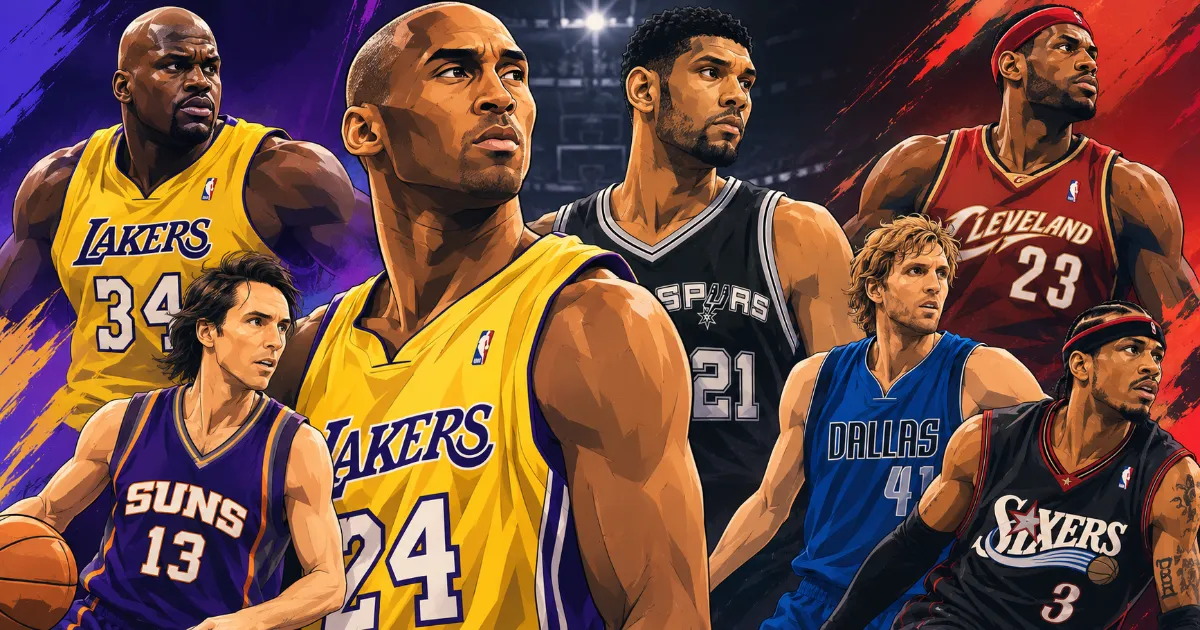
Sandwiched between the Jordan era and the social-media age, the greatest NBA players of the 2000s quietly produced some of the most complete championship résumés in league history
Sandwiched between Michael Jordan’s culturally dominant 1990s and LeBron James’s social-media-amplified 2010s and beyond, the 2000s often gets overlooked in broader conversations about the NBA’s greatest eras. That’s a mistake. The greatest NBA players of the 2000s produced some of the most tactically diverse championship dynasties in league history, from Shaquille O’Neal’s overwhelming interior dominance to Tim Duncan’s quiet fundamental excellence to Kobe Bryant’s obsessive scoring artistry, all while a new generation of international and homegrown talent began reshaping what an NBA superstar could look like heading into the following decade.
NBA Championship Winners List — Every Title From 1947 Through Today
Greatest NBA Dynasties — What Made Each Era Truly Unstoppable
Rather than a single straightforward ranking, this retrospective groups the decade’s greatest players into tiers, reflecting both individual dominance and the sheer stylistic diversity that made the 2000s such a rich, if underappreciated, chapter in league history.
Tier One: The Decade-Defining Superstars
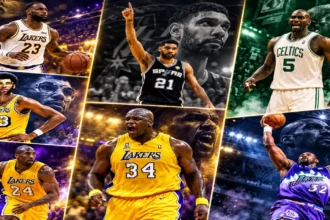
Shaquille O’Neal. No player physically dominated the early 2000s quite like Shaquille O’Neal, whose combination of size and athleticism made him nearly unguardable in the post. O’Neal won three consecutive championships and Finals MVP awards with the Los Angeles Lakers from 2000 to 2002, followed by a fourth championship with the Miami Heat in 2006, giving him one of the most complete championship résumés of the decade across two different franchises.
Tim Duncan. Tim Duncan’s quiet, fundamentally sound game anchored the San Antonio Spurs to three championships during the 2000s alone, part of a broader five-championship career that stretched from 1999 to 2014. Duncan’s understated dominance, built on elite post defense, rebounding, and reliable mid-range scoring, made him the defining counterpoint to flashier, more athletically driven stars throughout the decade.
Kobe Bryant. Kobe Bryant’s evolution from co-star to unquestioned franchise leader defined much of the decade’s second half, culminating in back-to-back championships in 2009 and 2010 as the clear centerpiece of the Los Angeles Lakers. His 81-point game against Toronto in 2006 remains one of the most iconic individual scoring performances in NBA history, cementing his standing among the greatest NBA players of the 2000s regardless of how the rest of his career unfolded.
Tier Two: The MVP-Caliber Stars
Steve Nash. Steve Nash’s back-to-back regular-season MVP awards in 2005 and 2006 reflected his role in popularizing the up-tempo, pace-and-space offensive style that would later become the league’s dominant tactical philosophy. His playmaking and shooting efficiency with the Phoenix Suns helped establish a stylistic template that directly influenced how offenses would be built throughout the following decade.
Dirk Nowitzki. Dirk Nowitzki’s unique shooting-big skill set, combining reliable perimeter shooting with post-up scoring well before that combination became common among NBA forwards, culminated in a regular-season MVP award in 2007 and helped establish the stylistic foundation for the stretch-four role that would become increasingly common in later decades.
Allen Iverson. Allen Iverson’s fearless scoring and crossover dribble made him one of the most electrifying and culturally significant players of the decade’s earlier years, capturing a regular-season MVP award in 2001 and leading a Philadelphia 76ers roster to the Finals that year despite a significant talent disadvantage against the eventual champion Lakers.
Kevin Garnett. Kevin Garnett’s intense, all-around game anchored the Minnesota Timberwolves for years before his 2007 trade to Boston helped form a new “Big Three” alongside Paul Pierce and Ray Allen, culminating in a 2008 championship that reinvigorated one of the league’s most storied franchises.
Tier Three: The Emerging Faces of the Next Era
LeBron James. James entered the league in 2003 and had already established himself as one of the sport’s most talented young stars by the decade’s end, though his signature championship success wouldn’t arrive until the following decade. His early-career statistical dominance and 2007 Finals appearance with Cleveland signaled the beginning of what would become one of the most significant individual careers in league history.
Dwyane Wade. Dwyane Wade’s explosive athleticism and clutch performance anchored the Miami Heat to a 2006 championship, capturing Finals MVP honors in a series widely remembered for his relentless attacking style and ability to draw contact at the rim at a historically high rate.
Chris Paul. Chris Paul emerged during the decade’s final years as one of the league’s most cerebral floor generals, establishing himself as an elite playmaker and defensive point guard whose statistical and leadership impact would continue growing well into the following decade.
Tier Four: The International Wave and Stylistic Pioneers
Manu Ginobili and Tony Parker. Alongside Tim Duncan, Manu Ginobili and Tony Parker helped form one of the most successful international-heavy championship cores in NBA history, contributing to the Spurs’ sustained excellence throughout the decade while helping popularize the league’s growing international talent pipeline.
Yao Ming. Yao Ming’s arrival from China represented one of the most significant international basketball stories of the decade, helping expand the NBA’s global popularity significantly while establishing himself as one of the league’s most skilled and effective centers before injuries shortened his career.
Why the 2000s Gets Overlooked
Part of why the greatest NBA players of the 2000s rarely receives the same cultural spotlight as the preceding Jordan era or the following James-Curry era comes down to timing. The decade lacked a single, dominant global cultural icon in the way Jordan defined the 1990s, instead distributing its greatest individual seasons and championships across a wider range of stars and stylistically diverse championship teams. Additionally, the decade predated the explosion of social media and modern digital highlight culture that has amplified individual player narratives so significantly in more recent years, meaning many of this era’s greatest individual moments simply didn’t receive the same viral amplification that similar performances would generate today.
The Tactical Diversity of the Decade
One of the most underappreciated aspects of the greatest NBA players of the 2000s is just how stylistically diverse the decade’s championship teams actually were. Shaquille O’Neal’s Lakers relied on overwhelming interior dominance, the Spurs built sustained success around defensive discipline and international talent development, Steve Nash’s Suns popularized pace-and-space offense years before it became the league’s dominant philosophy, and the Celtics’ 2008 championship relied on a veteran “Big Three” model that would later influence how superstar-driven rosters were constructed throughout the following decade. This tactical variety, more than any single dominant storyline, is what made the decade such a foundational bridge between two more culturally celebrated eras of NBA history.
The Coaching Legends Who Shaped the Decade
No retrospective of the greatest NBA players of the 2000s would be complete without acknowledging the coaching influences that shaped these championship rosters. Phil Jackson’s continued success, first with O’Neal and Bryant’s Lakers and later returning for another title run in 2009 and 2010, extended his championship-caliber coaching legacy well into this new decade. Gregg Popovich’s steady leadership of the Spurs throughout the 2000s established the organizational culture that would sustain San Antonio’s championship contention for years beyond the decade itself. And Doc Rivers’s 2008 championship with Boston’s newly formed “Big Three” demonstrated how a well-constructed veteran roster could still produce a title even without the same generational individual talent driving other contenders of the era.
Statistical Milestones Achieved During the Decade
Several significant individual statistical milestones were also reached during this decade, further cementing its stars among the greatest NBA players of the 2000s. Kobe Bryant’s 81-point performance remains the second-highest single-game scoring total in NBA history. Shaquille O’Neal’s dominant interior scoring throughout the decade’s early years helped him climb significantly up the NBA’s all-time scoring list before his career concluded. And Steve Nash’s back-to-back MVP awards remain a frequently cited example of how efficient, pass-first offensive systems could still produce individual hardware even without the kind of gaudy scoring totals more commonly associated with MVP-caliber seasons in other eras.
Rivalries That Defined the Decade
Beyond individual greatness, the decade produced several memorable team rivalries that helped elevate its greatest stars even further. The Lakers-Spurs playoff battles throughout the early-to-mid 2000s repeatedly pitted O’Neal and Bryant’s overwhelming talent against Duncan’s disciplined, fundamentally sound Spurs teams, producing some of the most competitively balanced playoff series of the era. The rekindled Lakers-Celtics rivalry in 2008 and 2010, discussed extensively elsewhere in conversations about the two franchises’ broader head-to-head history, also provided a fitting bookend to a decade that began and ended with these two storied organizations both fielding legitimate championship contenders.
How This Decade Set Up the Next Generation
The greatest NBA players of the 2000s also directly shaped the stars who would come to define the following decade. LeBron James’s early career development throughout the 2000s set the stage for his unprecedented run of championship success beginning in the 2010s. Steve Nash’s pace-and-space offensive innovations directly influenced coaching philosophies that would become dominant league-wide within a decade. And the international pipeline established by players like Yao Ming, Tony Parker, and Manu Ginobili helped pave the way for the even greater international talent influx that would follow in subsequent decades, including eventual international MVP winners who built directly on the foundation this generation of players established.
Underrated Role Players Who Shaped Championship Success
Beyond the headline stars, the greatest NBA players of the 2000s conversation also benefits from acknowledging the elite role players who made these championship runs possible. Robert Horry, already a veteran champion entering the decade, added further title-clinching performances that cemented his reputation as one of the most clutch complementary players in league history. Bruce Bowen’s defensive versatility anchored the Spurs’ championship rosters, while Derek Fisher’s reliable perimeter shooting and leadership provided crucial stability across the Lakers’ championship runs. These contributors rarely headline retrospective lists, but their consistent, high-level performance in supporting roles remains an essential part of understanding how the decade’s dominant teams actually won their championships.
Final Thoughts
The greatest NBA players of the 2000s deserve significantly more recognition than they typically receive in broader historical conversations, having produced some of the most complete championship résumés and stylistically influential playing careers in league history. From Shaquille O’Neal’s physical dominance to Tim Duncan’s quiet excellence to Steve Nash’s offensive revolution, this decade laid much of the tactical and cultural groundwork for the eras that followed, even if its greatest stars rarely receive the same spotlight as the decades immediately surrounding them, a gap in recognition that this retrospective hopefully helps close for a new generation of fans discovering this era for the first time.
Frequently Asked Questions
Who was the most dominant player of the 2000s? Shaquille O’Neal and Tim Duncan are the two most frequently cited as the decade’s most dominant players, having combined for seven championships between them during the 2000s alone.
Why is the 2000s considered an underrated NBA decade? The decade lacked a single dominant cultural icon in the way Jordan defined the 1990s, instead distributing its greatest moments across a wider range of stylistically diverse stars, and it also predated the social media amplification that has boosted individual player narratives in more recent years.
Which players from the 2000s remained relevant into the following decade? LeBron James, Dwyane Wade, and Chris Paul all emerged during the 2000s and went on to have significant, in some cases even more decorated, careers throughout the 2010s and beyond.
How many championships did the Spurs win during the 2000s? The San Antonio Spurs won three championships during the decade — in 1999 (partially overlapping the prior decade), 2003, and 2005 — with a fourth title following in 2007, all anchored by Tim Duncan.
🔹🔹 Follow us on Facebook 🔹🔹
Ryan Garcia Crushes Conor Benn in 2 Rounds to Defend WBC Title

One Comment