From seven championships to a 23-season career, this is the full case for Tom Brady as the greatest QB ever — tested against Manning, Rodgers, Brees, Mahomes, and Montana.
Every GOAT debate in football eventually arrives at the same starting point: Tom Brady’s résumé, and whether anything in NFL history genuinely rivals it. This isn’t a debate built on a single dominant season or one iconic play — it’s built on 23 years of evidence, a mountain of it, spanning multiple decades, multiple head coaches, multiple supporting casts, and two different franchises. Rather than simply asserting Brady’s greatest-ever status, the case deserves to be built properly: the championships, the records, the longevity, and finally, tested directly against the five names most often raised against him — Peyton Manning, Aaron Rodgers, Drew Brees, Patrick Mahomes, and Joe Montana.
Exhibit One: The Championships
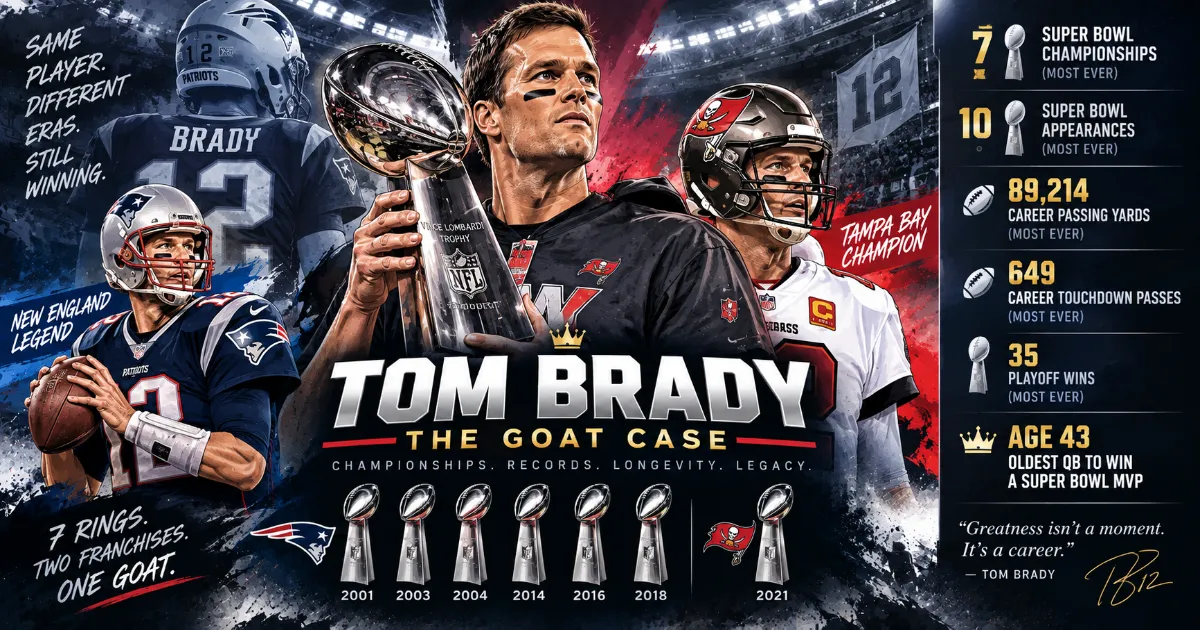
Brady won seven Super Bowl championships from ten appearances, a 7-3 record on football’s biggest stage that stands alone in NFL history. No other quarterback has more than four rings. Six of those titles came with New England across two decades; the seventh came in 2021 with Tampa Bay, at age 43, making him the oldest quarterback ever to start, play, win, and earn MVP honors in a single Super Bowl. That seventh ring matters more to this case than almost any other single fact available: it proves the first six weren’t merely a product of one system, one franchise, or one coach, because Brady replicated championship-level success immediately after leaving the only professional home he’d ever known.
Exhibit Two: The Records
Brady retired holding the NFL’s all-time records for career passing yards (89,214) and career touchdown passes (649), both by comfortable margins over the next closest competitors — nearly 9,000 yards ahead of Drew Brees, and 78 touchdowns ahead of him as well. He also holds the all-time records for career playoff passing yards (13,049), playoff touchdown passes (88, more than double anyone else in history), and playoff wins (35, against just 12 losses). These aren’t records built on a single explosive peak season the way some rivals’ records were — they’re built on sustained, era-spanning volume that took 23 seasons to accumulate, a career length almost no other quarterback in NFL history has approached at a comparable level of production.
Exhibit Three: The Longevity
This is arguably the least talked-about part of Brady’s case, and it shouldn’t be. He played until age 45 and was still leading the NFL in passing yards and touchdowns in his final season — not simply hanging on as a backup, but performing at a genuine starter’s level deep into an age range where almost every other quarterback in history has already retired. For context, Brady tore his ACL in Week 1 of the 2008 season, missed the entire year, and came back to play at an elite level for another 14 seasons afterward — evidence that his longevity wasn’t luck, but the product of a genuinely unusual approach to conditioning, recovery, and preparation that outlasted every rival who entered the league around the same time he did.
Exhibit Four: The Numbers That Rarely Get Mentioned
Beyond the headline records, a handful of secondary statistics reinforce just how complete Brady’s case is. He holds the record for most career game-winning drives in the fourth quarter or overtime, a stat that speaks directly to the “clutch” argument often used to elevate other quarterbacks above him. He also holds the record for most career wins by a starting quarterback, both in the regular season (a .769 winning percentage across 333 starts) and in the playoffs, giving him the strongest case of any quarterback in history for simply, consistently putting his team in position to win football games regardless of opponent, weather, or supporting cast quality in a given season. Few individual statistics capture “greatness” as directly as a two-decade-long record of outperforming the win-loss expectations set by the talent around him.
Exhibit Five: Adaptability Across Eras
One dimension of Brady’s case that’s easy to undersell is how many different versions of professional football he actually played through and mastered. He entered the league in 2000, when most NFL offenses still ran through a traditional under-center, play-action-heavy attack, and he retired in 2022 having thrived in the shotgun-spread, RPO-influenced passing era that defines the modern game. Few quarterbacks in NFL history have had to adapt their mechanics, decision-making, and offensive scheme understanding across that many distinct stylistic eras of the position — most great quarterbacks play their entire careers within a single dominant offensive philosophy. Brady played through several, adjusting his game each time rather than being left behind by it, which is its own form of evidence for sustained, rather than merely peak, greatness.
The Mahomes Test
No active quarterback has pressured Brady’s legacy more directly than Patrick Mahomes, and any complete case for Brady has to survive a direct comparison rather than simply ignore it.
Where Mahomes wins: Peak individual seasons and MVP rate. Mahomes has won two MVP awards in nine seasons; Brady won three in 23. Mahomes’ statistical peak seasons — particularly his 2022 MVP campaign — generally rate higher on a per-game basis than anything Brady produced, even accounting for era-driven passing inflation. The two have also met exactly once in the sport’s biggest game, Super Bowl LV, and Brady’s Buccaneers won comfortably, 31-9 — a data point that sits permanently on Brady’s side of the ledger regardless of how the rest of Mahomes’ career unfolds.
Where Brady wins, decisively: Everything else. Seven championships to three. All-time career passing records that Mahomes, even at his best pace, remains tens of thousands of yards and hundreds of touchdowns behind. A 35-12 playoff record built over 47 games, compared to Mahomes’ 17-4 through the same point. And crucially, timing: the 2025 season complicated Mahomes’ trajectory in a way that didn’t exist even a year ago. Kansas City collapsed to a 6-11 record, missed the playoffs for the first time in the Mahomes era, and he suffered a torn ACL and LCL that adds real uncertainty to the rest of his career. Brady’s case doesn’t need Mahomes to falter to remain ahead — but the fact that Mahomes’ march up the record books has genuinely stalled, for the first time, only widens a gap that was already considerable.
Verdict on this test: Brady wins clearly, five statistical and championship categories to Mahomes’ one. Mahomes remains the strongest active threat to eventually close the gap, but “eventually” is doing a lot of work in that sentence after 2025.
The Manning Test
No rivalry defined an entire era of NFL football quite like Brady vs. Peyton Manning, and it’s the comparison Brady’s case has been measured against longer than any other.
Where Manning wins: Individual honors and single-season records. Manning’s five career NFL MVP awards remain the most any player at any position has ever won, nearly double Brady’s three. His 2013 season — 5,477 passing yards and 55 touchdowns — still stands as the single-season record in both categories. Manning also holds a meaningful head-to-head edge in the rivalry’s biggest moments: he went 3-1 against Brady specifically in AFC Championship Games, the exact stage where this rivalry was decided most often, and he remains the only starting quarterback in NFL history to win a Super Bowl with two different franchises, Indianapolis and Denver.
Where Brady wins, decisively: Championships and career volume. Seven rings to two. All-time records in career passing yards and touchdowns that Manning’s own totals (71,940 yards, 539 touchdowns) fall well short of, despite Manning playing 17 professional seasons himself. Brady also finished with the higher career win percentage of the two by a wide margin, nearly 10 percentage points clear of the field according to statistical comparisons run during their overlapping careers.
Verdict on this test: Brady wins the overall case, but this is the rivalry where Manning’s individual-honors argument carries the most real weight — five MVPs and a head-to-head postseason edge in the games that mattered most are not small things to explain away.
The Rodgers Test
Aaron Rodgers represents the purest “efficiency versus volume” version of this debate anywhere on Brady’s résumé, a genuinely different kind of case than either Manning’s or Montana’s.
Where Rodgers wins: Nearly every rate-based efficiency statistic in the sport’s history. Rodgers holds the NFL’s all-time single-season passer rating record (122.5, set in 2011) and the lowest career interception percentage of any quarterback in history. His career touchdown-to-interception ratio remains the best the position has ever produced, and his four career MVP awards edge Brady’s three. Rodgers also became the second quarterback ever, after Brady, to throw 40 or more touchdown passes in a single season on multiple occasions, and matched Brees as the only passer to do it in consecutive seasons.
Where Brady wins, decisively: Everything that involves winning football games in January. Seven championships to Rodgers’ one. Ten Super Bowl appearances to Rodgers’ single trip. Brady’s career win percentage sits comfortably ahead of Rodgers’, and his all-time records in career passing yards and touchdowns remain tens of thousands of yards and well over a hundred touchdowns clear of Rodgers’ own considerable totals.
Verdict on this test: Brady wins clearly and by the widest margin of any comparison in this article. Rodgers’ case is the strongest pure “best pure passer” argument available anywhere in NFL history, but a career built almost entirely on individual efficiency, with just a single championship to show for it, was never going to be enough to seriously threaten Brady’s title.
The Brees Test
Drew Brees briefly held the exact two records that now define Brady’s legacy, making this comparison a useful reminder of how close this race actually was for a stretch of the 2010s.
Where Brees wins: Almost nothing outright, but he came closer than anyone. Brees actually passed Brady for the all-time record in both career completions and, briefly, career passing yards during their overlapping careers, before Brady reclaimed both records and pulled away for good. Brees also holds the record for most career pass completions (7,142) and was, for a period, statistically the most accurate high-volume passer in NFL history.
Where Brady wins, decisively: Championships, by a lopsided margin — seven titles to Brees’ one, won in Super Bowl XLIV. Brady also finished his career with the all-time edge in career passing yards (89,214 to 80,358) and touchdowns (649 to 571) once his final seasons in Tampa Bay were added to the ledger, closing the door on what had briefly been a genuine race between the two.
Verdict on this test: Brady wins comfortably. Brees’ case is a reminder that Brady’s records weren’t inevitable — for a real stretch of the 2010s, another quarterback was actually ahead of him in the two categories that now define his legacy — but Brady’s extra three-plus seasons of elite production ultimately settled the race well before either player’s career ended.
The Montana Test
If Mahomes represents Brady’s most dangerous active rival, Joe Montana represents his most serious historical one — and the honest version of this case has to acknowledge that Montana wins at least one major category outright.
Where Montana wins: Super Bowl perfection. Montana went 4-0 in the Super Bowl with zero interceptions across all four games, and his 127.8 career Super Bowl passer rating remains the highest in NFL history, untouched in the nearly four decades since he set it. Brady’s own Super Bowl numbers are outstanding — 3,039 yards, 21 touchdowns, five Super Bowl MVPs — but they include six interceptions and three losses across his larger sample of ten appearances, meaning his big-game passer rating (97.7) sits meaningfully below Montana’s flawless mark. On pure big-game efficiency, this category belongs to Montana, and no amount of Brady’s other numbers changes that specific fact.
Where Brady wins, decisively: Volume, championships, and longevity, once again. Seven rings to four. All-time records Montana’s own totals (40,551 career yards, 273 touchdowns) don’t come remotely close to threatening, in a career eight seasons shorter than Brady’s. Even Montana himself has repeatedly declined to claim the greatest-ever title outright, citing how differently the two played the position — Montana entirely from under center in Bill Walsh’s rhythm-based West Coast system, Brady across a career that spanned multiple offensive eras and adapted to shotgun-heavy modern football that didn’t exist for most of Montana’s career.
Verdict on this test: Brady wins the overall case, but Montana’s perfect Super Bowl record and record passer rating represent the single strongest specific counter-argument anyone has ever built against Brady’s claim to the title — a genuine, unmatched data point rather than a talking point.
Addressing the Counter-Arguments Honestly
A complete case has to engage with its strongest objections rather than avoid them. The most common pushback against Brady’s GOAT case isn’t statistical — it’s structural: that he played the bulk of his career under one of the greatest coaches in NFL history, Bill Belichick, in a stable organizational environment most quarterbacks never get. This is a fair point, and it’s precisely why the seventh ring in Tampa Bay matters so much to the full case — it’s the one championship Brady won entirely outside that system, with a different coaching staff, a different roster, and a franchise that had won exactly one Super Bowl in its entire history before he arrived. A résumé built purely on system would not have replicated itself elsewhere. Brady’s did.
The second common objection is that Brady benefited from rule changes over his career that increasingly favored quarterbacks and passing offenses. This is also true, but it’s a fair criticism of nearly every modern quarterback’s statistics, including Mahomes’, Rodgers’, and every other passer who played meaningful snaps after 2005 — it doesn’t specifically undermine Brady’s case relative to his actual contemporaries, since they all played under the same rulebook he did.
The Bottom Line
Tom Brady’s case as the greatest QB ever doesn’t rest on any single game, season, or statistic — it rests on the sheer comprehensiveness of a résumé that has now survived direct comparison against five of the strongest rival claims available — Manning, Rodgers, Brees, Mahomes, and Montana — and still comes out ahead in the overwhelming majority of categories that matter across all of them. Montana’s Super Bowl perfection remains the one genuine dent in the case. Manning’s five MVPs and head-to-head playoff edge come next closest. Rodgers’ efficiency numbers and Brees’ brief statistical lead in the 2010s round out the field, but neither seriously threatens the overall verdict. Mahomes’ pace, before 2025, was the more urgent long-term threat, and remains the most realistic path for anyone to eventually catch him. But “eventually” requires health, time, and sustained production that even Brady’s fiercest challengers haven’t yet proven they can deliver across two full decades. Until someone does, the case remains exactly what it’s been for years: closed, but never boring to reargue.
What ultimately separates this case from a simple “counting stats” argument is that Brady’s résumé holds up under every reasonable cross-examination — adjusted for era, tested against his most efficient historical rival, and tested against the most talented active challenger. Few legacies in professional sports survive that level of scrutiny from every conceivable angle without at least one category collapsing entirely. Brady’s has one honest dent, from Montana, and even that dent doesn’t come close to outweighing everything else stacked on the other side of the ledger.
Frequently Asked Questions
What is the strongest part of Tom Brady’s case as the greatest QB ever? His seven Super Bowl championships, all-time records in career passing yards (89,214) and touchdowns (649), and a 23-season career that included winning a title with a second franchise, proving his success wasn’t tied to one system or coach.
Does Joe Montana have a better argument than Tom Brady in any specific category? Yes — Montana’s perfect 4-0 Super Bowl record with zero interceptions and his 127.8 career Super Bowl passer rating remain the highest in NFL history, both marks Brady’s larger sample of ten Super Bowl appearances didn’t match.
How does Peyton Manning’s case compare to Brady’s? Manning holds the edge in individual honors, with five career MVP awards to Brady’s three and a 3-1 head-to-head record against Brady specifically in AFC Championship Games, but Brady’s seven championships to Manning’s two settle the broader comparison decisively.
Who is considered the most statistically efficient quarterback compared to Brady? Aaron Rodgers holds the NFL’s all-time single-season passer rating record and the lowest career interception percentage in history, making him the strongest “pure passing efficiency” rival to Brady, even though his single Super Bowl title leaves the overall comparison well in Brady’s favor.
Did Drew Brees ever hold records that Brady now owns? Yes — Brees briefly passed Brady for the all-time records in career completions and, for a period, career passing yards during their overlapping careers, before Brady reclaimed both and pulled away for good with his final seasons in Tampa Bay.
How does Patrick Mahomes’ 2025 season affect Brady’s GOAT case? Mahomes’ collapse to a 6-11 season, missed playoffs, and a torn ACL and LCL slowed what had been the most serious active threat to eventually challenge Brady’s records, adding genuine uncertainty to his championship pace for the first time in his career.
Did Tom Brady and Patrick Mahomes ever play against each other? Yes, once — Super Bowl LV, which Brady’s Tampa Bay Buccaneers won 31-9 over Mahomes’ Kansas City Chiefs, with Brady earning a record fifth Super Bowl MVP award.
What is the biggest criticism of Tom Brady’s GOAT case? The most common critique is that he played most of his career under head coach Bill Belichick in a historically stable organization, though his seventh championship — won with Tampa Bay after leaving New England — is frequently cited as a direct rebuttal to that argument.

One Comment