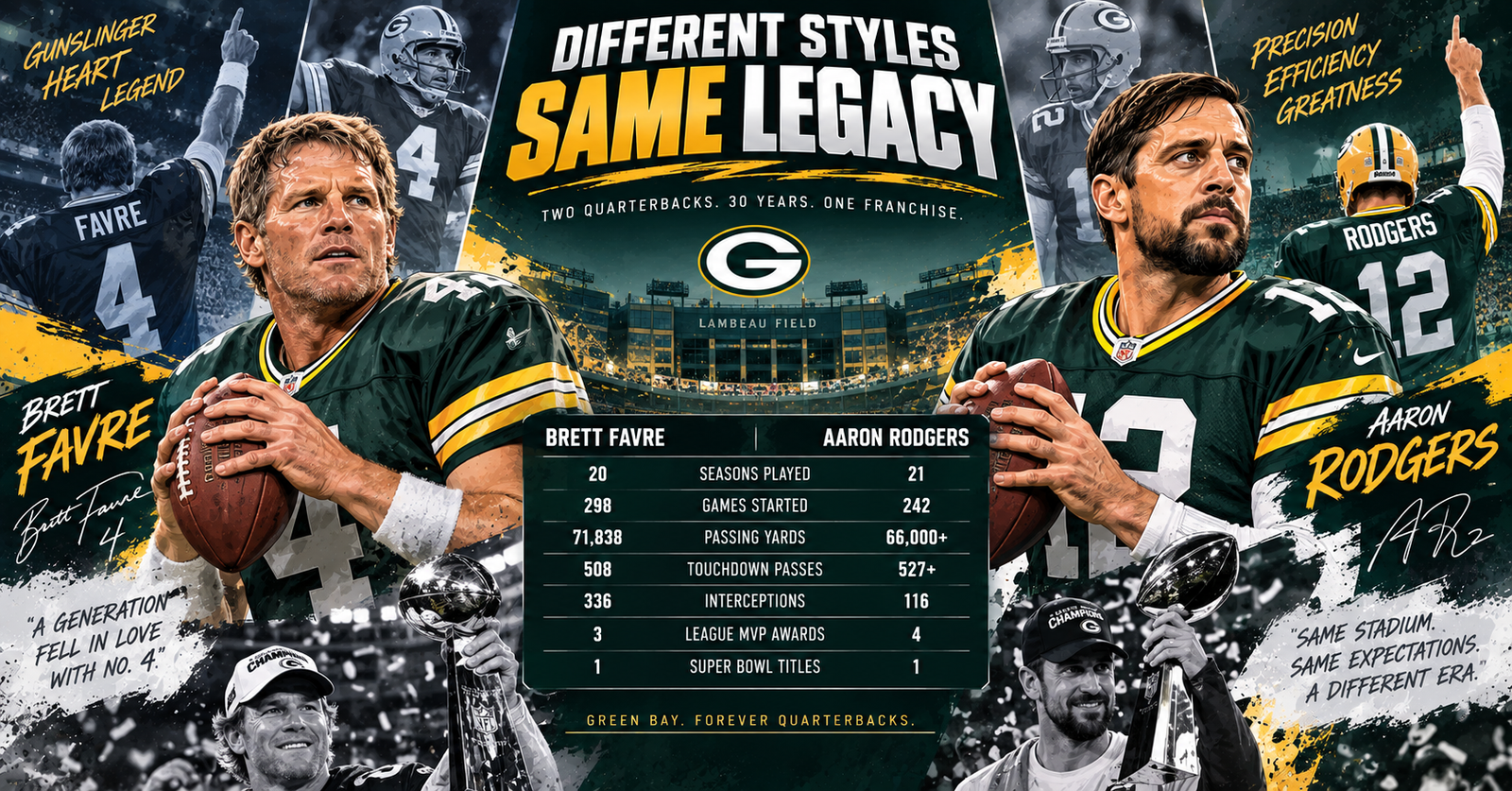
Aaron Rodgers vs Brett Favre began with a bitter succession in Green Bay and ended with both legends traded to the same team under eerily similar circumstances.
“I’m Not Brett Favre”
In March 2008, days after Green Bay handed its starting quarterback job to a 24-year-old who’d spent three seasons watching from the sideline, Aaron Rodgers told the Associated Press something that sounded like a young player trying to escape an impossible shadow: “I’m not Brett Favre. And if they’re wanting me to be the next Brett Favre, I’m not going to be him.” It was a reasonable thing to say at the time. It also turned out to be almost entirely wrong — not because Rodgers failed to live up to Favre, but because his career ended up mirroring his predecessor’s with a precision neither man could have predicted, right down to the exact team both were eventually traded to and the exact way both departures unraveled.
The NBA’s Scoring Rate Records: Career Leaders vs. Single-Season Peaks
Thirty Years, One Franchise, Two Legends
Between them, Favre and Rodgers started 519 games for the Green Bay Packers across 30 consecutive seasons, from 1992 to 2022 — with their combined backups starting a total of just 22 games in that entire span. That kind of uninterrupted quarterback stability is close to unheard of in professional sports, let alone in a league where the average career at the position lasts barely three years. Favre held the job for 16 seasons before Rodgers took over and held it for 15 more, meaning an entire generation of Packers fans went from childhood to adulthood without ever wondering who would be taking the snap on Sunday.
The Numbers, Side by Side
| Category | Brett Favre | Aaron Rodgers |
|---|---|---|
| Seasons Played | 20 | 21 |
| Games Started | 298 | 242 |
| Career Passing Yards | 71,838 | 66,000+ |
| Career TD Passes | 508 | 527+ |
| Career Interceptions | 336 | 116 |
| TD-INT Ratio | 1.51 | 4.37 (NFL record) |
| Completion % | 62.0% | 65.1% |
| Career Passer Rating | 86.0 | 102.8 (NFL record) |
| Pro Bowls | 11 | 10 |
| League MVP Awards | 3 | 4 |
| Super Bowl Titles | 1 | 1 |
| Super Bowl MVP Awards | 0 | 1 |
The table tells two very different stories depending on which column catches your eye first. Favre’s volume numbers — passing yards, games started — still edge Rodgers in several categories, a product of his remarkable durability across a 20-year career played in a rougher era for quarterbacks. But Rodgers’ efficiency numbers are in a different universe entirely: his career interception total is barely a third of Favre’s, his touchdown-to-interception ratio remains an NFL record by a wide margin, and his career passer rating sits nearly 17 points higher. During the 2025 season, Rodgers passed Favre outright for fourth place on the NFL’s all-time touchdown passes list — a symbolic moment made more pointed by the fact that Favre was literally the veteran Rodgers had sat behind as a rookie two decades earlier.
The Succession That Wasn’t Supposed to Happen This Way
Favre’s exit from Green Bay remains one of the messiest quarterback departures in NFL history, and understanding it is essential to understanding why the Rodgers comparison carries so much emotional weight. After a strong 2007 season that saw Favre finish runner-up in MVP voting and lead Green Bay to the NFC Championship Game at age 38, he announced his retirement in March 2008. The Packers, who had spent three years developing Rodgers as the heir apparent, moved to hand him the starting job. Favre, according to his own later admission, had second thoughts almost immediately — he reportedly sent the team a letter that summer requesting his unconditional release, hoping to return and reclaim the job he’d just vacated. Green Bay refused. The situation dragged on through training camp, divided the fanbase, and ended on August 7, 2008, when the Packers traded Favre to the New York Jets rather than let him compete with Rodgers for the job he’d already given up.
Favre has since taken responsibility for how it unfolded. Asked years later whether he’d have handled it differently, he said plainly that he was at fault and that both sides bore some responsibility for how badly the split was managed. The fallout strained his relationship with Rodgers for years, though both men have since said publicly that they’ve patched things up.
The Parallel Nobody Saw Coming
Here’s where this story gets genuinely strange. Fifteen years later, in 2023, Rodgers found himself in almost the exact same position Favre had occupied — an aging franchise legend, increasingly uncertain about his future, with a talented young backup (Jordan Love) waiting in the wings after being drafted specifically as the succession plan. Rodgers spent a drama-filled offseason weighing retirement on Pat McAfee’s show, eventually announcing he wanted to keep playing — and was subsequently traded to, of all franchises, the New York Jets, the exact team Favre had landed with under nearly identical circumstances a decade and a half earlier.
The parallels didn’t stop at the trade destination. Favre’s single season with the Jets in 2008 produced better on-field results than Rodgers’ Jets tenure ultimately did — Rodgers tore his Achilles four snaps into his Jets debut in 2023, then returned for an injury-affected 2024 season that still fell short of the playoffs. Both quarterbacks got their Jets head coaches fired shortly after their arrival — Eric Mangini after 2008, Robert Saleh partway through 2024 — a coincidence close enough that Rodgers himself referenced Favre’s own Jets experience directly in his introductory press conference, expressing hope that different circumstances would produce a better outcome. They largely didn’t.
Why the Rivalry Was Never Really About Rivalry
Despite the strain the 2008 departure put on their relationship, Favre and Rodgers were never really competitors in the traditional sense — they never played against each other as opposing starters representing different teams’ present against each other’s prime the way, say, Brady and Manning did for over a decade. Their comparison has always been generational rather than head-to-head: two men who occupied the exact same job, for the exact same franchise, separated by a single tense offseason, whose careers then somehow continued to rhyme with each other for another fifteen years after they stopped sharing a locker room.
There was, however, one strange wrinkle where their careers did briefly intersect on opposite sidelines. After his acrimonious Jets season, Favre signed with the division-rival Minnesota Vikings for the 2009 and 2010 seasons, meaning Green Bay fans who’d watched him win a championship were suddenly forced to watch him torch his old team twice a year while wearing purple. Favre’s Vikings beat Rodgers’ Packers in their first meeting in 2009, a genuinely uncomfortable afternoon for a fanbase still processing how the divorce had unfolded. It remains the closest thing to a true head-to-head chapter in this entire story — brief, emotionally loaded, and settled in Favre’s favor before Rodgers’ own championship run the following season shifted the balance of the rivalry for good.
What Each Man’s Exit Says About the Other’s
There’s a case to be made that watching how Rodgers’ own Green Bay exit unfolded in 2023 actually improved public perception of how Favre handled his departure 15 years earlier, and vice versa. Favre’s messy summer-long saga, complete with a release request and a public tug-of-war over the job, looked considerably more chaotic in the moment than Rodgers’ more contained, single-offseason deliberation on Pat McAfee’s show. But viewed together, both departures reveal the same underlying tension every legacy quarterback eventually faces: a franchise that has already moved on organizationally, and a future Hall of Famer who isn’t quite ready to let go of the job that defined him. Green Bay handled the emotional mechanics of Rodgers’ exit somewhat more gracefully than it had handled Favre’s, partly because the front office had learned directly from its own earlier mistakes — proof that even a franchise’s most painful chapters can shape how it manages the next one.
The Verdict on Green Bay’s Legacy
Statistically, Rodgers holds the clear edge in nearly every efficiency category that matters, and his NFL-record passer rating and touchdown-to-interception ratio represent a level of ball security Favre, for all his gunslinger brilliance, never came close to matching. Favre’s case rests on volume, durability, and a slightly longer prime, along with the fact that his Super Bowl title came as the unquestioned face of a Packers renaissance rather than as one entry in an already-established dynasty. Both men delivered exactly one championship to Green Bay, both won multiple MVP awards, and both will eventually stand together in the Pro Football Hall of Fame, representing the same 30-year stretch of quarterback stability that most NFL franchises can only dream of replicating even once, let alone twice in a row.
The Bottom Line
Aaron Rodgers vs Brett Favre was never destined to be a clean rivalry — it was always going to be a legacy handed down, awkwardly and painfully at first, between two men whose careers turned out to rhyme in ways neither could have scripted. Rodgers said he wasn’t going to be the next Brett Favre. Instead, he became something closer to Favre’s mirror image: the same franchise, the same eventual landing spot in New York, the same messy ending, and — when it finally mattered most, on the stat sheet — a genuinely better version of the quarterback he spent three years waiting to replace.
Frequently Asked Questions
Who had the better career, Aaron Rodgers or Brett Favre? By most statistical measures, Rodgers holds the edge in efficiency — a lower career interception total, the NFL’s all-time touchdown-to-interception ratio, and the all-time career passer rating record — while Favre leads in career passing yards and games started, reflecting his longer prime and greater durability.
Why did Brett Favre leave the Green Bay Packers? Favre retired in March 2008, but had second thoughts over the summer and asked for his release to potentially return. The Packers, having already committed to Aaron Rodgers as the starter, refused and instead traded Favre to the New York Jets in August 2008.
Did Aaron Rodgers and Brett Favre both get traded to the same team? Yes — both quarterbacks were eventually traded to the New York Jets under strikingly similar late-career circumstances, 15 years apart, and both saw their Jets head coach fired during or shortly after their tenure.
How many Super Bowls did Favre and Rodgers each win with Green Bay? Both quarterbacks won exactly one Super Bowl title with the Packers — Favre in Super Bowl XXXI (1996 season) and Rodgers in Super Bowl XLV (2010 season).
Has Aaron Rodgers passed Brett Favre in any career records? Yes — during the 2025 season, Rodgers passed Favre for fourth place on the NFL’s all-time career touchdown passes list, a symbolic milestone given Favre was the veteran quarterback Rodgers sat behind as a rookie.
Are Aaron Rodgers and Brett Favre on good terms today? Yes — despite years of strain following the 2008 departure, both men have said publicly that their relationship has been repaired.
🔹🔹 Follow us on Facebook 🔹🔹


One Comment