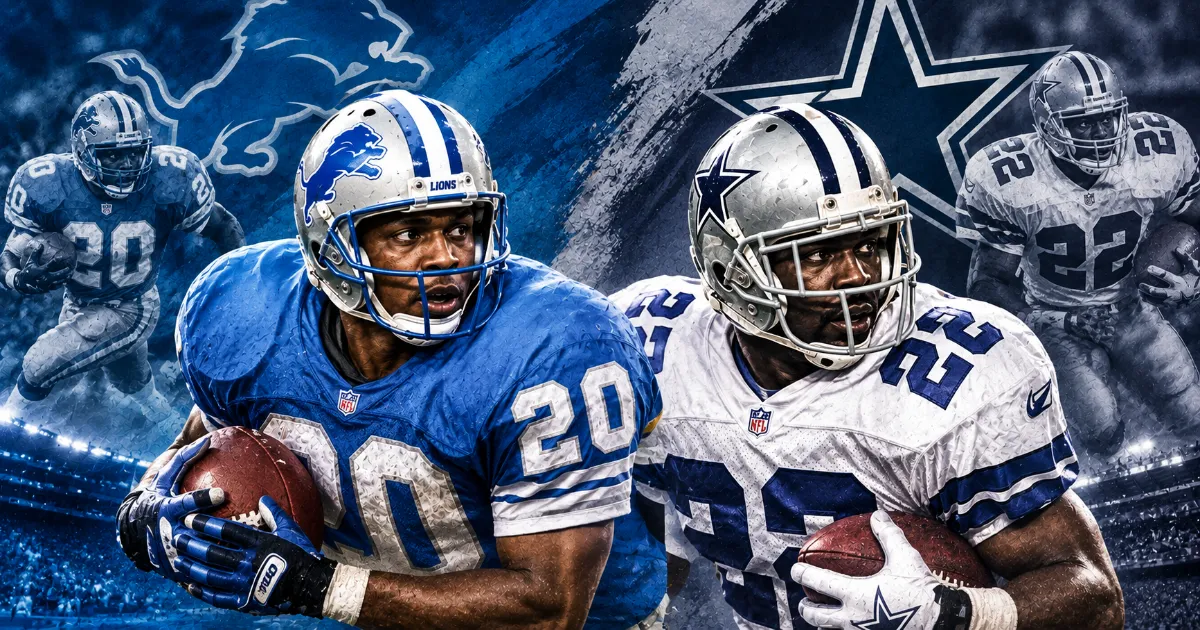
Decades later, the Barry Sanders vs Emmitt Smith argument is still full of myths — some true, some exaggerated, and one straight from Smith’s own mouth.
A Debate That Refuses to Die
Few rivalries in NFL history have generated as much recycled, half-true conventional wisdom as Barry Sanders vs Emmitt Smith. Both entered the league within a year of each other — Sanders in 1989, Smith in 1990 — and spent the better part of a decade being measured against one another in real time, splitting the NFL’s rushing title eight times between 1990 and 1997. More than 25 years since Sanders’ abrupt retirement, the debate still gets recycled every football season, usually accompanied by the same handful of claims repeated so often they’ve calcified into assumed fact. It’s worth actually fact-checking them.
Myth: “Barry Sanders Definitely Would Have Broken Emmitt Smith’s Rushing Record If He’d Played Longer”
Verdict: Plausible, but far from certain.
This is the single most repeated claim in the entire debate, and it’s more complicated than it sounds. Sanders retired with 15,269 career rushing yards after 10 seasons, averaging 1,526.9 yards per season — a pace that, if simply maintained rather than improved, would have carried him past Smith’s 18,355-yard record within roughly two more full seasons. Statistical projection models built around Sanders’ actual season-by-season production support this conclusion, with one detailed analysis projecting a hypothetical career total north of 21,000 yards had he played out a career of similar length to Smith’s.
The problem with treating this as settled fact is that it assumes no decline whatsoever — an assumption that essentially no running back in NFL history has actually managed across a 15-year career. Smith’s own numbers dropped considerably in his final five seasons (from 4.3 yards per attempt down to 3.62, and from 1,396 yards per season down to 878), a normal aging curve for the position that there’s no strong reason to assume Sanders would have somehow avoided entirely. The honest verdict: Sanders likely would have gotten closer to Smith’s total than his final numbers suggest, but “definitely would have broken it” overstates a genuinely uncertain projection.
Myth: “Emmitt Smith’s Numbers Were Purely a Product of Dallas’s Offensive Line”
Verdict: Partly true, but incomplete.
It’s undeniably true that Smith ran behind one of the most dominant offensive lines in NFL history for the bulk of his prime, complemented by a Hall of Fame quarterback in Troy Aikman and a Hall of Fame receiver in Michael Irvin drawing coverage away from the box. His 1995 season — 1,773 yards and an NFL-record 25 total touchdowns — is frequently cited as evidence of system-driven production. But this critique tends to ignore Smith’s postseason résumé specifically, where system advantages matter less against defenses keyed entirely on stopping the run: across 17 career playoff games, Smith rushed for 1,586 yards and 21 touchdowns, culminating in a Super Bowl XXVIII MVP award. Elite offensive line play helps every runner, but it doesn’t fully explain sustained production against defenses specifically game-planning to stop you — a distinction the “purely a product of his line” version of this myth tends to flatten.
Myth: “Barry Sanders Was a Selfish, One-Cut Highlight Reel Player With No Toughness”
Verdict: False, and contradicted by his own durability record.
This one doesn’t hold up well under scrutiny. Sanders started all but a handful of his team’s games across a full decade in the league, a durability record that undercuts any suggestion he was somehow fragile or built purely for highlight-reel moments rather than sustained, physical football. What’s true is that Sanders’ running style — extended, high-risk cutbacks designed to turn a modest gain into a home run — occasionally produced negative-yardage plays that a more conservative, north-south runner like Smith would have avoided, and he was genuinely more vulnerable in pass protection and blitz pickup than Smith. But “no toughness” is a significant overstatement for a player who authored one of the most physically demanding running styles the position has ever seen, virtually never left the field, and did it all without the benefit of a truly dominant supporting cast for most of his career.
Myth: “Barry Sanders Retired Because His Skills Were Declining”
Verdict: False.
Sanders’ final season, 1998, produced 1,491 rushing yards — hardly the statistical profile of a player in decline. His abrupt retirement, announced via fax before the 1999 season, was driven by a combination of factors that had little to do with his own physical ability: frustration with a Detroit front office he felt wasn’t building a competitive roster around him, a genuine desire to retire on his own terms rather than chase records for their own sake, and reported respect for Walter Payton’s approach to the game. Sanders has since acknowledged that playing his entire college career at Oklahoma State (rather than leaving early) made him three years older than Smith at the same career stage, an additional factor in his early exit that had nothing to do with declining performance.
Myth: “Emmitt Smith Thinks He Was Better Than Barry Sanders”
Verdict: Actually, reportedly the opposite.
This might be the most surprising fact-check in the entire debate. Smith has been reported saying, in reference to Sanders, that he considers him the best running back of all time — a remarkably generous concession from a player with every statistical and championship argument to claim the title for himself instead. Whether or not Smith has repeated this sentiment consistently over the years, its existence at all complicates the narrative that this rivalry is purely a matter of fan loyalty split down partisan lines; even the record-holder himself has, at least once, pointed the other direction.
What’s Actually True: The Head-to-Head Numbers
Stripped of myth, the real comparison is genuinely close and genuinely fascinating:
| Category | Barry Sanders | Emmitt Smith |
|---|---|---|
| Career Rushing Yards | 15,269 (4th all-time) | 18,355 (1st all-time) |
| Seasons Played | 10 | 15 |
| Yards Per Carry | ~5.0 | ~4.2 |
| Yards Per Game (career) | 99.9 | 90.3 (first 10 seasons) |
| Rushing Titles | 4 (1990, ’94, ’96, ’97) | 4 (1991-93, ’95) |
| Super Bowl Championships | 0 | 3 |
| Playoff Rushing Yards | Modest; struggled in several games | 1,586 across 17 games |
| Career Rushing TDs | 99 | 164 (all-time record) |
The rushing title split — 4 apiece across the decade they overlapped — is perhaps the most underappreciated true fact in this entire debate. For a full decade, neither player was able to claim clear statistical superiority over the other in the metric both were most defined by.
The One Category Where the Gap Is Real: The Postseason
If there’s a genuine, well-documented gap between the two that doesn’t rely on myth or exaggeration, it’s playoff performance. Sanders struggled repeatedly in the postseason, most notably being held to -1 yards on 13 carries in a 1994 Wild Card loss to Green Bay, and finished his career with exactly one playoff touchdown despite Detroit reaching the playoffs five times during his tenure. Smith, by contrast, was arguably at his best when the stakes were highest, culminating in his Super Bowl XXVIII MVP performance. This is the rare part of the debate where the conventional wisdom — Smith the postseason performer, Sanders the one who “disappeared” in big moments — actually holds up against the record.
Myth: “Sanders Never Had Good Teammates, While Smith Had Everything Handed to Him”
Verdict: Exaggerated on both ends.
This framing shows up constantly in the debate, and it flattens two more complicated realities into a lazy binary. Sanders’ supporting cast in Detroit wasn’t nearly as bare as this myth suggests — during his prime years, the Lions featured two Pro Bowl offensive linemen in Kevin Glover and Lomas Brown, a 4,000-yard passer in Scott Mitchell, and two productive receiving threats in Herman Moore and Johnnie Morton. It wasn’t a championship-caliber supporting cast, but it wasn’t the offensive wasteland this version of the myth implies either. On the other side, Smith’s final four seasons in Dallas came behind a considerably diminished offensive line compared to his 1990s prime, meaning even Smith spent a real portion of his career earning yards without the historically dominant blocking that defined his early years. Both players, in other words, experienced a mix of strong and weak supporting casts at different points — just not at the same time, which makes any single-era snapshot comparison inherently misleading.
What Made Each Player’s Style So Different
Beyond the numbers, part of what’s kept this debate alive for so long is how genuinely different watching each player felt in real time. Sanders built his game around lateral movement and unpredictability — a runner who would take a two-yard loss on one play and a 60-yard touchdown on the next, often on what looked like the exact same blocking scheme. Smith built his game around patience, vision, and short-area quickness, following his blocks rather than trying to create something entirely outside the play design. Both approaches produced elite results, but they asked completely different things of the offensive linemen blocking for them and completely different things of defenses trying to stop them — which is part of why comparing the two head-to-head has never fully satisfied either side of the debate.
The Verdict
Barry Sanders vs Emmitt Smith doesn’t resolve into a clean winner, and the honest fact-check reveals a debate that’s been distorted almost equally by both sides’ favorite talking points. Smith’s critics oversell the “he was just a product of the offensive line” argument in a way his playoff résumé doesn’t fully support. Sanders’ advocates oversell the “he definitely would have broken the record” projection in a way that ignores how universally running backs decline with age. What survives the fact-check is a genuinely rare case: two players who split their era’s rushing titles evenly, whose per-carry efficiency numbers favor Sanders, whose championship and postseason résumé favors Smith, and whose own mutual respect for each other — publicly stated, at least once, from the player with every incentive to claim sole ownership of the debate — suggests both men understood something the rest of us are still arguing about decades later.
The Bottom Line
Strip away the myths, and Barry Sanders vs Emmitt Smith becomes less a debate to be won and more a genuine testament to how differently greatness can look at the same position. Sanders redefined what a runner could do with the ball in open space, doing it for a decade without ever missing significant time. Smith redefined what sustained volume and championship production could look like, doing it for five additional seasons behind one of the greatest offensive lines ever assembled. Both things are true. Neither cancels the other out. And if the record-holder himself has already conceded the argument once, maybe it’s time the rest of us stopped pretending this one has a tidy answer.
Frequently Asked Questions
Who has more career rushing yards, Barry Sanders or Emmitt Smith? Emmitt Smith holds the all-time NFL rushing record with 18,355 career yards. Barry Sanders ranks fourth all-time with 15,269 yards, despite playing five fewer seasons.
Did Barry Sanders retire because of declining skills? No — Sanders rushed for 1,491 yards in his final season in 1998, showing no statistical decline. His retirement was driven by frustration with the Detroit Lions organization and a personal decision to walk away on his own terms.
Who performed better in the playoffs, Sanders or Smith? Emmitt Smith significantly outperformed Sanders in the postseason, rushing for 1,586 yards and 21 touchdowns across 17 playoff games and winning Super Bowl XXVIII MVP. Sanders struggled in several playoff appearances and finished with just one career playoff touchdown.
Has Emmitt Smith ever said Barry Sanders was better than him? Yes — Smith has been reported saying he considers Sanders the best running back of all time, a notable statement given his own record-holding career and championship résumé.
How many rushing titles did each player win? Both players won four NFL rushing titles during the years their careers overlapped — Smith in 1991, 1992, 1993, and 1995; Sanders in 1990, 1994, 1996, and 1997.
Would Barry Sanders have broken Emmitt Smith’s rushing record if he had played longer? It’s plausible but not certain. Statistical projections suggest Sanders could have surpassed Smith’s total had he maintained his career pace, but such projections don’t account for the physical decline nearly every running back experiences late in their career, including Smith himself.
🔹🔹 Follow us on Facebook 🔹🔹