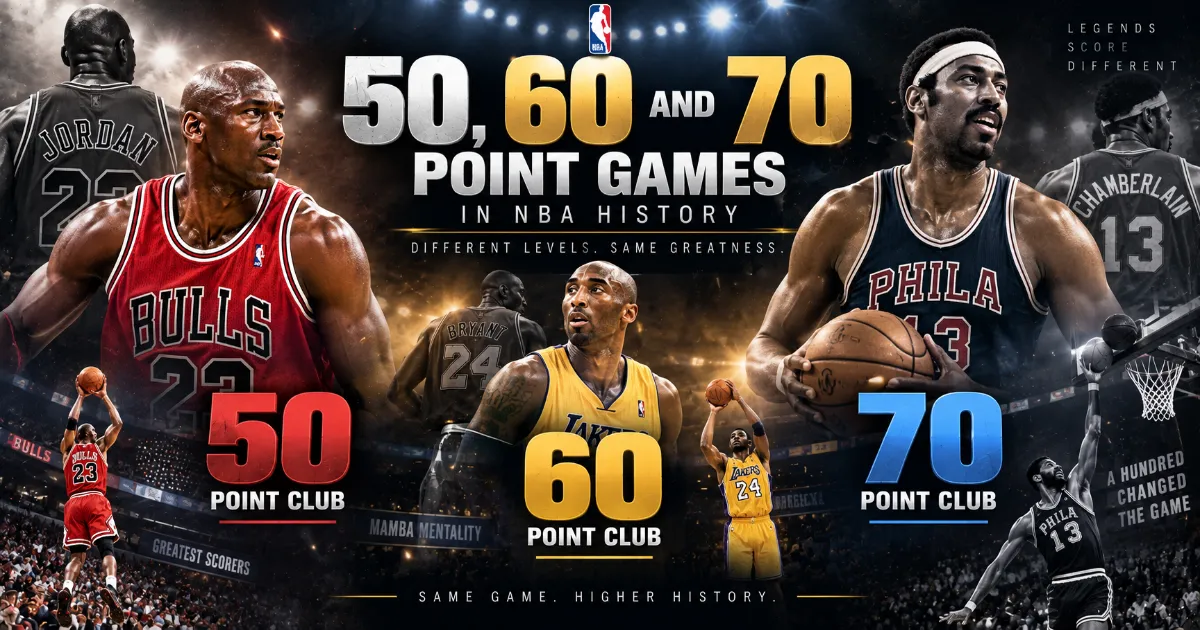
 The 50-point club is crowded, the 60-point club is rare, and the 70-point club has only ever had eight members — here’s the complete breakdown across all three scoring thresholds
Not every big scoring night belongs in the same conversation. Fifty-point games happen several times most seasons. Sixty-point games remain genuinely rare. And the 70-point club has only ever admitted eight members in the sport’s entire history. Treating these as one undifferentiated category misses how dramatically the difficulty curve steepens at each threshold.
Who Has the Most Steals in NBA History? A Full Breakdown
The Different Kinds of Great Three-Point Shooters in NBA History
The 50-Point Club: Crowded but Still Elite
Reaching 50 points in a single game remains a notable individual achievement, but it’s happened often enough that certain players have done it dozens of times across their careers. Wilt Chamberlain holds the record for most 50-point games in a career by a wide margin, having done it 118 times, including 45 times in a single season during his statistically extreme 1961-62 campaign. Michael Jordan reached 50 points on 34 occasions, Kobe Bryant on 25, and Elgin Baylor on 17, reflecting that this specific threshold, while impressive, has been cleared repeatedly by the sport’s elite scorers across multiple eras.
Modern players have added to this list as well: Devin Booker, Damian Lillard, and Luka Doncic have all reached 50 points multiple times in recent seasons, demonstrating that the 50-point threshold remains achievable even in a league with more sophisticated defensive schemes than existed during Chamberlain’s era.
The 60-Point Club: A Genuine Step Up in Rarity
Sixty points represents a meaningfully steeper climb. Wilt Chamberlain again leads this category, having scored 60 or more points 32 times across his career — a total that remains almost incomprehensible relative to every other player’s combined total in this specific tier. Kobe Bryant reached 60 points on six occasions, including his 60-point farewell game in 2016 at age 37. David Thompson, David Robinson, and Devin Booker each have multiple 60-point games as well, though none approach Chamberlain’s volume.
The gap between the 50-point club and 60-point club illustrates something important about scoring difficulty: even elite scorers who reach 50 with some regularity often top out there, since the final 10 points require avoiding foul trouble, sustaining shooting efficiency deep into the fourth quarter, and typically playing nearly a full 48 minutes without meaningful rest.
The 70-Point Club: An Exclusive List of Eight
Only eight players in NBA history have ever scored 70 or more points in a single game, making this the sport’s most exclusive individual scoring threshold below Chamberlain’s unique 100-point outlier.
| Player | Points | Date | Opponent |
|---|---|---|---|
| Wilt Chamberlain | 100 | March 2, 1962 | New York Knicks |
| Kobe Bryant | 81 | January 22, 2006 | Toronto Raptors |
| Wilt Chamberlain | 78 | December 8, 1961 | Los Angeles Lakers |
| Wilt Chamberlain | 73 | January 13, 1962 | Chicago Packers |
| Wilt Chamberlain | 73 | November 16, 1962 | New York Knicks |
| David Thompson | 73 | April 9, 1978 | Detroit Pistons |
| Donovan Mitchell | 71 | January 2, 2023 | Chicago Bulls |
| Elgin Baylor | 71 | November 15, 1960 | New York Knicks |
| David Robinson | 71 | April 24, 1994 | Los Angeles Clippers |
| Devin Booker | 70 | March 24, 2017 | Boston Celtics |
Chamberlain accounts for four of the ten highest-scoring games in NBA history, a statistical dominance at the extreme end of individual scoring that no other player has approached, either before or since his career.
Why the 100-Point Game Exists in Its Own Category
Chamberlain’s 100-point game against the Knicks in 1962 sits so far above every other individual scoring performance that it’s rarely grouped even with his own other 70-plus-point games in casual conversation. The game was played without television broadcast, meaning much of what’s known comes from radio broadcasts, newspaper accounts, and a small number of surviving photographs. Chamberlain shot 36-of-63 from the field that night, attempt totals that remain almost unthinkable by modern shot-distribution standards, reflecting both his own individual dominance and a Knicks roster with essentially no answer for him defensively.
The Team Context Behind Each Scoring Explosion
Several games on the 70-point list share a common feature worth examining: a team situation that either enabled or was created by the individual explosion. Kobe Bryant’s 81-point game came in a contest the Lakers trailed by 18 points at halftime, meaning his second-half outburst was as much about erasing a deficit as building a lead. Chamberlain’s 100-point game, by contrast, came in a contest his Philadelphia Warriors led comfortably for much of the second half, with teammates reportedly feeding him the ball specifically to help him reach the milestone rather than simply playing the game’s natural flow. This distinction matters for understanding these games in proper context — some represent a player single-handedly rescuing a losing effort, while others reflect a team consciously building toward an individual record once it became a realistic possibility.
Statistical Efficiency Across the Three Tiers
Looking at shooting efficiency across these thresholds reveals an interesting pattern. Several 50-point games in NBA history have come on relatively modest shot attempt totals, reflecting an efficient, high-percentage shooting night rather than pure volume. The 60 and 70-point tiers, by contrast, almost universally require extremely high shot attempt totals, since even elite shooting efficiency struggles to produce that many points without a correspondingly high volume of attempts. Chamberlain’s 100-point game required 63 field goal attempts, a volume that would be considered highly unusual by any modern team’s shot-distribution philosophy, reflecting both his individual dominance and the fundamentally different offensive approach of his specific era.
Recent Additions to the 70-Point Tier
Donovan Mitchell’s 71-point game in January 2023 marked the first addition to the 70-point club in nearly three decades, breaking a long stretch during which the modern, more physical and defensively sophisticated NBA had produced no new members at this specific tier. This recent addition suggests that while 70-point games remain extraordinarily rare, they haven’t become entirely extinct in the modern era, even accounting for significantly improved defensive schemes and shot-contesting technology compared to Chamberlain’s or Baylor’s eras.
How These Thresholds Reflect Different Kinds of Dominance
The 50-point club rewards elite scoring talent applied over a single strong night. The 60-point club requires that talent combined with unusual endurance and sustained efficiency. The 70-point club requires all of that plus either a genuinely historic individual performance or, in several cases on this list, a specific game environment — a weaker opposing roster, an era with less sophisticated defensive schemes, or extended playing time — that allowed a dominant scorer’s ceiling to fully express itself without the usual limiting factors of foul trouble, fatigue, or defensive adjustment.
Modern Players Approaching These Thresholds
Several current NBA stars have posted 50-point games with enough regularity to suggest a realistic future path toward the rarer tiers discussed above. Luka Doncic and Joel Embiid have each produced multiple 50-point performances in recent seasons, and Damian Lillard’s late-career scoring explosions, including multiple 60-point-adjacent performances, suggest the modern game hasn’t fully closed the door on these extreme scoring nights despite significantly more sophisticated defensive schemes than existed during Chamberlain’s or Baylor’s careers. Whether any active player realistically threatens the 70-point tier, let alone Chamberlain’s singular 100-point outlier, remains a genuinely open question that depends heavily on the same combination of individual talent, sustained playing time, and specific game circumstances that produced the existing entries on this list.
How These Games Get Remembered Differently Over Time
Not every game on this list carries equal cultural weight decades later, despite comparable statistical achievement. Kobe Bryant’s 81-point game benefits from complete television broadcast footage that’s been endlessly replayed and analyzed shot by shot, while several of Chamberlain’s own 70-plus-point games, including his second-highest 78-point outing, receive comparatively little modern attention specifically because so little video documentation survives from that era. This documentation gap means the modern cultural memory of these scoring thresholds is shaped as much by broadcast availability as by the statistical achievement itself, a pattern worth acknowledging whenever older and newer entries on this list get compared purely on how frequently they’re still discussed today.
Final Thoughts
Most 50, 60, and 70-point games in NBA history represent three genuinely different levels of scoring achievement rather than a single continuous category. Wilt Chamberlain’s statistical dominance across all three tiers, and especially his solitary 100-point game, remains unmatched by any other player’s combined career total at these thresholds, while Kobe Bryant’s 81-point game and Donovan Mitchell’s more recent 71-point performance demonstrate that individual scoring explosions at this magnitude, while exceedingly rare, haven’t disappeared from the modern game entirely.
Frequently Asked Questions
How many players have scored 70 or more points in a single NBA game? Eight players have reached this threshold, led by Wilt Chamberlain’s 100-point game, the highest total ever recorded.
Who is the most recent player to score 70 or more points in a game? Donovan Mitchell, who scored 71 points against the Chicago Bulls in January 2023, the first new member of the 70-point club in nearly three decades.
How many career 50-point games did Wilt Chamberlain have? 118, an all-time record by a wide margin, including 45 in a single season during his historic 1961-62 campaign.
Did Kobe Bryant’s 81-point game come in a win or a loss? A win — the Lakers trailed by 18 points at halftime before Bryant’s second-half scoring explosion, scoring 55 points after the break, completed the comeback.


One Comment