A 33-game streak that predates the modern shot clock era, and the teams that have come closest to touching it since
Some records get approached repeatedly before finally falling. The NBA’s longest winning streak isn’t one of them — it’s stood since 1972, and in more than five decades since, no team has gotten within nine games of it. This is the full breakdown of the league’s most durable team record.
The All-Time Record: 33 Consecutive Wins
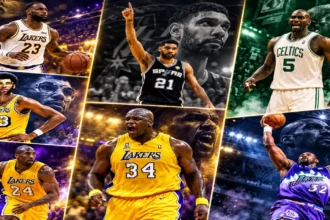
The 1971-72 Los Angeles Lakers won 33 consecutive games, a streak that ran from early November through mid-January of that season, anchored by Jerry West, Wilt Chamberlain, and Gail Goodrich. The streak remains the longest in the history of North American major professional sports, not just basketball, and the Lakers went on to win the franchise’s first Los Angeles-era championship that same season, a reminder that the historic run wasn’t simply a regular-season statistical curiosity but part of a genuinely championship-caliber team.
Who Has the Most Blocks in NBA History? A Full Breakdown
Longest Winning Streaks — Complete Rankings
| Rank | Team | Streak | Season |
|---|---|---|---|
| 1 | Los Angeles Lakers | 33 games | 1971-72 |
| 2 | Golden State Warriors | 28 games (spanning two seasons) | 2014-16 |
| 3 | Miami Heat | 27 games | 2012-13 |
| 4 | Milwaukee Bucks | 20 games | 1970-71 |
| 5 | Houston Rockets | 22 games | 2007-08 |
Why the Lakers’ Streak Has Proven So Durable
Several factors specific to the 1971-72 season help explain why this record has remained unbroken for more than fifty years. The league featured fewer teams during that era, meaning less overall competitive parity and a smaller pool of games where a genuinely dangerous upset opponent might appear on the schedule. The Lakers’ roster also featured minimal turnover during the streak itself, avoiding the injury-driven interruptions that have derailed several more recent teams’ shorter streaks. Modern load management practices, which didn’t exist in any meaningful form during the 1970s, also mean today’s contending teams frequently rest star players for stretches of the regular season, a strategic choice that makes sustaining a 30-plus-game streak considerably more difficult under contemporary team-management philosophy.
Losing Streaks as a Statistical Counterpoint
For contrast, it’s worth briefly noting the opposite end of this record book. The Philadelphia 76ers hold the record for longest losing streak, at 28 consecutive defeats during the 2015-16 season, part of a broader rebuilding stretch widely referred to as “The Process.” Comparing the two extremes reveals an interesting statistical symmetry: the gap between the greatest winning streak and one of the most significant losing streaks in league history spans just five games, underscoring how much team-building philosophy, roster continuity, and era-specific competitive parity can swing a franchise’s fortunes toward either extreme end of this particular record book.
Why This Record Rarely Comes Up in Modern Streak Conversations
Despite being one of the most durable records in professional sports, the Lakers’ 33-game streak receives comparatively less mainstream media attention than several shorter, more recent streaks, largely because it predates modern broadcast archiving and comprehensive highlight-reel culture. Games from the 1971-72 season exist in far less complete video form than the Warriors’ or Heat’s more recent streaks, meaning contemporary sports media has considerably less footage available to revisit and package into retrospective content, even though the underlying achievement remains statistically far more significant than either of those later streaks.
The Modern Era’s Closest Challengers
The Miami Heat’s 27-game streak during the 2012-13 season, anchored by LeBron James, Dwyane Wade, and Chris Bosh, came the closest any modern team has managed, falling six games short of the Lakers’ mark. The Golden State Warriors’ 28-game streak, which spanned the end of their record-breaking 73-win 2015-16 season and continued briefly into the following season, actually crossed two separate seasons, a distinction that complicates direct comparison to single-season streaks like the Lakers’ and Heat’s runs.
How the Streak Finally Ended
The Lakers’ 33-game streak ended on January 9, 1972, with a loss to the Milwaukee Bucks, who were themselves in the midst of their own franchise-best 20-game winning streak earlier that same season. The fact that two of the era’s most dominant streaks both occurred within the same season, involving two of the league’s best rosters, reflects just how competitively top-heavy the early 1970s NBA had become, with a small handful of genuinely dominant teams separating themselves significantly from the rest of the league.
Longest Winning Streaks to Start a Season
A related but distinct record involves the longest winning streak specifically at the start of a season, rather than at any point during it. The 2015-16 Golden State Warriors won their first 24 games of that record-breaking 73-win season, the best start in NBA history, before eventually losing for the first time in late December. This specific record differs from the all-time streak record since it measures season-opening dominance rather than a streak that could occur at any point, including mid-season, and it highlights just how statistically dominant that particular Warriors roster was across the entire campaign, not just during the streak itself.
Individual Player Availability Streaks
A separate but related category worth mentioning involves individual iron-man streaks — players who avoided missing games for extraordinarily long stretches. While not the same as a team winning streak, these durability records intersect with team success, since a stable, healthy roster is often a prerequisite for sustaining a genuine winning streak in the first place. The Lakers’ 1971-72 roster benefited from unusually strong health and availability throughout the streak, reinforcing how team-level durability and team-level winning streaks are often connected phenomena rather than entirely separate statistical categories.
How Playoff Winning Streaks Differ From Regular-Season Records
Playoff winning streaks represent a related but statistically distinct category from the regular-season records discussed above, since postseason competition inherently involves facing tougher, more prepared opponents on a series-by-series basis. Several championship teams have posted double-digit playoff winning streaks spanning multiple series within a single postseason run, though these streaks are necessarily capped by the structure of best-of-seven series rather than the open-ended possibility a regular-season streak offers. The Los Angeles Lakers’ 1971-72 championship run itself included a lengthy playoff winning streak that overlapped with the tail end of their historic regular-season mark, adding playoff wins onto the record-setting streak before it was eventually snapped, though official record-keeping treats the two contexts as separate statistical categories.
What It Would Take to Break This Record Today
Given the league’s modern structure, breaking the Lakers’ record would require an extraordinarily specific combination of circumstances: a genuinely dominant roster with minimal injury interruption, a front office and coaching staff willing to prioritize the streak over strategic regular-season rest, and a stretch of schedule fortunate enough to avoid too many games against elite competition in quick succession. Even the most dominant modern rosters, including the Warriors’ dynasty-era teams, have generally prioritized long-term playoff health over regular-season streak preservation once a loss became a realistic risk to a core player’s availability, a philosophical shift in team management that makes approaching this specific record considerably less likely under current competitive incentives than it might have been in earlier eras of the league.
Final Thoughts
The longest winning streaks in NBA history remain dominated by a single, more than five-decade-old achievement: the 1971-72 Lakers’ 33 consecutive wins, a record that has survived the Miami Heat’s 27-game run, the Golden State Warriors’ 28-game streak spanning two seasons, and every other genuine championship-caliber roster the league has produced since. Given modern load management practices and the league’s increased competitive parity across thirty franchises, most analysts consider this one of the safer records in the entire NBA record book.
Frequently Asked Questions
What is the longest winning streak in NBA history? The Los Angeles Lakers won 33 consecutive games during the 1971-72 season, a record that remains unmatched more than five decades later.
Which modern team has come closest to breaking the Lakers’ record? The Miami Heat’s 27-game winning streak during the 2012-13 season remains the closest single-season approach, falling six games short.
How did the Lakers’ 33-game winning streak finally end? The streak ended with a loss to the Milwaukee Bucks on January 9, 1972, a Bucks team that was itself in the midst of a franchise-record 20-game winning streak that same season.
What is the longest losing streak in NBA history? The Philadelphia 76ers hold this record at 28 consecutive losses during the 2015-16 season, part of a broader rebuilding stretch during the franchise’s “Process” era.