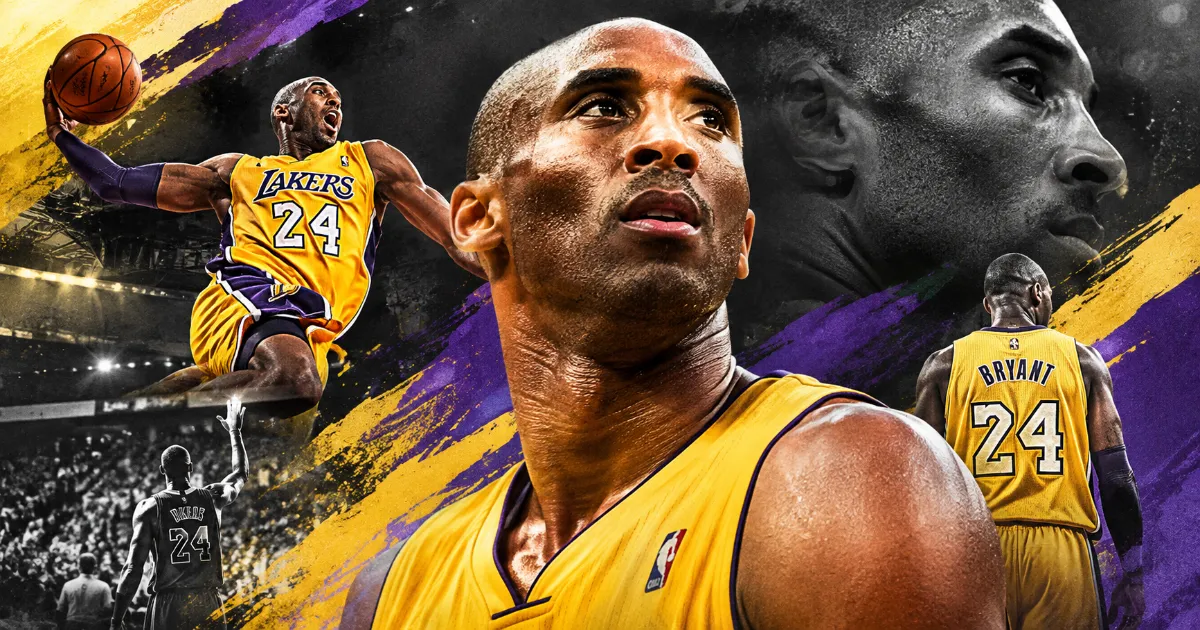
Twenty seasons of numbers, the second-highest scoring game in NBA history broken down quarter by quarter, and the moments that built the Mamba legend
Twenty seasons with a single franchise produced one of the most statistically documented careers in NBA history. This is a straight reference breakdown: career totals, an inside look at the 81-point game specifically, the awards ledger, and the other signature moments that, together, built the full picture of what Kobe Bryant’s career actually looked like in numbers.
Kobe Bryant’s Case Among the All-Time Greats, Explained
Greatest Wide Receivers in NFL History: Jerry Rice, and Then Everyone Else
Career Totals at a Glance
Bryant retired in 2016 with 33,643 career points, then the third-highest total in NBA history, since surpassed by both LeBron James and Kareem Abdul-Jabbar’s original mark being passed as well. He averaged 25.0 points, 5.2 rebounds, and 4.7 assists per game across twenty seasons, all played with the Los Angeles Lakers. He shot 44.7 percent from the field for his career and 83.7 percent from the free-throw line.
His per-season output remained remarkably stable across two very different eras of his career — the early years playing alongside Shaquille O’Neal, and the later years as the Lakers’ primary offensive option — a rare statistical consistency across two fundamentally different team roles.
The 81-Point Game: Quarter by Quarter
Played on January 22, 2006, against the Toronto Raptors, Bryant’s 81-point performance remains the second-highest single-game scoring total in NBA history, trailing only Wilt Chamberlain’s 100-point game in 1962.
First quarter: Bryant scored 14 points as the Lakers fell behind early, with Toronto building a double-digit lead.
Second quarter: He added just 12 points, and the Lakers went into halftime trailing by 18 points, making the eventual outcome of the game statistically improbable at the break.
Third quarter: Bryant scored 27 points in the quarter alone, an outburst that erased most of the deficit and shifted the game’s entire trajectory.
Fourth quarter: He scored 28 more points, finishing the game with 81 on 28-of-46 shooting, including 7-of-13 from three-point range and 18-of-20 from the free-throw line, as the Lakers completed the comeback and won by 18 points.
The performance is notable not just for the total but for its structure — more than two-thirds of his points came after halftime, in a game the Lakers were losing badly before his second-half takeover.
Season Milestone Snapshot
| Season | Team Role | PPG | Notable |
|---|---|---|---|
| 1996-97 | Rookie, off the bench | 7.6 | Youngest player in NBA history at the time |
| 1999-2000 | Co-star alongside Shaq | 22.5 | First championship |
| 2002-03 | Co-star alongside Shaq | 30.0 | Third straight championship |
| 2005-06 | Primary scoring option | 35.4 | Led NBA in scoring, 81-point game |
| 2007-08 | Team leader | 28.3 | Regular-season MVP |
| 2009-10 | Team leader | 27.0 | Fifth championship, Finals MVP |
| 2012-13 | Late-career | 27.3 | Season ended by Achilles tear |
Individual Awards Ledger
Bryant’s individual honors include one regular-season MVP award (2008), two Finals MVP awards (2009, 2010), eighteen All-Star selections, twelve All-Defensive selections including nine First Team nods, and two scoring titles (2006, 2007). He also won the All-Star Game MVP award four times, and the award itself was later renamed in his honor following his death in 2020.
His nine All-Defensive First Team selections match Michael Jordan’s total exactly, a statistic frequently cited as evidence that Bryant’s defensive commitment is underappreciated relative to how heavily his offensive reputation dominates most retrospectives of his career.
The Two Championship Eras, Statistically Compared
Bryant’s five championships split cleanly into two statistically distinct periods. The first three, from 2000 to 2002, came as the second option alongside a dominant Shaquille O’Neal, with Bryant averaging in the low-to-mid 20s in points during those Finals runs. The final two, in 2009 and 2010, came with Bryant as the unquestioned leader, averaging over 30 points across both championship runs and capturing Finals MVP both times.
This statistical split matters because it addresses a specific criticism that trailed Bryant through the middle of his career — that he couldn’t win without O’Neal. The 2009 and 2010 numbers, achieved as the clear primary option, directly answered that question statistically.
Career-High Games Beyond the 81-Point Night
While the 81-point game remains his signature statistical achievement, Bryant recorded four separate 60-point games across his career, including his final NBA game in 2016, when he scored 60 points at age 37 in what was announced in advance as his retirement game. That final performance, on 50 shot attempts, remains one of the more statistically unusual farewell performances in professional sports — a player closing his career with his fourth-highest scoring output ever, at an age when most players’ primary role has long since diminished.
Playoff Statistical Record
Bryant’s playoff scoring average of 25.6 points per game ranks among the highest in NBA history across a substantial sample size of more than 220 playoff games — more playoff games than all but a handful of players in league history, a reflection of how consistently his Lakers teams reached deep into the postseason across two decades. His three separate 40-point-or-higher games within a single first-round series against Phoenix in 2006 remains one of the most statistically dominant individual playoff stretches by any player facing early elimination pressure.
The Context Behind the 81-Point Game
What made the 81-point game statistically remarkable wasn’t just the total but the game situation surrounding it. The Lakers roster that season was widely considered mediocre outside of Bryant himself, and Toronto had built an 18-point halftime lead against a team many analysts expected to struggle that year. Bryant’s coach at the time, Phil Jackson, has spoken about deliberately feeding him the ball repeatedly in the second half once it became clear he had found an offensive rhythm the Raptors had no answer for, effectively running the entire offense through him rather than maintaining a more balanced second-half approach.Was Shaquille O’Neal the Most Physically Dominant Center in NBA History?
The 7-of-13 three-point shooting is also worth highlighting statistically, since Bryant wasn’t historically regarded as a high-volume three-point shooter for most of his career. That specific game required him to be effective from every level of the floor simultaneously — the free-throw line, midrange, and beyond the arc — rather than relying on a single shot type to reach the total.
Signature Moments Beyond the Scoring Records
Several other career moments round out Bryant’s statistical and cultural legacy beyond his highest-scoring individual games. His four-point play against Portland in the 2000 Western Conference Finals, drawing a foul on a game-tying three-pointer late in the fourth quarter and completing the four-point play, was a signature early-career moment that demonstrated the clutch reputation that would follow him for the rest of his career.
His 2008 Beijing Olympics performance, part of the “Redeem Team” that recaptured Olympic gold after the United States’ disappointing 2004 finish, added an international dimension to his résumé that pure NBA statistics don’t capture. Bryant was widely credited as the roster’s defensive anchor and emotional leader during that tournament, a role that differed from his primary-scorer identity with the Lakers.
Injury History and Its Statistical Impact
Bryant’s career statistics were shaped significantly by injuries in the second half of his career, most notably a torn Achilles tendon suffered in April 2013 at age 34. He famously attempted, and made, both free throws immediately after the injury before leaving the court, an image that became its own signature moment separate from any single scoring total. He never fully returned to his prior level of athletic dominance afterward, playing out his final three seasons at a statistically diminished capacity before the 60-point farewell game provided one final, statistically improbable peak.
Statistical Comparison Across Signature Scoring Games
| Game Date | Opponent | Points | Context |
|---|---|---|---|
| January 22, 2006 | Toronto Raptors | 81 | Second-highest game in NBA history |
| December 20, 2005 | Dallas Mavericks | 62 | Scored more than the entire opposing team through three quarters |
| March 16, 2007 | Portland Trail Blazers | 65 | Part of a stretch of four straight 50-plus-point games |
| April 13, 2016 | Utah Jazz | 60 | Final career game, age 37 |
The Stretch of Four Consecutive 50-Point Games
Beyond the 81-point game itself, Bryant’s 2006-07 season included a remarkable four-game stretch in which he scored 50 or more points in each contest, a run that remains one of the most statistically dominant sustained scoring stretches in modern NBA history. This stretch is sometimes overshadowed by the singular 81-point night from the previous season, but it arguably demonstrates a different kind of statistical dominance — not a single outlier performance, but a sustained ability to produce at an elite scoring level night after night across a meaningful sample size.
How the 81-Point Game Is Remembered Differently Than the 100-Point Game
Wilt Chamberlain’s 100-point game, scored in 1962, occurred in an era with far less comprehensive media coverage — no television broadcast exists of the full game, and much of what’s known about it comes from newspaper accounts and photographs rather than complete video footage. Bryant’s 81-point game, by contrast, was fully broadcast and has been replayed, analyzed, and dissected shot by shot in the decades since. This difference in documentation is part of why Bryant’s performance, despite being statistically second to Chamberlain’s, often receives more detailed tactical analysis in modern retrospectives — there’s simply more complete footage available to study exactly how he generated each individual basket.
Final Thoughts
The numbers behind Kobe Bryant’s career tell a story of remarkable consistency across two very different roles on the same roster — from second option to primary scorer — anchored by a single, statistically extreme night in January 2006 that remains unmatched by all but one performance in NBA history. Twenty seasons, five championships split across two distinct eras, and an 81-point half-empty-arena comeback that still gets discussed as one of the most singular individual scoring performances the sport has ever produced.
Frequently Asked Questions
How many points did Kobe Bryant score in his final NBA game? He scored 60 points in his final game in 2016, at age 37, in a performance announced in advance as his retirement game.
Is the 81-point game the highest-scoring game in NBA history? No, it’s the second-highest, trailing only Wilt Chamberlain’s 100-point game from 1962.
How many championships did Kobe Bryant win, and in what split? Five championships total — three from 2000 to 2002 alongside Shaquille O’Neal, and two more in 2009 and 2010 as the Lakers’ clear leader.
How many career All-Star selections did Kobe Bryant have? Eighteen All-Star selections across his twenty-season career, along with four All-Star Game MVP awards, and the All-Star Game MVP trophy itself was later renamed in his honor.
🔹🔹 Follow us on Facebook 🔹🔹


One Comment