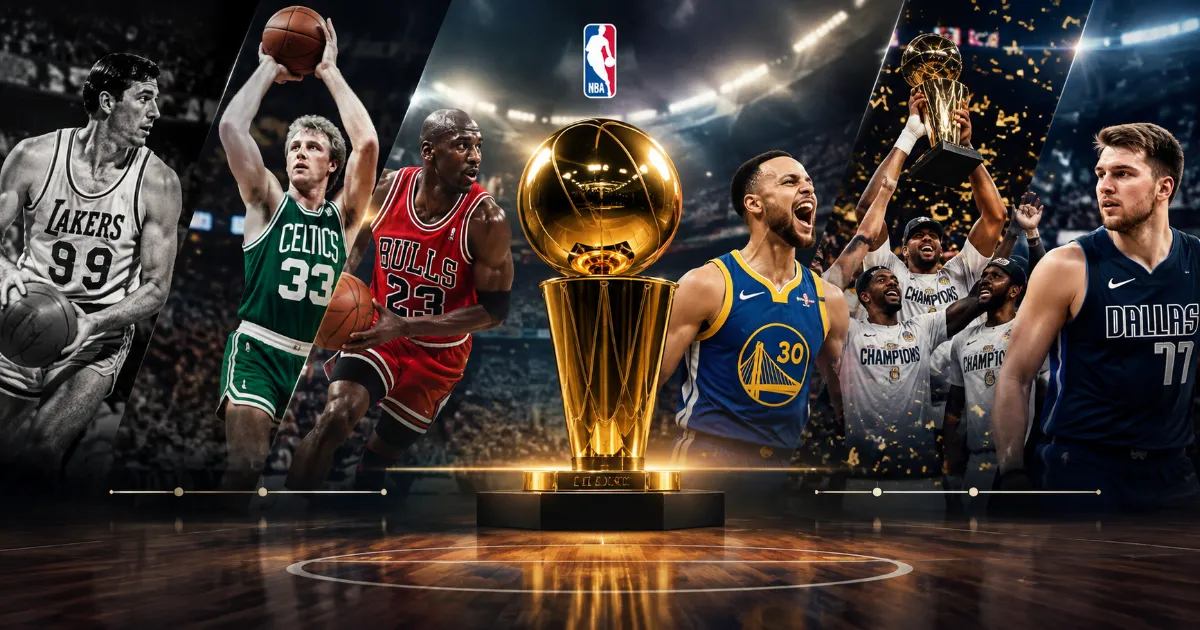
From the Minneapolis Lakers dynasty to the Knicks’ long-awaited return to glory, here’s the complete NBA championship winners list, year by year
Nearly eighty years of professional basketball history are contained within a single, ever-growing document: the complete NBA championship winners list. It’s a record that tells the story of the league itself — its earliest days as a regional curiosity split between rival leagues, its mid-century dynasties, its global expansion, and its current era of unprecedented parity, in which the last eight seasons have each crowned a different champion for the first time in league history.
Most NBA Championships by a Player — Why Bill Russell’s Record May Be Unbreakable
The Greatest NBA Players of All Time, Judged by Every Standard That Matters
Below is the full year-by-year breakdown, along with the context needed to understand how dramatically the competitive landscape behind this list has shifted across nearly eight decades of basketball.
The Complete NBA Championship Winners List
| Year | Champion | Year | Champion |
|---|---|---|---|
| 1947 | Philadelphia Warriors | 1987 | Los Angeles Lakers |
| 1948 | Baltimore Bullets | 1988 | Los Angeles Lakers |
| 1949 | Minneapolis Lakers | 1989 | Detroit Pistons |
| 1950 | Minneapolis Lakers | 1990 | Detroit Pistons |
| 1951 | Rochester Royals | 1991 | Chicago Bulls |
| 1952 | Minneapolis Lakers | 1992 | Chicago Bulls |
| 1953 | Minneapolis Lakers | 1993 | Chicago Bulls |
| 1954 | Minneapolis Lakers | 1994 | Houston Rockets |
| 1955 | Syracuse Nationals | 1995 | Houston Rockets |
| 1956 | Philadelphia Warriors | 1996 | Chicago Bulls |
| 1957 | Boston Celtics | 1997 | Chicago Bulls |
| 1958 | St. Louis Hawks | 1998 | Chicago Bulls |
| 1959 | Boston Celtics | 1999 | San Antonio Spurs |
| 1960 | Boston Celtics | 2000 | Los Angeles Lakers |
| 1961 | Boston Celtics | 2001 | Los Angeles Lakers |
| 1962 | Boston Celtics | 2002 | Los Angeles Lakers |
| 1963 | Boston Celtics | 2003 | San Antonio Spurs |
| 1964 | Boston Celtics | 2004 | Detroit Pistons |
| 1965 | Boston Celtics | 2005 | San Antonio Spurs |
| 1966 | Boston Celtics | 2006 | Miami Heat |
| 1967 | Philadelphia 76ers | 2007 | San Antonio Spurs |
| 1968 | Boston Celtics | 2008 | Boston Celtics |
| 1969 | Boston Celtics | 2009 | Los Angeles Lakers |
| 1970 | New York Knicks | 2010 | Los Angeles Lakers |
| 1971 | Milwaukee Bucks | 2011 | Dallas Mavericks |
| 1972 | Los Angeles Lakers | 2012 | Miami Heat |
| 1973 | New York Knicks | 2013 | Miami Heat |
| 1974 | Boston Celtics | 2014 | San Antonio Spurs |
| 1975 | Golden State Warriors | 2015 | Golden State Warriors |
| 1976 | Boston Celtics | 2016 | Cleveland Cavaliers |
| 1977 | Portland Trail Blazers | 2017 | Golden State Warriors |
| 1978 | Washington Bullets | 2018 | Golden State Warriors |
| 1979 | Seattle SuperSonics | 2019 | Toronto Raptors |
| 1980 | Los Angeles Lakers | 2020 | Los Angeles Lakers |
| 1981 | Boston Celtics | 2021 | Milwaukee Bucks |
| 1982 | Los Angeles Lakers | 2022 | Golden State Warriors |
| 1983 | Philadelphia 76ers | 2023 | Denver Nuggets |
| 1984 | Boston Celtics | 2024 | Boston Celtics |
| 1985 | Los Angeles Lakers | 2025 | Oklahoma City Thunder |
| 1986 | Boston Celtics | 2026 | New York Knicks |
The Early Years: 1947-1956
The earliest entries on the NBA championship winners list reflect a league still finding its footing, having formed in 1949 through a merger between the Basketball Association of America and the National Basketball League. The Minneapolis Lakers, led by dominant center George Mikan, won five championships in six seasons during this stretch, establishing the sport’s first true dynasty and demonstrating early on how a single dominant big man could anchor sustained team success in the league’s formative years.
The Celtics Dynasty: 1957-1969
No stretch on the NBA championship winners list compares to Boston’s dominance from 1957 through 1969, during which the Celtics won eleven championships in thirteen seasons, including eight consecutive titles from 1959 to 1966. Anchored by Bill Russell’s historic defensive and rebounding dominance, this run remains the single most lopsided sustained stretch of championship success in the history of American professional team sports, a mark widely considered unbreakable given the far greater competitive parity and roster turnover of the modern NBA.
The 1970s: A Decade of Parity
The 1970s produced one of the most competitively balanced stretches on the entire NBA championship winners list, with eight different franchises winning championships across the decade, including first-time winners like the Milwaukee Bucks, Portland Trail Blazers, Washington Bullets, and Seattle SuperSonics. This period reflected a league still expanding its footprint and talent distribution, without any single dynasty managing to replicate the sustained dominance the Celtics had shown in the previous decade.
The Magic-Bird Era: 1980-1989
The 1980s reintroduced dynastic dominance to the NBA championship winners list, primarily through the rivalry between Magic Johnson’s Los Angeles Lakers and Larry Bird’s Boston Celtics, who combined to win eight of the decade’s ten championships. This rivalry is widely credited with reviving the league’s national television popularity after a stretch of declining ratings in the late 1970s, setting the stage for the league’s global expansion in the decades that followed.
The Jordan Era and Its Interruptions: 1991-1998
Michael Jordan’s Chicago Bulls won six championships across two separate three-peats during the 1990s, interrupted only by Jordan’s mid-career retirement to pursue professional baseball, during which the Houston Rockets claimed back-to-back titles in 1994 and 1995. The Bulls’ dominance during this stretch remains one of the most closely studied dynasties on the entire NBA championship winners list, distinguished by a perfect Finals record across all six title runs.
The Shaq-Kobe and Spurs Rivalry: 1999-2007
The turn of the millennium produced a compelling rivalry between two very different championship models. The Los Angeles Lakers, led by Shaquille O’Neal and Kobe Bryant, won three consecutive titles from 2000 to 2002, while the San Antonio Spurs, built around Tim Duncan’s quiet consistency, won four championships across this same broader stretch, demonstrating that dominant individual talent and disciplined organizational culture could both produce sustained championship success through very different roster-building philosophies.
The Modern Parity Era: 2011-Present
Perhaps no stretch on the NBA championship winners list better illustrates the league’s current competitive landscape than the years since 2011, during which twelve different franchises have won championships, including first-time or long-awaited winners like the Toronto Raptors, Denver Nuggets, Oklahoma City Thunder, and, most recently, the New York Knicks, who claimed their first title since 1973 with a five-game Finals victory over the San Antonio Spurs in June 2026. This stretch of unprecedented parity, with eight consecutive seasons producing a different champion, reflects a combination of modern salary cap rules, expanded player movement through free agency, and a far deeper distribution of elite talent across the league than existed during any previous era.
What This List Reveals About Modern Parity
The most striking pattern in the recent NBA championship winners list is how dramatically the league’s competitive balance has shifted compared to earlier decades. Where a handful of dynasties once dominated multi-year stretches, modern salary cap restrictions, luxury tax penalties, and free agency rules designed specifically to prevent long-term roster continuity have made sustained championship dynasties increasingly difficult to build. The current run of eight consecutive unique champions, a league record, reflects just how much harder it has become for any single franchise to replicate the kind of extended dominance shown by the Celtics in the 1960s or the Lakers and Celtics combined throughout the 1980s.
Franchises With the Most Championships
Several franchises stand out clearly atop the all-time NBA championship winners list. The Boston Celtics and Los Angeles Lakers each hold the most championships in league history, tied at seventeen titles apiece, a rivalry that has anchored much of the league’s marquee history since its earliest decades. The Chicago Bulls, Golden State Warriors, and San Antonio Spurs each hold multiple championships from more concentrated championship windows, while a growing number of franchises, including the Toronto Raptors, Milwaukee Bucks, Denver Nuggets, and Oklahoma City Thunder, have claimed their first championships in recent years, reflecting the league’s broader expansion of legitimate championship contenders.
Notable Championship Droughts and Their Endings
Part of what makes the NBA championship winners list compelling reading is tracking which storied franchises endured the longest waits between titles. The New York Knicks’ 53-year gap between their 1973 and 2026 championships stands as one of the most significant droughts ever broken by an original-era franchise, surpassed in recent history only by a handful of comparably long waits. The Cleveland Cavaliers ended their own championship drought in 2016, delivering the city’s first major professional sports title in over five decades, a moment made even more significant by LeBron James’s decision to return to his home-state franchise specifically to pursue that goal. The Denver Nuggets’ 2023 championship and the Milwaukee Bucks’ 2021 title similarly represented first-ever championships for historically competitive but previously ring-less franchises, reinforcing just how meaningful a first or long-awaited title can be for a fan base that has watched the NBA championship winners list fill up with other teams’ names for decades.
How Expansion Has Shaped the List
The NBA has grown from an original group of eleven teams following its 1949 merger to thirty franchises today, and this expansion has directly shaped the shape of the NBA championship winners list over time. Newer franchises, particularly those added during the league’s major expansion waves in the 1960s, 1970s, and 1980s, have generally taken considerably longer to reach championship contention than the league’s original core group of teams, a pattern reflecting both the difficulty of building a competitive roster from scratch and the deeper overall talent pool modern expansion teams must compete against compared to the smaller, less globally scouted league of earlier decades. Some expansion-era franchises, including several created in the 1980s and 1990s, have yet to win a single championship, underscoring just how difficult sustained title contention remains even in a league with far greater roster movement than existed during the sport’s earliest decades.
Final Thoughts
The complete NBA championship winners list captures nearly eight decades of shifting basketball history, from the sport’s earliest dynasties built around dominant big men, through the golden age of the Celtics-Lakers rivalry, into the modern era’s unprecedented parity. As the New York Knicks’ long-awaited 2026 title demonstrates, even historic championship droughts can eventually end, and this list will continue growing every June as a new chapter of NBA history gets written.
Frequently Asked Questions
Which team has won the most NBA championships? The Boston Celtics and Los Angeles Lakers are tied for the most championships in league history, with seventeen titles apiece.
Who won the most recent NBA championship? The New York Knicks won the 2026 NBA championship, defeating the San Antonio Spurs four games to one, marking their first title since 1973.
How many different teams have won an NBA championship? More than twenty different franchises have won at least one NBA championship since the league’s founding in 1946, though a smaller handful of dynasties account for a significant share of the total titles awarded.
🔹 🔹 Follow us on Facebook 🔹 🔹

2 Comments