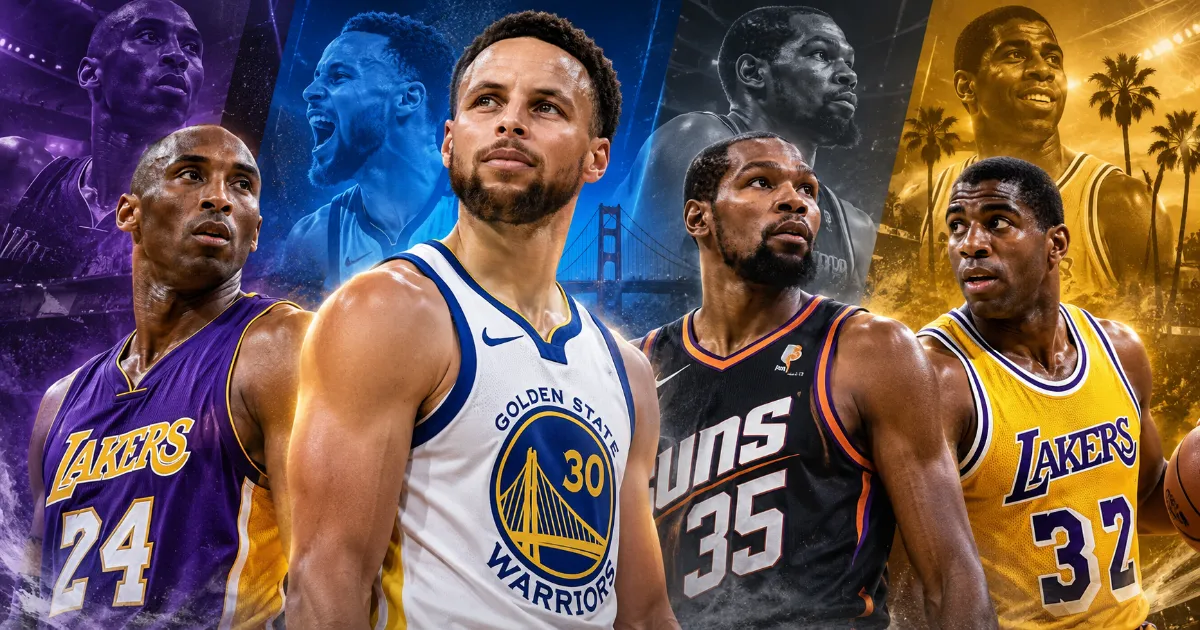
His cases against Jordan and LeBron are their own stories — here’s how Stephen Curry’s shooting revolution holds up against Kobe Bryant’s scoring artistry, Kevin Durant’s efficiency, and Magic Johnson’s Showtime legacy
Stephen Curry’s standing against Michael Jordan and LeBron James — the two comparisons that dominate most greatest-of-all-time conversations involving him — have their own dedicated space elsewhere. This piece measures him against three different legacies: Kobe Bryant’s shot-difficulty scoring philosophy, Kevin Durant’s efficiency-first approach, and Magic Johnson’s Showtime-era Lakers legacy, three comparisons that each test a different part of Curry’s own case.
Greatest Defensive Players in NFL History: Lawrence Taylor, and Then the Debate Begins
Against Kobe Bryant: Volume Shooting vs. Shot Difficulty
Few comparisons illustrate basketball’s stylistic range better than Curry against Bryant. Bryant’s offensive identity was built on shot difficulty as a feature — contested fadeaways, tightly guarded isolation jumpers, shots most shooting coaches would tell a young player to avoid. Curry’s identity is built on the nearly opposite principle: volume and range, taking shots from well beyond the three-point line at a frequency no player before him had attempted, relying on quick release and elite accuracy rather than degree of difficulty in the traditional sense.
Statistically, Curry’s career field-goal percentage sits several points higher than Bryant’s, largely because Curry’s shot selection, however unconventional in terms of distance, is actually more efficient by modern analytical standards than Bryant’s contested mid-range attempts ever were. Curry’s four championships trail Bryant’s five, and Curry has one Finals MVP to Bryant’s two, giving Bryant’s case the edge in pure team-success terms. But Curry’s stylistic influence on the sport — reshaping how every team in the league approaches spacing and shot selection — has no parallel in Bryant’s more individually contained offensive legacy.
How Advanced Metrics Treat Each Comparison Differently
Modern efficiency metrics generally treat these three comparisons very differently from how box-score totals alone would suggest. Durant’s True Shooting Percentage ranks among the best ever recorded for a high-usage scorer, a mark Curry’s own excellent efficiency numbers don’t quite match despite his shooting reputation, largely because Durant’s height allows him to convert a wider variety of shot types efficiently while Curry’s value is more heavily concentrated in one specific shot category. Bryant’s advanced efficiency numbers trail both players significantly, a direct statistical consequence of his shot-difficulty-first philosophy discussed above. Johnson’s advanced metrics remain difficult to fully compare given how much the pace and rules of his era differ from the three more contemporary players in this piece, though his assist-adjusted efficiency figures remain historically elite by any era-adjusted standard analysts have applied.
The Tactical Ripple Effect Each Player Created
Beyond individual statistics, it’s worth measuring how directly each player’s style reshaped what other teams around the league chose to do. Johnson’s Showtime system encouraged other franchises to prioritize transition-oriented, size-at-guard roster construction throughout the 1980s. Curry’s shooting volume triggered a league-wide surge in three-point attempt rates that has continued accelerating for nearly a decade since his rise, arguably the more dramatic and more thoroughly documented tactical ripple effect of any player discussed in this piece. Bryant and Durant, for all their individual brilliance, didn’t trigger comparable league-wide strategic shifts in how other franchises approached roster construction or shot selection philosophy, a distinction that matters specifically when the question being asked is about revolutionary impact rather than pure individual statistical greatness.
Against Kevin Durant: Two Forms of Modern Efficiency
This comparison sits closer than most, since both players represent different expressions of the same broader shift toward efficiency-conscious offense. Durant’s game is built on height and touch, making shots that would be difficult for most players look almost routine through sheer shooting mechanics and release point. Curry’s game is built on range and volume, making shots that were previously considered low-percentage into some of the most efficient looks in basketball simply by taking enough of them at a high enough accuracy rate.
Durant holds the edge in career field-goal percentage and True Shooting Percentage, reflecting his more traditionally efficient shot diet. Curry holds the edge in games actually altered at a tactical level — his shooting gravity forces defenses into rotations that create advantages for an entire roster, whereas Durant’s individual scoring efficiency, while historically elite, doesn’t reshape opposing defensive philosophy in quite the same systemic way. Championships sit at four to two in Curry’s favor, and his 2016 unanimous MVP award remains a level of single-season individual recognition Durant has never matched.
Against Magic Johnson: Two Different Warriors and Lakers Revolutions
This comparison is less about direct statistical overlap and more about parallel tactical revolutions three decades apart. Johnson’s Showtime Lakers reshaped the sport by proving a 6-foot-9 point guard could run an up-tempo offense built on transition scoring and playmaking vision, a genuinely unprecedented positional profile at the time. Curry’s Warriors reshaped the sport by proving a smaller guard’s three-point shooting volume could anchor an offense more efficiently than traditional interior scoring, an equally unprecedented stylistic shift for his own era.
Johnson’s five championships edge Curry’s four, and Johnson’s three regular-season MVPs match Curry’s two (one unanimous). But the two revolutions, separated by roughly three decades, share a common thread worth noting directly: both fundamentally altered what kind of skill set a winning offense could be built around, forcing the rest of the league to adapt in response rather than the other way around.
Where His Case Against Jordan and LeBron Already Stands
Curry’s direct comparisons to Michael Jordan and LeBron James are covered in full elsewhere on this site. The short version: against Jordan, Curry’s case rests on a genuine stylistic revolution against Jordan’s peak all-around dominance and perfect Finals record. Against LeBron, Curry’s case rests on shooting efficiency and tactical influence against James’s statistical completeness and unmatched longevity. Both comparisons deserve their own full read rather than a condensed summary here.
What Defenders Say About Guarding Each Player
Players who have defended Curry, Bryant, and Durant across different eras have offered a useful, informal way to compare the specific defensive problems each one poses. Defenders describe guarding Curry as a full-court exercise in constant vigilance, since his shooting range means help defense itself becomes dangerous the moment attention shifts away from him, even 30 feet from the basket. Defenders who faced Bryant in his prime describe a more physically demanding, possession-by-possession battle, given his combination of footwork and willingness to simply out-work a defender over the course of a single isolation possession. Durant’s defenders describe a different kind of difficulty entirely — his release point sits so high that contesting his jumper effectively requires a defender’s own height and length advantages that most players simply don’t have available to them. These three genuinely distinct defensive challenges reinforce how differently each player solved the same underlying problem of scoring against elite defense.
Head-to-Head Comparison Summary
| Category | Stephen Curry | Kobe Bryant | Kevin Durant | Magic Johnson |
|---|---|---|---|---|
| Championships | 4 | 5 | 2 | 5 |
| Regular-Season MVPs | 2 (1 unanimous) | 1 | 1 | 3 |
| Finals MVPs | 1 | 2 | 2 | 3 |
| Career Field-Goal % | ~47% | ~45% | ~50% | ~52% |
| Signature Statistical Trait | Three-point volume | Shot difficulty | Scoring efficiency | Playmaking vision |
Why This Specific Three-Way Pairing Matters
Testing Curry against Bryant, Durant, and Johnson rather than only against Jordan and LeBron reveals something a single comparison can’t: how his specific offensive revolution stacks up against three entirely different value propositions — shot difficulty, pure scoring efficiency, and playmaking-driven system revolution. That his case holds up reasonably well against all three, despite none of them sharing his specific skill set, suggests his shooting-based approach represents a genuinely fourth path to elite offensive impact, distinct from anything the three comparisons in this piece offer.
The Role of Supporting Casts in Each Legacy
None of these four legacies were built in isolation, and it’s worth acknowledging how much each player’s supporting roster shaped their statistical case. Curry’s championships came alongside Klay Thompson and Draymond Green, two Hall-of-Fame-caliber complementary pieces who made his shooting gravity even more devastating by punishing help defense from multiple angles simultaneously. Bryant’s championships split between an O’Neal-anchored roster and a later Gasol-supported one, meaning his individual case genuinely varies depending on which specific era is being evaluated. Durant’s two championships came alongside an already-established Curry-Thompson-Green core in Golden State, a context his critics frequently raise and his supporters frequently dismiss as irrelevant to his own individual Finals MVP-level performance in both series. Johnson’s Showtime teams featured Kareem Abdul-Jabbar for the majority of his championship run, meaning even his groundbreaking rookie-year Finals performance came before he’d fully established himself as the roster’s unquestioned offensive centerpiece.
Final Thoughts
Stephen Curry’s case as the greatest shooter ever doesn’t need to win every individual comparison to remain historically significant. Measured against Kobe Bryant’s shot-difficulty philosophy, Kevin Durant’s efficiency-first approach, and Magic Johnson’s Showtime-era system revolution, Curry’s four championships and tactical influence on the sport hold their own against three of the most decorated Lakers-and-Warriors-adjacent legacies in NBA history, even while trailing each of them in total championships.
Frequently Asked Questions
How does Stephen Curry’s shooting efficiency compare to Kevin Durant’s? Durant holds a higher career field-goal percentage overall, but Curry’s three-point volume and accuracy at that volume remain statistically unmatched by any player in NBA history, including Durant.
Did Stephen Curry and Magic Johnson ever compete against each other? No, their careers didn’t overlap — Johnson’s career ended in the mid-1990s, while Curry entered the league in 2009, meaning any comparison between them is necessarily generational rather than head-to-head.
Who has more championships, Stephen Curry or Kobe Bryant? Kobe Bryant has five championships to Stephen Curry’s four, though Curry remains active and could still add to his total.
Did Stephen Curry win a unanimous MVP award like any of these other players? Yes, Curry’s 2016 MVP award was the first unanimous selection in NBA history, a distinction none of Bryant, Durant, or Johnson achieved during their own MVP-winning seasons.
🔹🔹 Follow us on Facebook 🔹🔹
Greatest NBA Dynasties — What Made Each Era Truly Unstoppable