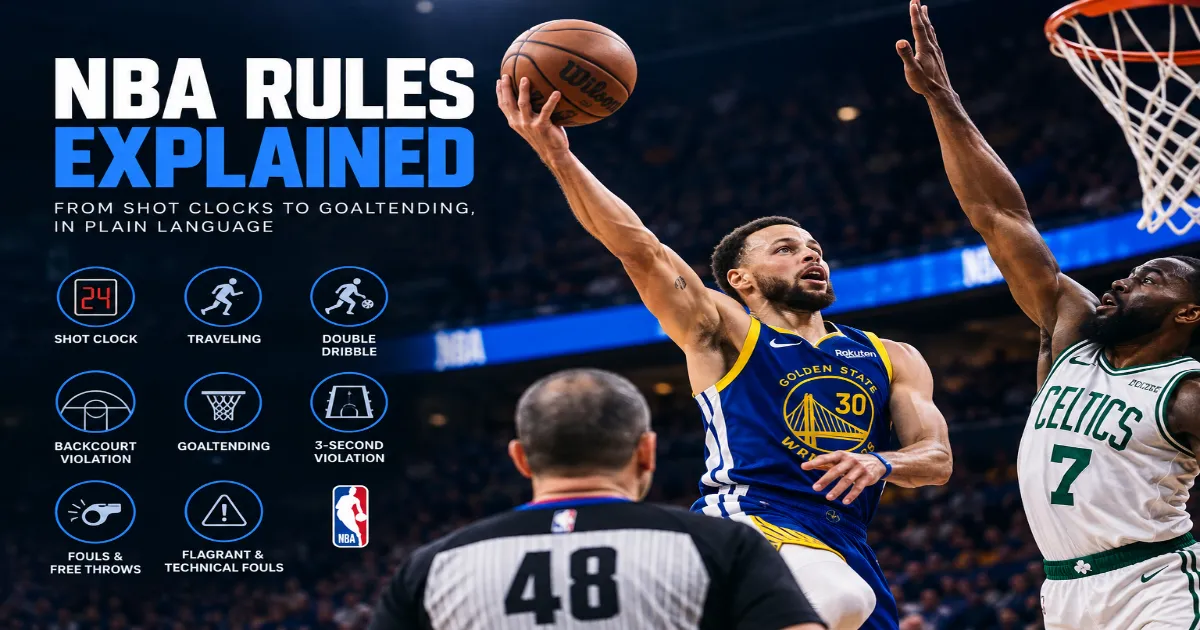
From shot clocks to goaltending to the increasingly debated foul-drawing techniques, here’s NBA rules explained in plain language for new and casual fans alike
Basketball looks simple from the outside — put the ball in the hoop more times than the other team — but the NBA’s actual rulebook contains dozens of specific regulations that shape nearly every possession, many of which go unnoticed by casual viewers until a referee’s whistle stops the action. This guide breaks down NBA rules explained in plain, accessible language, covering everything from basic gameplay structure to the more nuanced violations that often confuse newer fans.
Greatest NBA Players of the 2000s — The Stars Who Defined a Transitional Era
Most Triple-Doubles in NBA History — How Russell Westbrook Rewrote a 47-Year-Old Record
Basic Game Structure
An NBA game consists of four quarters, each twelve minutes long, for a total of 48 minutes of regulation game time, not including stoppages for fouls, timeouts, and other clock-stopping events that often extend an actual broadcast well beyond two hours. If the score remains tied after regulation, teams play a five-minute overtime period, repeated as many times as necessary until one team leads at the end of a full overtime period.
Each team fields five players on the court at a time, with substitutions allowed only during dead-ball situations such as fouls, violations, or timeouts. Teams are permitted a limited number of timeouts per game, which coaches use strategically to stop opposing scoring runs, draw up specific plays, or manage player fatigue during crucial stretches.
The Shot Clock
One of the most fundamental NBA rules explained to new fans involves the shot clock, a 24-second timer that requires the offensive team to attempt a shot that at least hits the rim before it expires. This rule, introduced in the 1954-55 season, was specifically designed to prevent teams from simply holding the ball and stalling once they had built a lead, a strategy that had made earlier-era games significantly slower and less entertaining for spectators. If the shot clock expires without a qualifying shot attempt, possession is awarded to the opposing team.
The shot clock resets to 24 seconds whenever a team gains a new possession, though it resets to only 14 seconds in specific situations, such as when the offensive team retains possession after an offensive rebound following a missed shot that hit the rim.
Common Violations
Several common violations regularly stop play throughout an NBA game, and understanding them is essential to following the sport at any level of detail.
Traveling occurs when a player holding the ball moves either foot illegally without dribbling, typically taking more than the permitted number of steps without maintaining a dribble.
Double Dribble happens when a player dribbles the ball, stops, and then begins dribbling again, or uses both hands simultaneously while dribbling in a way that violates continuous single-hand control.
Backcourt Violation occurs when the offensive team, after crossing into the frontcourt, allows the ball to cross back over the half-court line, a violation designed to prevent stalling tactics near midcourt.
Goaltending happens when a defensive player illegally blocks a shot on its downward trajectory toward the basket, or touches the ball while it’s on or above the rim, resulting in the shot being counted as made regardless of whether it would have actually gone in.
Three-Second Violation occurs when an offensive player remains in the painted key area for more than three consecutive seconds without either attempting a shot or leaving the area, a rule designed to prevent taller players from simply camping near the basket.
Personal Fouls and Free Throws
Personal fouls occur when a player makes illegal physical contact with an opponent, typically while attempting to block a shot, contest a dribble, or otherwise defend against an offensive player. Each player is allowed six personal fouls before being disqualified from the remainder of the game, a limit that becomes strategically significant late in close contests when coaches must carefully manage foul-prone players’ remaining playing time.
When a player is fouled while in the act of shooting, they’re typically awarded free throws — two if the shot attempt was a two-point attempt, or three if the shot attempt was from beyond the three-point line. If a team commits enough non-shooting fouls within a single quarter, reaching what’s known as the “penalty,” the fouled team is awarded free throws even on non-shooting fouls for the remainder of that quarter.
Flagrant Fouls and Technical Fouls
Beyond standard personal fouls, the NBA rulebook also includes more serious foul categories. A flagrant foul involves unnecessary or excessive contact, and is further categorized as Flagrant 1 or the more serious Flagrant 2, with the latter resulting in automatic ejection from the game. A technical foul can be assessed for unsportsmanlike conduct, including arguing with officials, taunting an opponent, or other rule violations unrelated to standard physical contact during gameplay, and typically results in the opposing team receiving free throws along with continued possession of the ball.
Instant Replay Review
Modern NBA games also incorporate instant replay review for specific situations, including determining whether a shot was released before the shot clock or game clock expired, reviewing potential flagrant fouls, and confirming whether a shot attempt should count as a two-point or three-point attempt based on foot placement relative to the three-point line. This system, expanded significantly over the past decade, allows officials to correct clear and obvious errors that might otherwise significantly impact a game’s outcome, though it remains a frequent subject of debate regarding how extensively replay should be used without excessively slowing down the pace of play.
The Three-Point Line and Scoring Values
Introduced in the 1979-80 season, the three-point line awards an additional point for successful shot attempts made from beyond a specific arc-shaped distance from the basket, which varies slightly at the corners compared to the top of the key. Standard shot attempts inside this line are worth two points, while free throws, awarded after certain fouls, are worth one point each. This scoring structure has become increasingly central to modern offensive strategy, as analytics departments across the league have demonstrated that three-point shots generally produce a higher expected point value per possession than long two-point jump shots.
Defensive Three-Second Rule
A specific defensive violation, distinct from the offensive three-second rule mentioned above, prohibits a defensive player from remaining in the painted key area for more than three consecutive seconds without actively guarding an offensive player within arm’s reach. This rule, introduced in the 2001-02 season, was specifically designed to prevent defenses from simply stationing a tall shot-blocking specialist under the basket at all times, encouraging more perimeter-oriented defensive schemes throughout the league.
Understanding Common Fan Confusion Points
Several NBA rules explained here regularly confuse newer fans, particularly the distinction between a common foul and a flagrant foul, or the specific circumstances under which a shooting foul results in two versus three free throws. Another frequent point of confusion involves understanding exactly how the bonus, or “penalty,” situation works, since it requires tracking cumulative team fouls within a single quarter rather than simply counting fouls across the entire game. Taking time to understand these specific mechanics significantly improves how enjoyable and comprehensible the sport becomes for newer viewers following along during live broadcasts.
How NBA Rules Differ From College and International Basketball
Understanding NBA rules explained also benefits from recognizing how they differ from other levels of the sport. College basketball in the United States uses a shorter three-point line and, until relatively recently, played two twenty-minute halves rather than four twelve-minute quarters. International basketball, governed by FIBA rules, features a shorter shot clock reset in certain situations and different foul-out thresholds compared to the NBA’s six-foul limit. These differences occasionally create adjustment periods for players transitioning between levels, particularly regarding spacing and shot selection near the different three-point line distances used across each level of competition.
Understanding Offensive Fouls and the Charge Rule
Among the more debated aspects of NBA rules explained to newer fans is the offensive foul, commonly called a “charge,” which occurs when an offensive player runs into a defender who has already established legal guarding position with both feet planted before contact occurs. This is distinguished from a “block,” where the defender was still moving into position at the moment of contact, making it a legal play by the offensive player instead. Determining whether a defender had established position in time remains one of the most frequently reviewed and debated calls in the sport, since the difference between a charge and a block often comes down to fractions of a second and can dramatically affect both the foul count and free throw opportunities in a given possession.
Timeouts, Substitutions, and Game Management
NBA teams are allotted a specific number of timeouts per game, with additional restrictions on how many can be used during the fourth quarter and overtime periods specifically, encouraging coaches to manage their strategic stoppages carefully throughout a close contest. Substitutions can only occur during dead-ball situations, meaning coaches must anticipate stoppages in play, such as fouls or violations, to make desired lineup changes rather than substituting freely during live action. This structure adds a layer of strategic timing to coaching decisions, since a coach who wants to rest a tiring star player must wait for the next natural stoppage rather than making the change immediately.
The Clear Path Foul
A more specialized rule within NBA rules explained involves the clear path foul, which occurs when a defensive player fouls an offensive player who has a clear, uncontested path to the basket during a fast-break opportunity, with no other defenders positioned between the ball handler and the rim. This specific foul results in two free throws for the fouled team along with continued possession of the ball, a more severe penalty than a standard shooting foul, since the rule is specifically designed to discourage defenses from using a tactical foul to prevent an otherwise certain transition scoring opportunity.
Player Eligibility and Roster Rules
Beyond on-court gameplay rules, the NBA also maintains specific regulations regarding player eligibility and roster construction that indirectly shape game strategy. Teams are permitted a maximum active roster size for any given game, with additional players allowed on the broader roster but inactive for specific contests due to injury, coaching decisions, or salary cap considerations. Understanding these roster mechanics helps explain why certain players might be unavailable for a given game even without a formally announced injury, since teams sometimes make strategic inactive-list decisions for reasons related to salary cap management or long-term player development rather than immediate game-day health concerns.
Final Thoughts
NBA rules explained in full reveal a sport with far more procedural nuance than casual viewers typically appreciate, from the strategic implications of the shot clock and bonus situations to the more technical violations like goaltending and defensive three-second calls. Understanding these rules doesn’t just make watching NBA games less confusing — it reveals the strategic depth behind decisions coaches and players make throughout every single possession, transforming casual viewing into a much richer appreciation of the sport’s genuine tactical complexity.
Frequently Asked Questions
How long is an NBA shot clock? The NBA shot clock is 24 seconds, requiring the offensive team to attempt a shot that hits the rim before it expires, or possession is turned over to the opposing team.
How many personal fouls can a player have before fouling out? A player is disqualified from the remainder of the game after committing six personal fouls.
What is the difference between a flagrant foul and a technical foul? A flagrant foul involves unnecessary or excessive physical contact during gameplay, while a technical foul is typically assessed for unsportsmanlike conduct unrelated to physical contact, such as arguing with officials or taunting an opponent.
🔹🔹 Follow us on Facebook 🔹🔹
Maya Bennett — Athlete News Editor
Maya Bennett serves as GridironHoops’ Athlete News Editor, overseeing coverage centered on the athletes themselves — their performances, milestones, career developments, major announcements and stories away from the traditional game-day cycle.
Her coverage crosses sports and leagues, allowing GridironHoops to follow the biggest names in basketball, football, motorsports, swimming, athletics and other major sports. Maya focuses on presenting athlete-related news with context and clarity while keeping the reporting centered on information that matters to sports fans.
She also works across the editorial team to identify important athlete stories and ensure that major developments receive consistent coverage regardless of the sport involved.
Coverage: Athlete news, player developments, career milestones, major announcements and cross-sport stories.


One Comment