Most Interceptions in NFL History: Paul Krause’s Record and the Golden Age That Produced It
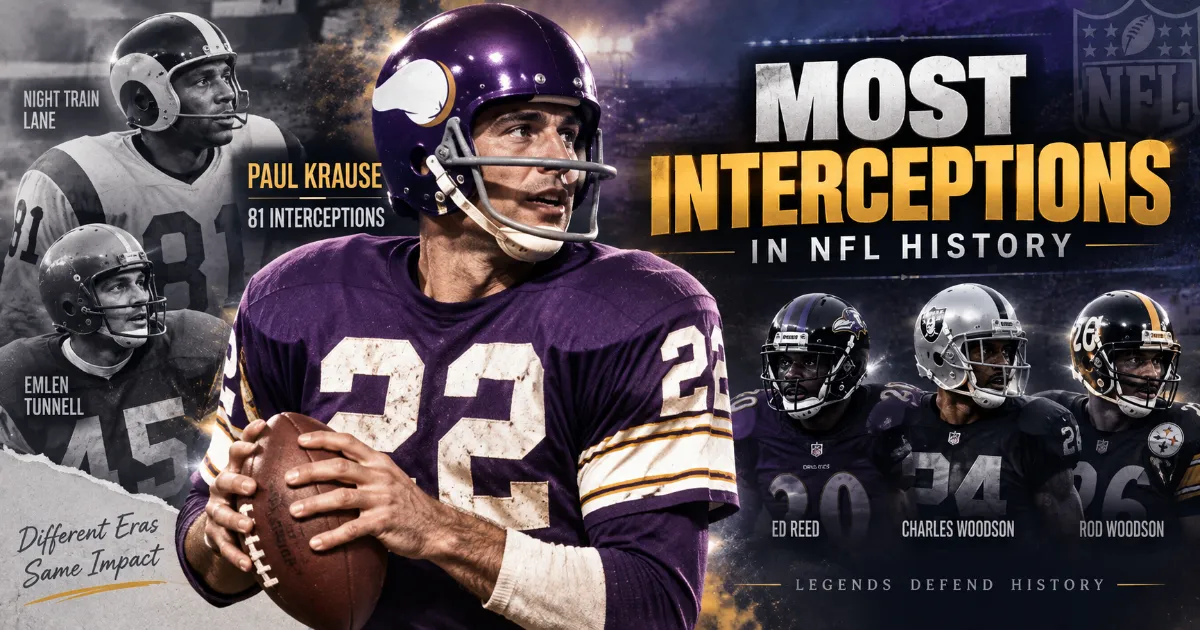
Ask a casual fan who holds the NFL’s career interceptions record and you’ll get guesses like Deion Sanders, Ed Reed, or Charles Woodson — three of the most recognizable ball-hawks the league has produced. The actual answer is Paul Krause, a Minnesota Vikings safety whose 81 career interceptions have stood as the record since 1979. Nearly half a century later, no one has come particularly close.
This list is one of the NFL’s most stable records, and understanding why says as much about how the sport has changed as it does about the players themselves.
NFL Overtime Rules Explained (2025 Update): How It Really Works
Most Rebounds in NBA History — Why Wilt Chamberlain’s Record Still Stands
The Official Record: Paul Krause, 81 Interceptions
Paul Krause played 16 seasons, four with the Washington Redskins (1964–1967) and twelve with the Minnesota Vikings (1968–1979), finishing his career with 81 interceptions. He was named to the Pro Football Hall of Fame in 1998, and his record has now stood for more than 45 years without a serious challenger. Krause built his total the way most great ball-hawks did in that era: he played free safety in a defense that trusted him to read quarterbacks, took chances on jumping routes, and rarely missed an opportunity when the ball was in the air. He intercepted at least one pass in seven consecutive games at one point in his career and remained productive into his late 30s, which is part of what allowed him to accumulate a total that still leads the league.
The Full Career Interceptions Leaderboard
Based on records the NFL and Pro Football Reference recognize going back to 1940, the top of the all-time list looks like this:
- Paul Krause — 81 (Redskins, Vikings, 1964–1979)
- Emlen Tunnell — 79 (Giants, Packers, 1948–1961)
- Rod Woodson — 71 (Steelers, 49ers, Ravens, Raiders, 1987–2003)
- Dick “Night Train” Lane — 68 (Rams, Cardinals, Lions, 1952–1965)
- Ken Riley — 65 (Bengals, 1969–1983)
- Charles Woodson — 65 (Raiders, Packers, 1998–2015)
- Ed Reed — 64 (Ravens, Texans, Jets, 2002–2013)
- Ronnie Lott — 63 (49ers, Raiders, Jets, 1981–1994)
- Darren Sharper — 63 (Packers, Vikings, Saints, 1997–2010)
- Dave Brown — 62 (Steelers, Seahawks, Packers, 1975–1989)
- Dick LeBeau — 62 (Lions, 1959–1972)
Every player in that top ten is either already in the Pro Football Hall of Fame or, in Sharper’s case, a candidate whose case is complicated by matters unrelated to his on-field production. That alone tells you something about how much career interceptions correlate with a Hall of Fame résumé — it’s one of the clearest statistical gateways into Canton for a defensive back.
Why This Record Is So Hard to Break
Interceptions have become significantly rarer over the decades, and the drop-off is well documented. The interception rate on pass attempts league-wide has fallen sharply since the early 1970s, when it sat above 5%, to well under 3% in recent seasons. Several forces are behind that decline: quarterbacks are coached more precisely, offenses use shorter, higher-percentage passing concepts, defensive backs are penalized more strictly for contact that used to be legal, and coaches at every level emphasize protecting the football far more than they did in Krause’s or Lane’s era.
That combination makes multi-interception seasons less common than they used to be, and it makes compiling a career total north of 60 or 70 picks increasingly rare. As of the 2026 season, no active player has even reached 40 career interceptions — less than half of Krause’s total — which underscores how far the modern game has moved from the conditions that produced the all-time leaderboard. The active list is populated by very good defensive backs having strong careers, but none are within realistic range of the top ten, let alone the record.
The Single-Season Record: Night Train Lane’s Rookie Year
While Krause holds the career mark, the single-season record belongs to Dick “Night Train” Lane, who intercepted 14 passes as a rookie with the Los Angeles Rams in 1952 — in a 12-game season. That works out to more than an interception per game, an almost unthinkable rate by modern standards, and it has stood since before the merger with the AFL. Lane’s rookie total remains the single most dominant defensive season in the category’s history, and it’s part of why he’s remembered as one of the most feared defensive backs the game has ever seen despite playing in an era with far less statistical documentation than today’s game.
A Note on Terminology: Interceptions Made vs. Interceptions Thrown
One source of confusion worth clearing up: “most interceptions in NFL history” almost always refers to interceptions a defensive player has made — the list Paul Krause tops. There’s a separate, unrelated record for interceptions thrown by a quarterback, which belongs to Brett Favre, who threw 336 over his career. Favre’s total reflects a 20-year career built on aggressive, high-volume passing rather than poor quarterback play by the standards of his era; several other prolific passers, including George Blanda and Fran Tarkenton, also rank near the top of that separate list. The two records measure completely different things, and mixing them up is one of the most common mistakes in football trivia.
Why the Top of the List Is Dominated by an Earlier Generation
Look closely at the all-time top ten and a pattern emerges: outside of Charles Woodson, Ed Reed, and Darren Sharper, the list is heavily populated by players from the 1950s through the 1980s. That’s not a coincidence. Several factors from that era combined to inflate interception totals compared to today:
Defensive backs in the 1950s and 1960s were allowed far more physical contact with receivers down the field, which made it easier to disrupt timing and create turnovers. Passing offenses were also less sophisticated, with fewer of the quick, high-percentage concepts that dominate today’s game, meaning quarterbacks threw into more contested coverage more often. And because the position group simply intercepted more passes across the league, defensive backs of that generation had more raw opportunities to compile large career totals, even before accounting for individual skill.
That’s part of why modern defensive backs like Woodson, Reed, and Sharper stand out so much for reaching the mid-60s in a passing environment that actively worked against high interception totals. Reed in particular is remembered as one of the most instinctive free safeties ever, someone whose ability to read quarterbacks pre-snap allowed him to keep pace with players from a very different statistical era.
The Bottom Line
Paul Krause’s 81 career interceptions have survived nearly five decades of rule changes, offensive evolution, and generational defensive talent, and the gap between his total and the modern game’s best active defenders continues to widen rather than close. Barring a dramatic shift back toward a more turnover-friendly passing environment, Krause’s record looks likely to remain one of the NFL’s most secure statistical marks for the foreseeable future.



One Comment