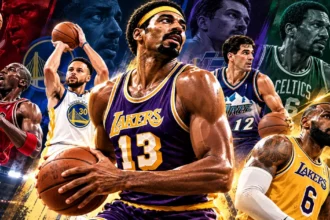
Wilt Chamberlain still holds the top spot decades later, but the era he compiled it in matters as much as the number itself
Rebounding records occupy a strange position in NBA history — dominated almost entirely by a handful of centers from the 1960s whose numbers remain so far ahead of every modern player that direct comparison requires serious era-adjustment. This is the full breakdown of the all-time rebounding leaders, and an honest look at why this specific record book looks so different from most others.
Career Rebounding Leaders
| Rank | Player | Career Rebounds | Seasons |
|---|---|---|---|
| 1 | Wilt Chamberlain | 23,924 | 14 |
| 2 | Bill Russell | 21,620 | 13 |
| 3 | Kareem Abdul-Jabbar | 17,440 | 20 |
| 4 | Elvin Hayes | 16,279 | 16 |
| 5 | Moses Malone | 16,212 | 21 |
| 6 | Tim Duncan | 15,091 | 19 |
| 7 | Karl Malone | 14,968 | 19 |
Chamberlain and Russell, the two players most closely associated with each other’s careers given their rivalry throughout the 1960s, hold the top two spots by a significant margin over every player who followed them, including several genuine rebounding specialists from more recent eras.
Why the Top of This List Looks So Different From Other Records
Unlike the career scoring or assist leaderboards, which include a healthy mix of players from multiple decades, the top of the rebounding list is dominated almost entirely by centers who played in the 1960s and 1970s. This reflects a combination of factors specific to rebounding as a statistical category: the league’s pace was dramatically faster during that era, producing significantly more total shot attempts and therefore more rebounding opportunities per game than the modern league generates. Chamberlain and Russell also played an unusual volume of minutes per game, further inflating their rebounding opportunities relative to modern players who typically rest more across a season.
The Chamberlain-Russell Rivalry, Statistically Measured
No discussion of NBA rebounding records is complete without addressing the direct statistical rivalry between Chamberlain and Russell, who faced each other regularly throughout the 1960s as the league’s two dominant centers. Despite Chamberlain holding the higher career and single-season rebounding totals, Russell’s Boston Celtics won the head-to-head championship battle overwhelmingly, with Russell’s team-oriented rebounding and defensive positioning proving more valuable to sustained team success than Chamberlain’s individually dominant statistical totals. This dynamic — Chamberlain’s superior individual numbers against Russell’s superior team results — remains one of the most frequently cited examples in basketball history of how individual statistical dominance doesn’t automatically translate into greater team success.
How Rule Changes Have Reduced Rebounding Opportunities
Beyond pace differences, specific rule changes since Chamberlain and Russell’s era have gradually reduced the total number of rebounding opportunities available in a typical NBA game. The introduction of the three-point line in 1979 changed shot selection patterns in ways that affected rebound positioning and long-rebound frequency. The defensive three-second rule, introduced in 2001-02, further discouraged the kind of paint-camping interior positioning that had once allowed dominant centers to control rebounding position more easily. These cumulative rule changes mean that even a hypothetically identical rebounding talent playing in the modern league would likely produce meaningfully lower raw totals than Chamberlain or Russell managed in their own competitive environment.
Single-Season Rebounding Records
| Rank | Player | Season | Rebounds Per Game |
|---|---|---|---|
| 1 | Wilt Chamberlain | 1960-61 | 27.2 |
| 2 | Wilt Chamberlain | 1961-62 | 25.7 |
| 3 | Bill Russell | 1963-64 | 24.7 |
| 4 | Wilt Chamberlain | 1959-60 | 23.6 |
Chamberlain’s single-season rebounding peak of 27.2 rebounds per game remains so far beyond any modern equivalent that no player since has approached even 20 rebounds per game across a full season, a gap that has only widened as the league’s pace and shot-attempt volume have declined from that specific era’s peak.
Elvin Hayes and Moses Malone: The Overlooked Statistical Bridge
Elvin Hayes and Moses Malone occupy an important, often overlooked statistical position between the 1960s rebounding giants and the more modern game. Both played primarily in the 1970s and early 1980s, a period with somewhat reduced pace compared to Chamberlain and Russell’s peak years but still considerably faster than the modern league. Malone’s particular specialty was offensive rebounding, using relentless positioning and second-effort put-backs to become one of the most dominant offensive rebounders the sport has ever produced, a skill that directly contributed to his three regular-season MVP awards and a championship with Philadelphia. Hayes’s more balanced offensive-defensive rebounding profile helped him accumulate the fourth-highest career total in league history despite receiving considerably less mainstream historical attention than many of the other names on this list.
Karl Malone’s Case as a Modern-Era Rebounder
Karl Malone’s presence among the career rebounding leaders reflects a different kind of achievement than the pace-driven totals compiled by earlier era centers. Playing primarily as a power forward rather than a traditional center, and competing largely within the more physically demanding, slower-paced late 1980s through early 2000s NBA, Malone’s rebounding total reflects nineteen seasons of remarkably consistent per-game production rather than the benefit of an unusually fast-paced statistical environment. His case is frequently cited as the strongest longevity-driven rebounding total achieved primarily within a recognizably modern competitive era.
Modern Rebounding Leaders in Proper Context
Among more recent players, Dennis Rodman stands out as the clearest modern rebounding specialist, winning seven consecutive rebounding titles during the 1990s despite standing shorter than most centers he competed against for boards. His per-game rebounding average during his peak seasons ranks among the best of any player from the modern era, even though his career total rebounds fall well short of the 1960s-era leaders simply due to a shorter career and fewer minutes played per game relative to Chamberlain and Russell.
Tim Duncan’s presence in the top ten reflects a different kind of rebounding excellence — sustained, consistent production across nineteen seasons rather than a single dominant peak, anchoring the San Antonio Spurs’ defensive rebounding for the better part of two decades.
Offensive vs. Defensive Rebounding Splits
Modern statistical tracking allows for a more granular breakdown between offensive and defensive rebounds that wasn’t consistently recorded during Chamberlain and Russell’s careers. Among players with complete tracking data, Dennis Rodman’s offensive rebounding rate remains one of the highest ever recorded relative to his own team’s total missed shots, reflecting a genuinely elite individual skill at anticipating rebound positioning rather than simply benefiting from playing extensive minutes.
How Advanced Rebounding Metrics Adjust for Era
Modern analytics have developed rebounding rate statistics, such as total rebound percentage, that attempt to measure a player’s rebounding relative to all available rebounds during their time on the floor rather than raw per-game totals. These rate-adjusted metrics narrow the gap between Chamberlain’s era and modern specialists like Rodman somewhat, since they account for the reduced number of total available rebounds in today’s slower-paced, more efficient-shooting league. Even after this adjustment, however, Chamberlain’s rebounding rate during his peak seasons remains statistically extreme by any measure, reinforcing that his dominance wasn’t purely a product of playing more minutes in a faster league, but reflected genuine individual rebounding ability that modern rate statistics still struggle to fully contextualize against any other player in league history.
Rebounding by Position: A Statistical Breakdown
The career rebounding list also reveals an interesting positional pattern worth noting. Every name in the top seven played center or power forward, reflecting how thoroughly rebounding has historically remained the domain of interior players rather than guards or wings, even as other statistical categories like assists and three-pointers have increasingly seen positional boundaries blur in the modern game. This positional concentration stands in contrast to the career scoring average list, which skews more heavily toward wing players, underscoring that rebounding remains one of the few major statistical categories where traditional positional specialization has persisted largely unchanged across the sport’s entire history.
Final Thoughts
Most rebounds in NBA history remains a record book dominated by a specific era’s pace and playing-time conditions as much as by individual talent, with Wilt Chamberlain and Bill Russell’s totals reflecting both genuine generational rebounding ability and a competitive environment that produced far more rebounding opportunities than exists in the modern league. Dennis Rodman’s more recent rebounding specialization and Tim Duncan’s sustained two-decade production offer useful modern context, even as neither approaches the career totals compiled during basketball’s fastest-paced era.
Frequently Asked Questions
Who holds the NBA record for most career rebounds? Wilt Chamberlain, with 23,924 career rebounds across fourteen seasons, a total that remains well ahead of every other player in league history.
Why do 1960s-era players dominate the rebounding record book so completely? The league played at a dramatically faster pace during that era, producing significantly more shot attempts and rebounding opportunities per game, and both Chamberlain and Bill Russell also played an unusually high volume of minutes per game.
Who is considered the best modern-era rebounder? Dennis Rodman is most frequently cited, having won seven consecutive rebounding titles during the 1990s despite being undersized relative to most centers he competed against.
Is any active player likely to threaten the top of the career rebounding list? No active player is on a realistic pace to approach Chamberlain’s or Russell’s career totals, given the combination of reduced league-wide pace, defensive rule changes, and shorter average minutes played that define the modern game compared to the 1960s.
🔹🔹 Follow us on Facebook 🔹🔹