NFL Overtime Rules Explained: How the Game Really Ends When Regulation Isn’t Enough
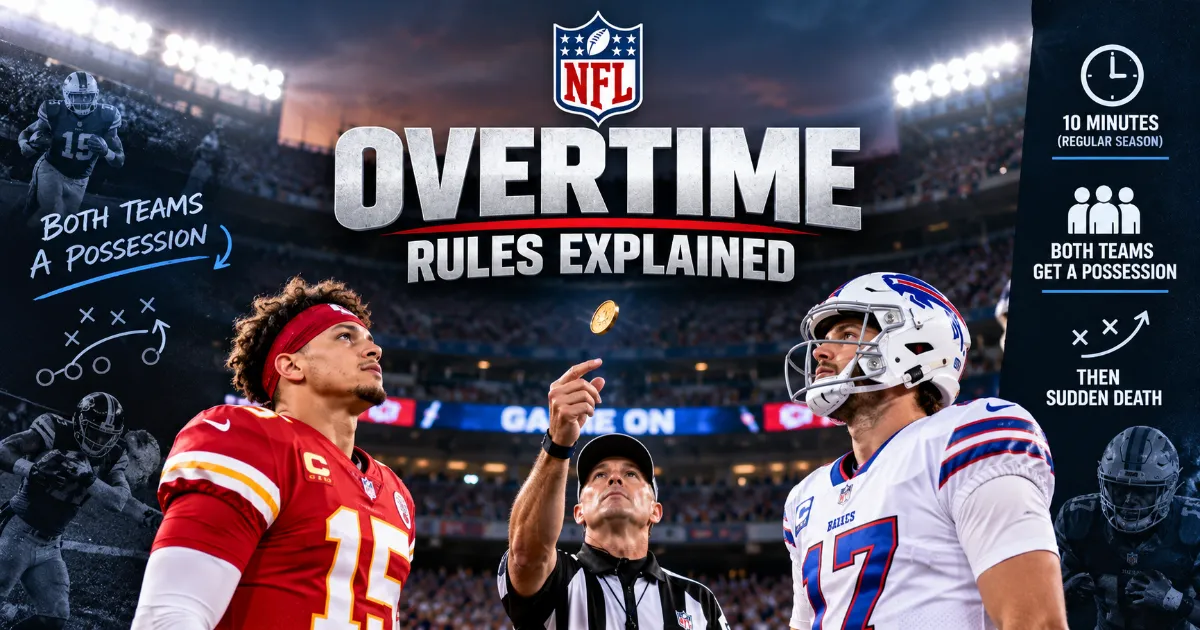
Overtime has decided some of the most memorable games in NFL history, and for just as long, it has been a source of argument. For decades, the complaint was simple: win the coin toss, drive for a touchdown, and the other team’s offense never gets on the field. That complaint finally reshaped the rulebook. Starting with the 2025 season, the NFL overtime rules guarantee both teams a possession in overtime — not just in the playoffs, where that change began in 2022, but in every regular-season game as well.
Understanding how NFL overtime works now means understanding both the current rule and the long, occasionally messy history that led to it. This piece breaks down the mechanics teams actually follow when a game is tied after 60 minutes, how the regular season and postseason differ, and why the league kept revisiting a rule it once considered settled.
How NFL Overtime Works Today
When regulation ends in a tie, the two teams don’t go straight to sudden death anymore. Instead, the format works like this:
A coin toss determines which team gets the choice — traditionally the option to receive, defend a particular end zone, or kick. The visiting team’s captain calls the toss. The team that wins can choose to receive the ball, but under the current rules a team can also choose to kick, which effectively hands the opponent the first possession while guaranteeing the choosing team gets the ball second, with full knowledge of what it needs to do to tie or win.
From there, both teams are guaranteed a possession, regardless of what happens on the first one. If the team that receives the opening kickoff scores a touchdown, the game does not end. The opposing team gets the ball back with a chance to answer — tie the game with a matching touchdown and extra point, force overtime to continue with a field goal, or win outright with a touchdown and a two-point conversion.
Once both teams have had a possession, the game reverts to standard sudden death: the next score of any kind — touchdown, field goal, or safety — ends it. If neither team has scored, or if the score remains tied after both possessions, sudden death rules also apply immediately.
The Basics: Length, Timeouts and the Clock
Regular-season overtime is a single 10-minute period. That length has been in place since 2017, when the league trimmed it down from the 15-minute period that had been standard since sudden death overtime was introduced in 1974. Each team gets two timeouts for the period, the same as a normal quarter. At the five-minute mark of overtime, fourth-quarter timing rules kick in — meaning the clock stops on more penalties, even declined ones — and there is a two-minute warning as regulation play would have.
Crucially, the 10-minute clock is a hard cap in the regular season. If time expires while a second possession is still in progress, the game ends immediately with the score as it stands, even if that means the team that never got a fair chance to finish its drive loses. If the score is still level when the 10 minutes run out, the game is recorded as a tie — an outcome that still happens a handful of times most seasons.
Regular Season vs. Playoff Overtime: The Key Differences
This is where a lot of confusion sets in, because the two formats aren’t identical.
In the regular season, a tie is an acceptable final result. A single 10-minute overtime period is played, and if nobody has won by the end of it, the game simply ends tied. The postseason cannot end in a tie — the NFL has to produce a winner to advance in the bracket. So while playoff overtime follows the same “both teams get a possession” principle introduced for the postseason in 2022, if the period ends deadlocked, the teams play another full overtime period. This can theoretically repeat multiple times, though in practice it rarely goes beyond a second period.
Another subtle difference: the guaranteed-possession rule was the postseason’s first, introduced in 2022 after a series of high-profile games ended before the losing offense ever touched the ball. It only reached the regular season three years later, in 2025, when NFL owners voted at the league’s Annual League Meeting to align the two rulebooks. Before that vote, regular-season overtime had used a different, older compromise rule dating back to 2012.
A Brief History of NFL Overtime Rules
Overtime in the NFL has changed more times than most fans realize.
1974 — Sudden death introduced. Before this, regular-season games that were tied after 60 minutes simply ended in a tie. Starting in 1974, a 15-minute sudden-death period was added: first team to score, by any means, won.
2010 — Modified sudden death for the playoffs. After several postseason games ended on an opening-drive field goal without the other team’s offense taking the field, the league changed the playoff rule so that a field goal on the first possession no longer automatically ended the game. Only a touchdown on the opening drive would end things immediately; a field goal meant the other team got a chance to answer.
2012 — Same modification extended to the regular season. What began as a playoff-only rule became standard across the entire league.
2017 — Overtime shortened. The 15-minute period was reduced to 10 minutes, partly out of concern for player safety and additional wear on rosters late in games.
2022 — Guaranteed possessions in the playoffs. Following a run of postseason games — most notably an AFC Divisional Round shootout between the Kansas City Chiefs and Buffalo Bills that ended in overtime without Buffalo’s offense getting a snap — the league went further for the postseason. Now, both teams are guaranteed a possession in the playoffs no matter how the first one ends, even with a touchdown.
2025 — The same guarantee extended to the regular season. NFL owners approved a proposal, championed in part by the Philadelphia Eagles, to align regular-season overtime with the playoff standard. The core mechanics of a first-possession touchdown no longer instantly ending the game now apply to every NFL game, not just the postseason.
Why the League Kept Changing the Rule
The throughline across every change is the same complaint: the team that wins the coin toss has too much control over the outcome. Statistically, teams that won the coin toss and elected to receive historically won overtime games at a rate well above 50%, and a first-drive touchdown ended the discussion entirely. Coaches, players and fans argued for years that a defense should at least get the opportunity to make a stop, and an offense should get the opportunity to answer, before the game is decided.
The 2022 playoff change is widely tied to that AFC Divisional Round classic between Kansas City and Buffalo, a game so competitive and so evenly played that a coin toss effectively determining the winner felt indefensible to a large share of the league’s ownership. Three years later, with no controversy suggesting otherwise, the same logic was applied to the regular season.
Common Overtime Scenarios, Explained
A few situations trip fans up more than others:
First team scores a touchdown. The game does not end. The scoring team attempts its extra point or two-point conversion, then kicks off. The second team now knows exactly what it needs — a touchdown to win, a touchdown plus two-point conversion to win outright if the first team only kicked the extra point, or a field goal to force the game into standard sudden death.
First team scores a field goal. The second team gets the ball. A matching field goal sends the game to sudden death; a touchdown wins it outright; no score at all means the first team’s field goal stands and they win once the second possession ends without a score.
A turnover on the first possession. If the first team fails to score and loses the ball, the game immediately shifts into standard sudden death — the next score of any kind wins, because both teams have technically had their opportunity to possess.
A safety. A safety immediately ends the game in the safety-scoring team’s favor, since it’s a score, with one narrow exception involving a botched conversion attempt that produces a one-point safety.
Defensive touchdown. A pick-six or fumble return for a touchdown ends the game instantly, regardless of which possession it happens on.
Overtime Strategy: The Coin Toss Decision
Under the current rules, winning the coin toss is no longer the decisive advantage it once was, but it still matters. A team that wins the toss and wants to receive the ball first can do so, betting on its offense to set the tone. But there’s a case for the opposite: electing to kick guarantees a team the second possession, meaning its offense will know exactly what’s required — score a touchdown to win, match a field goal to continue, or attempt a two-point conversion to walk it off. That informational advantage is real, and some coaches now treat “defer” thinking — even though the rule doesn’t technically use that terminology in overtime — as the smarter percentage play.
What Happens If Nobody Scores?
If both teams punt, turn the ball over without scoring, or otherwise fail to find the end zone or a field goal by the time the 10-minute regular-season clock expires, the result is recorded as a tie. Ties count as half a win and half a loss in the standings for both teams — a quirk that occasionally matters in close playoff-seeding races. In the postseason, this scenario simply triggers another overtime period, since the league cannot advance a tied outcome into the bracket.
The Bottom Line
The NFL’s current overtime rules — a single 10-minute period in the regular season, guaranteed possessions for both teams, and an open-ended format in the playoffs that continues until a winner emerges — represent the league’s clearest attempt yet to remove pure luck from extra-time outcomes. It took more than a decade of incremental tweaks, from the 2010 playoff fix to the 2025 regular-season alignment, to get there. Whether it’s the final answer or simply the next stop in an ongoing conversation depends on how the next controversial coin toss plays out.
🔹🔹 Follow us on Facebook 🔹🔹





One Comment