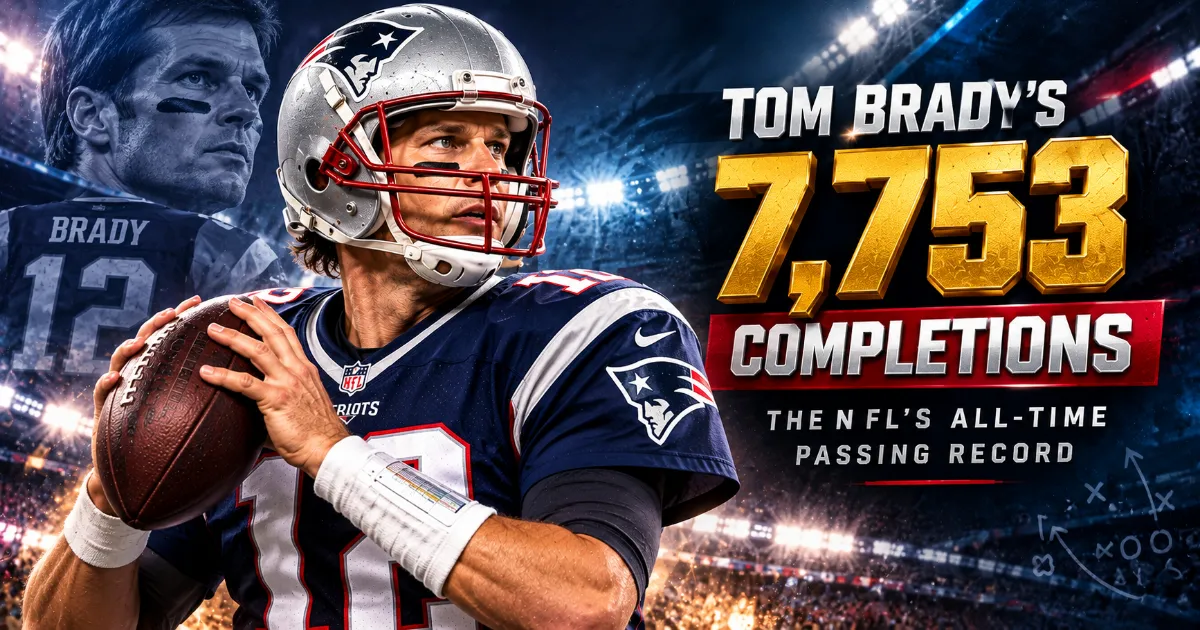
Tom Brady’s 7,753 completions top the Most Passing Completions in NFL History leaderboard, highlighting the longevity and consistency behind his record-setting career.
Tom Brady’s career is filled with records that reflect his longevity, consistency and ability to remain productive at the highest level of professional football. Among those achievements, his career passing completions total stands out as a measure of just how frequently he connected with receivers throughout his remarkable NFL journey. Brady finished his career with 7,753 completions, the most by any quarterback in NFL history.
Passing completions are an important statistic because they combine opportunity with execution. A quarterback must attempt a pass, find an open receiver and deliver the ball accurately enough for the play to count as a completion. While completion totals do not tell the entire story of a quarterback’s performance, they provide a useful way to measure sustained passing production over an entire career.
Most Successful NFL Teams of All Time: Packers Lead With 13 Titles
Biggest NFL Contracts Ever: Mahomes’ $450M Deal Still Leads
Brady’s record also highlights the importance of durability. He played 23 NFL seasons, started hundreds of games and remained a central part of his team’s offense well into his 40s. Drew Brees, Brett Favre and Peyton Manning also accumulated thousands of completions during long careers, but none reached Brady’s final total.
Tom Brady Holds the NFL Career Completions Record
Tom Brady completed 7,753 passes during his NFL career, establishing the all-time record for career passing completions. He recorded those completions while playing for the New England Patriots and Tampa Bay Buccaneers between the 2000 and 2022 seasons.
Brady’s career passing numbers demonstrate the scale of his production. He attempted 12,050 passes and completed approximately 64.3% of them. That percentage was not the highest among the leading quarterbacks on this list, but his combination of accuracy, passing volume and longevity allowed him to build a total that few players have approached.
His career also included extended periods of offensive stability. Brady spent the majority of his career in New England, where he worked with head coach Bill Belichick and played in a system that regularly relied on his decision-making. After leaving the Patriots, he joined Tampa Bay in 2020 and continued producing at a high level.
Brady’s final NFL season came in 2022. By that point, he had established himself as the career leader in several major passing categories, including completions and attempts. His record illustrates why counting statistics often reward quarterbacks who remain effective starters over an unusually long period.
Most Passing Completions in NFL History: All-Time Leaderboard
The following table lists the leading quarterbacks by career passing completions, using the totals in the supplied leaderboard. Active-player totals can change as additional games are played, so those figures should be checked against updated NFL statistics before publication.
Rank | Quarterback | Career completions |
|---|---|---|
1 | Tom Brady | 7,753 |
2 | Drew Brees | 7,142 |
3 | Brett Favre | 6,300 |
4 | Peyton Manning | 6,125 |
5 | Aaron Rodgers | 5,743 |
6 | Matthew Stafford | 5,577 |
7 | Matt Ryan | 5,551 |
8 | Ben Roethlisberger | 5,440 |
Brady leads the table by 611 completions over Brees, his closest competitor. That difference is substantial, particularly when considering that reaching the top of this leaderboard requires thousands of successful passes accumulated over many seasons.
Brees and Favre are the other two quarterbacks on the list who finished their careers with more than 6,000 completions. Manning also surpassed that mark, while Rodgers, Stafford, Ryan and Roethlisberger established their places among the most productive passers in league history.
The order of active quarterbacks may change as their careers progress. Unlike retired players, their totals are not final, making it important to distinguish between completed career statistics and ongoing records.
Drew Brees: The Closest Challenger to Brady
Drew Brees finished his NFL career with 7,142 passing completions, placing him second behind Brady. His total is particularly impressive because he combined high passing volume with a career completion percentage of approximately 67.7%.
Brees played for the San Diego Chargers and New Orleans Saints during a career that extended from 2001 through 2020. Although he began his career in San Diego, his most productive years came in New Orleans, where head coach Sean Payton built an offense that made extensive use of Brees’ accuracy and quick decision-making.
The Saints frequently relied on short and intermediate passes, allowing Brees to distribute the football to a wide range of receivers. His ability to read defenses and release the ball quickly helped him maintain a high completion rate while accumulating substantial passing totals.
Brees’ completion percentage is higher than Brady’s career figure of approximately 64.3%. That difference illustrates why completion totals and completion percentages should not be treated as interchangeable statistics.
Brady completed more passes overall because he accumulated more attempts across a longer career. Brees, meanwhile, completed a larger proportion of his passes. Both achievements are significant, but they measure different aspects of quarterback performance.
The gap of 611 completions between them also provides a useful perspective on Brady’s record. Brees had one of the most productive passing careers in NFL history, yet he still finished several hundred completions short of the all-time mark.
Brett Favre’s Longevity and Passing Production
Brett Favre ranks third with 6,300 career completions. His NFL career began with the Atlanta Falcons in 1991 and included long stretches with the Green Bay Packers, followed by seasons with the New York Jets and Minnesota Vikings.
Favre became one of the defining quarterbacks of his generation. He won three consecutive NFL Most Valuable Player awards from 1995 through 1997 and helped Green Bay win Super Bowl XXXI.
His passing totals reflect an unusually long career. Favre continued playing into the 2010 season, giving him nearly two decades to accumulate completions. His willingness to throw the ball frequently contributed to his high career totals, although it also meant that interceptions were a prominent part of his statistical record.
Favre’s career is an example of how longevity can influence passing leaderboards. A quarterback does not need to lead the league in completion percentage every season to finish near the top of the career rankings. Remaining a starter and consistently receiving opportunities to pass can be just as important.
His total of 6,300 completions placed him behind Brady and Brees, but comfortably ahead of many other accomplished quarterbacks.
Peyton Manning’s Place Among the All-Time Leaders
Peyton Manning finished his career with 6,125 passing completions, ranking fourth in the supplied leaderboard. He played for the Indianapolis Colts and Denver Broncos between 1998 and 2015.
Manning was known for his pre-snap adjustments, detailed understanding of defensive formations and ability to change plays at the line of scrimmage. Rather than relying exclusively on physical ability, he built much of his success around preparation, anticipation and decision-making.
His career included five NFL MVP awards and two Super Bowl championships, one with Indianapolis and another with Denver. He also played a central role in some of the league’s most productive offenses during the 2000s and early 2010s.
Manning’s completion total reflects his consistency as a starter across 17 seasons. However, his career was shorter than Brady’s, and his final season was affected by injuries and reduced playing time before he retired after winning Super Bowl 50.
The difference between Manning’s total and Brady’s record is 1,628 completions. That gap shows how a few additional seasons of high-volume passing can make a major difference in career statistics.
Aaron Rodgers and Matthew Stafford: Active Career Leaders
Aaron Rodgers and Matthew Stafford have also accumulated enough completions to rank among the leading passers in NFL history.
Rodgers entered the league in 2005 and spent most of his career with the Green Bay Packers. He won four NFL MVP awards and led Green Bay to a Super Bowl XLV victory. His career has been marked by efficient passing, a strong touchdown-to-interception record and the ability to make difficult throws under pressure.
Stafford entered the NFL in 2009 with the Detroit Lions before joining the Los Angeles Rams in 2021. He helped the Rams win Super Bowl LVI during his first season with the franchise. His career has included several high-volume passing seasons, particularly during his time in Detroit.
According to the figures in the supplied leaderboard, Rodgers has 5,743 completions and Stafford has 5,577. These totals should be treated as a snapshot rather than definitive current-season figures if the article is being published during the 2026 NFL season.
Both quarterbacks have benefited from lengthy careers as starting passers. Their positions on the leaderboard demonstrate how sustained availability and regular passing opportunities can produce impressive career totals, even when a player does not approach Brady’s record.
However, the distance between their totals and Brady’s final mark remains considerable. Any comparison must also account for the number of seasons each quarterback has played and whether their careers are still ongoing.
Matt Ryan and Ben Roethlisberger’s Career Totals
Matt Ryan and Ben Roethlisberger round out the supplied top-eight list, with 5,551 and 5,440 career completions, respectively.
Ryan spent the majority of his career with the Atlanta Falcons after entering the league in 2008. He won the NFL MVP award for the 2016 season and led Atlanta to Super Bowl LI. His passing production was particularly notable during his years working with offensive coordinator Kyle Shanahan and head coach Dan Quinn.
Ryan’s career also included a final season with the Indianapolis Colts in 2022. He retired after 15 NFL seasons, having established himself as one of the most productive quarterbacks of his era.
Roethlisberger played his entire NFL career with the Pittsburgh Steelers from 2004 through 2021. He won two Super Bowls and became known for his ability to extend plays, absorb pressure and deliver passes while defenders closed in around him.
Both quarterbacks benefited from long periods as their teams’ primary starters. Their career totals demonstrate that a quarterback can accumulate thousands of completions without necessarily holding the top position in individual statistical categories.
What Passing Completions Tell Us About a Quarterback
Passing completions are useful for measuring career production, but the statistic has limitations. A completion counts whenever a quarterback successfully completes a forward pass, regardless of how many yards the play gains.
For example, a five-yard completion and a 50-yard completion each add one to a quarterback’s career completions total. The statistic therefore does not measure the distance covered by each pass or the overall value of the play.
Completions also depend on the number of opportunities a quarterback receives. A passer who attempts 600 passes in a season has more chances to accumulate completions than one who attempts 400, even if the second quarterback has a higher completion percentage.
This is why career completions are best considered alongside other statistics, including:
Pass attempts: The total number of passes a quarterback throws, including incomplete passes.
Completion percentage: The proportion of attempts that result in completed passes.
Passing yards: The total yards gained through completed forward passes.
Passing touchdowns: The number of touchdown passes thrown.
Interceptions: The number of passes caught by opposing defenders.
Together, these figures provide a more complete picture of a quarterback’s production. Completions show volume, completion percentage measures accuracy in relation to attempts, and passing yards indicate how much ground the offense gains through the air.
No single statistic can fully capture a quarterback’s contribution. Team strategy, receiver performance, protection from the offensive line and the quality of opposing defenses all affect passing numbers.
Why the NFL Passing Era Matters
The evolution of NFL offenses has influenced career passing statistics. Over time, rule changes, offensive strategies and greater emphasis on the passing game have helped create more opportunities for quarterbacks to throw the football.
Modern offenses often use quick passes, spread formations and short routes to move the chains. These approaches can generate high completion totals, particularly for quarterbacks who remain healthy and play in systems that prioritize passing.
Earlier generations played in different offensive environments. Quarterbacks such as Dan Marino became prolific passers during periods when many teams placed greater emphasis on running the ball. Marino’s career demonstrated that high-volume passing could succeed even before passing-heavy offenses became widespread across the league.
Comparing players from different eras is therefore complicated. A quarterback’s raw completion total reflects not only individual ability but also the rules, strategies and expectations of the period in which he played.
Brady’s record benefits from his long career in the modern passing era, but it also reflects his ability to remain a starting quarterback for more than two decades. Both factors matter when understanding the scale of his achievement.
Can Any Active Quarterback Break Tom Brady’s Record?
Breaking Brady’s record would require an extraordinary combination of longevity, consistent playing time and passing volume.
A quarterback would need to remain a starter for many seasons while completing passes at a high rate. Even a player who averages 300 completions per season would need more than 25 seasons to reach 7,753 without already having a substantial career total.
That calculation illustrates why Brady’s mark is so difficult to approach. Most quarterbacks do not remain full-time starters for 20 seasons, and injuries, team changes, declining playing time or retirement can interrupt their progress.
Active quarterbacks such as Rodgers and Stafford have already accumulated significant career totals, but their eventual positions depend on how much longer they play and how many passes they complete in future seasons.
Younger quarterbacks have more time to build their numbers, but they also face uncertainty over their careers. A strong start does not guarantee two decades of production.
For now, Brady’s final total of 7,753 remains the benchmark in the supplied career leaderboard. Whether another quarterback eventually surpasses it will depend on a combination of individual performance, team circumstances and sustained longevity.
The Bottom Line
Tom Brady’s 7,753 career passing completions represent one of the defining statistical achievements of his NFL career. His record reflects much more than accuracy alone: it combines 12,050 pass attempts, 23 seasons of professional football and an exceptional ability to remain a starting quarterback well into his 40s.
Drew Brees finished second with 7,142 completions, while Brett Favre and Peyton Manning also surpassed 6,000. Aaron Rodgers, Matthew Stafford, Matt Ryan and Ben Roethlisberger round out the supplied top eight, illustrating the sustained production required to rank among the NFL’s most prolific passers.
Ultimately, the completions record tells a story of opportunity and execution over time. Brady did not need to lead every season in completion percentage to establish the career mark. He needed to keep playing, keep throwing and keep completing passes. His final total remains a striking measure of the longevity and consistency that defined his career.