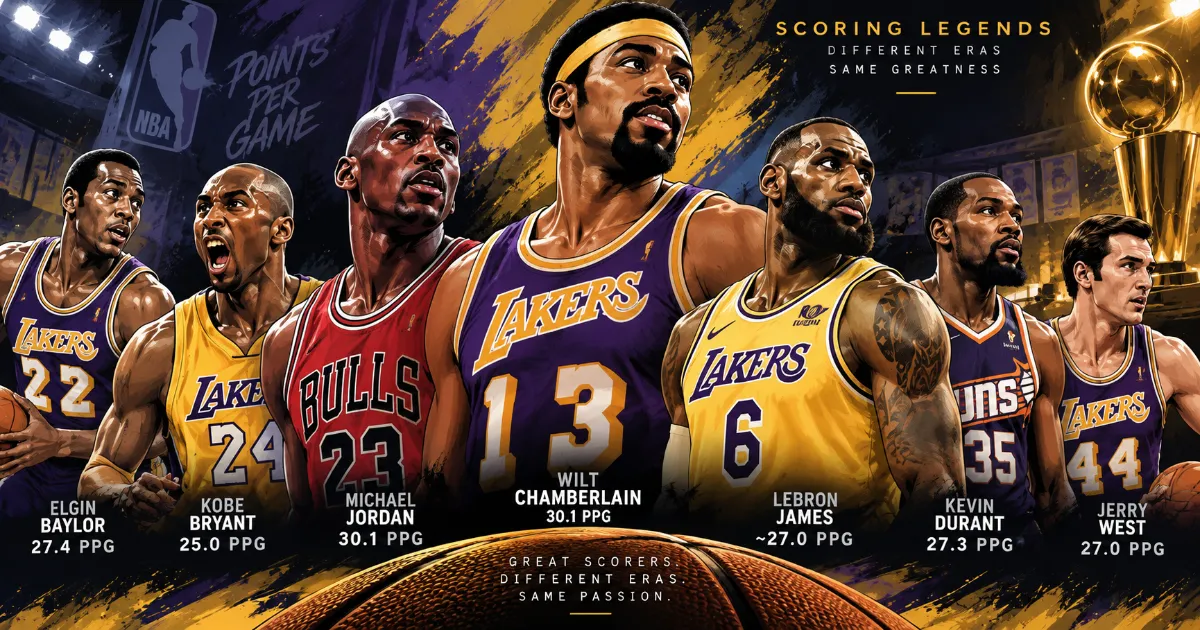
Wilt Chamberlain still tops it by a staggering margin, and half the names on this list don’t appear anywhere near the top of the all-time career scoring rankings
Career scoring totals reward longevity. Points-per-game averages reward pure scoring rate, regardless of how many seasons a player sustained it. These two records measure genuinely different things, and the gap between them produces one of the more interesting mismatches in NBA record-keeping — several names who dominate the career points list barely register on this one, while others who never came close to the all-time scoring total sit right at the top.
The 81-Point Game Explained: Kobe Bryant’s Historic Night, Quarter by Quarter
The Complete Rankings
1. Wilt Chamberlain — 30.1 PPG
Chamberlain’s career scoring average remains the highest in NBA history, a mark made even more remarkable by the fact that his rookie season alone, in which he averaged 37.6 points per game, would still rank as one of the greatest individual scoring seasons ever recorded on its own. His statistical dominance came in a significantly faster-paced era with far less sophisticated interior defense than exists today, a context most historians factor into any direct comparison, though the sheer scale of his advantage over the rest of the league at the time remains statistically unmatched regardless of era adjustment.
2. Michael Jordan — 30.1 PPG
Jordan’s career average sits fractions of a point behind Chamberlain’s, making the two effectively tied at the top depending on the specific rounding used. Unlike Chamberlain, Jordan’s average came across a full fifteen-season career against increasingly sophisticated, physical defensive schemes, and against a significantly deeper, more globally competitive talent pool than existed during Chamberlain’s playing days.
3. Elgin Baylor — 27.4 PPG
Baylor’s scoring average places him third all-time despite never winning a championship, a testament to just how statistically dominant his individual scoring was throughout the 1960s, even as his Lakers teams repeatedly fell short against Bill Russell’s Celtics dynasty in the Finals.
4. Kevin Durant — 27.3 PPG
Durant’s placement this high reflects one of the most efficiently sustained scoring averages of the modern era, achieved across a career that has included significant injury interruptions without ever meaningfully diminishing his per-game scoring rate when healthy.
5. LeBron James — ~27.0 PPG
James’s average is notable less for its raw height and more for its remarkable consistency across more than twenty seasons, a stretch of career length that makes maintaining any scoring average this high a genuinely unusual statistical achievement, regardless of where it ranks numerically against shorter, more concentrated careers above him.
6. Kobe Bryant — 25.0 PPG
Bryant’s twenty-season average places him lower on this specific list than his broader reputation might suggest, a reflection of how his early career, spent as a developing role player behind Shaquille O’Neal, pulled his overall career average down relative to his peak individual seasons in the mid-2000s.
7. Jerry West — 27.0 PPG
West’s average, achieved entirely during the 1960s and early 1970s, reflects a level of individual scoring dominance that gets somewhat overshadowed in broader retrospectives by his teams’ repeated Finals losses to Boston, but which places him firmly among the highest-scoring-rate players the sport has ever produced.
Single-Season Scoring Averages vs. Career Averages
It’s worth distinguishing career scoring average from single-season scoring average, since the two produce meaningfully different lists. Wilt Chamberlain’s 1961-62 season, in which he averaged 50.4 points per game, remains the highest single-season scoring average in NBA history by an enormous margin, a mark most historians consider effectively unbreakable given how dramatically pace and defensive sophistication have changed since. Chamberlain also holds several of the other highest individual single-season averages ever recorded, meaning his career average, while extraordinary on its own, actually understates just how statistically dominant his very best individual seasons were relative to the rest of his own career.
Where Active Players Currently Stand
Several currently active players remain within reach of this list depending on how the remainder of their careers unfold. Joel Embiid’s scoring average during his peak seasons has approached the lower end of this ranking, though durability concerns have limited the number of games factored into his career total. Luka Doncic’s early-career scoring average places him on a trajectory that, if sustained, could eventually push him into this conversation, though a much longer career sample would be needed before his placement could be considered statistically meaningful relative to the established names above.
Era Adjustment and Why It Matters Here Specifically
This particular record arguably requires more careful era adjustment than almost any other statistical category, given how dramatically pace of play has changed across NBA history. Chamberlain’s era featured significantly more possessions per game than the modern league, meaning his raw scoring average benefited from more scoring opportunities per contest than a modern player at an equivalent efficiency level would receive. Adjusting for pace narrows, though doesn’t eliminate, the gap between Chamberlain’s era and more recent players on this list, a nuance that responsible historical comparison should always account for rather than treating raw averages as directly equivalent across such different competitive environments.
Why This List Diverges So Dramatically From Career Totals
The most striking feature of the points-per-game rankings is how differently they’re constructed compared to the career total scoring list. Kareem Abdul-Jabbar, Karl Malone, and Dirk Nowitzki all rank among the very top of career points scored, yet none of them appear near the top of this specific list, since their career averages, while excellent, sit meaningfully below the names above — a direct consequence of accumulating their massive career totals across twenty-plus seasons rather than through a shorter, more concentrated high-volume scoring peak.
This divergence illustrates a fundamental tension in how NBA scoring greatness gets measured: total points reward showing up and producing at a strong level for as long as possible, while scoring average rewards sustained peak-level dominance regardless of career length, and the two lists genuinely measure different accomplishments rather than one simply being a more complete version of the other.
Points Per Game Comparison Table
| Rank | Player | Career PPG | Career Length | Career Total Points Rank |
|---|---|---|---|---|
| 1 | Wilt Chamberlain | 30.1 | 14 seasons | 7th |
| 2 | Michael Jordan | 30.1 | 15 seasons | 5th |
| 3 | Elgin Baylor | 27.4 | 14 seasons | Outside top 25 |
| 4 | Kevin Durant | 27.3 | 15+ seasons | Outside top 15 |
| 5 | LeBron James | ~27.0 | 20+ seasons | 1st |
| 6 | Jerry West | 27.0 | 14 seasons | Outside top 25 |
| 7 | Kobe Bryant | 25.0 | 20 seasons | 4th |
Why Shorter Careers Dominate This Specific List
A clear pattern emerges when examining the top of this ranking: shorter careers, generally 14 to 15 seasons, dominate the highest positions, while twenty-season careers like LeBron James’s and Kobe Bryant’s rank comparatively lower despite both players’ massive career point totals. This isn’t a coincidence. Maintaining an elite scoring average becomes statistically more difficult the longer a career extends, since nearly every player experiences some form of decline in their final several seasons, which drags down a career-long average even if that player’s peak seasons were individually spectacular.
How Modern Efficiency Metrics Complicate the Comparison
Advanced statistics add useful context to this list, since raw scoring average doesn’t account for the number of shot attempts required to reach it. Jordan and Chamberlain both maintained their scoring averages at relatively high shooting efficiency for their respective eras, while some historically high-scoring seasons by other players required significantly higher shot volume to reach a comparable per-game total. This distinction matters for evaluating whether a high scoring average reflects genuine shot-making efficiency or simply a high number of total attempts per game, a nuance the raw points-per-game statistic alone doesn’t fully capture.
What Coaches and Analysts Weigh When Discussing This Record
When evaluating which statistic better reflects scoring greatness, coaches and analysts generally fall into one of two camps. Those who prioritize peak dominance tend to favor points-per-game rankings, arguing that sustaining an elite scoring rate against the league’s best defenses night after night represents the purest test of individual scoring ability. Those who prioritize durability and sustained value tend to favor career totals, arguing that showing up and performing at a high level across two decades reflects a different, equally legitimate form of greatness that a shorter, higher-rate career doesn’t capture. Neither camp is wrong, which is precisely why both statistics remain in regular use rather than one having been discarded in favor of the other over time.
Final Thoughts
The list of most points per game in NBA history rewards a genuinely different accomplishment than career total scoring, producing rankings dominated by shorter, more concentrated peak careers rather than the sustained longevity that defines the all-time points list. Wilt Chamberlain and Michael Jordan’s near-identical marks at the top, achieved across dramatically different eras and playing styles, remain the clearest evidence that pure scoring rate and career scoring volume, while related, are ultimately measuring two different forms of basketball greatness — and understanding which one actually matters more for a given argument depends entirely on what question is being asked in the first place.
Frequently Asked Questions
Who has the highest career scoring average in NBA history? Wilt Chamberlain holds the record at 30.1 points per game, with Michael Jordan finishing an extremely close second at the same rounded average.
Why doesn’t LeBron James rank near the top of this list despite being the all-time leading scorer? His twenty-plus-season career, while producing the most total career points in NBA history, includes enough seasons across a longer career to bring his overall per-game average below several players with shorter, more concentrated scoring peaks.
Is points per game or total career points a better measure of scoring greatness? Neither is definitively better — they measure different things, with points per game rewarding peak scoring rate and total points rewarding sustained career-long production, and most complete evaluations of a player’s scoring legacy consider both statistics together.
What is the highest single-season scoring average in NBA history? Wilt Chamberlain’s 1961-62 season, in which he averaged 50.4 points per game, remains the highest single-season scoring average ever recorded and is considered effectively unbreakable under modern pace and defensive conditions.
🔹🔹 Follow us on Facebook 🔹🔹






2 Comments