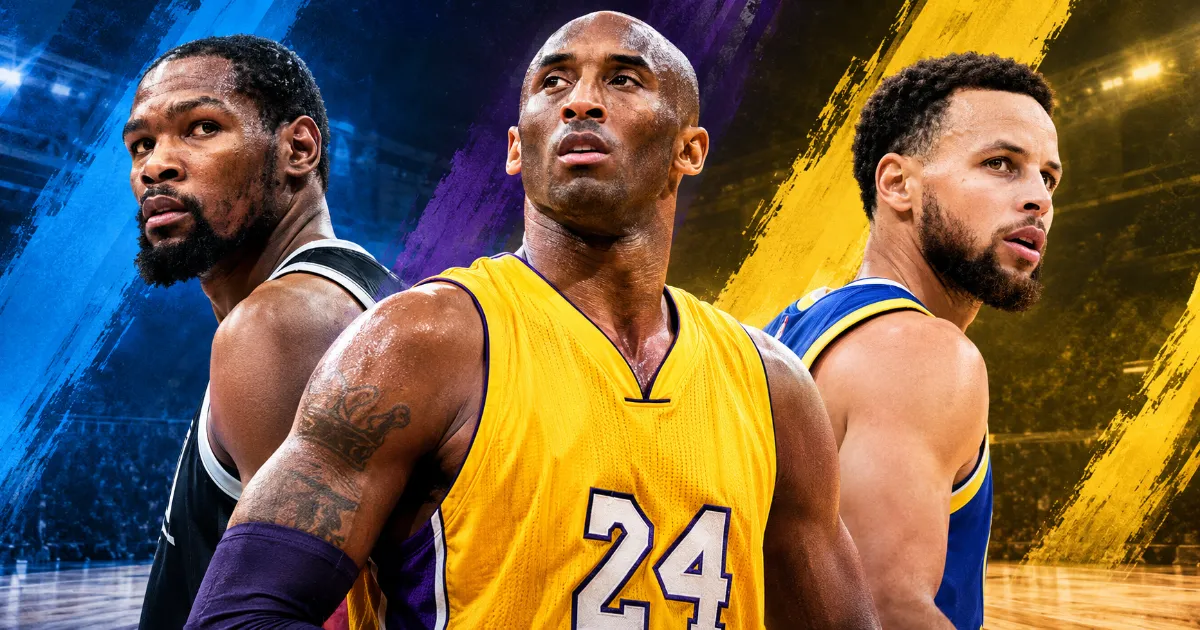
His cases against Jordan and LeBron are their own stories — here’s how Kobe Bryant’s legacy holds up against the two players who’ve reshaped the game since he retired
Kobe Bryant’s standing against Michael Jordan and LeBron James — the two comparisons that dominate most conversations about his legacy — have their own dedicated space elsewhere. This piece measures him against a different, more recent pairing: Kevin Durant, whose scoring efficiency represents a genuinely different offensive philosophy than Bryant’s shot-difficulty-first approach, and Stephen Curry, whose shooting revolution reshaped the sport in ways that make a direct comparison to Bryant’s game almost a study in two different eras happening within a decade of each other.
Michael Jordan Career Stats, Records and Six Championships Explained
Against Kevin Durant: Difficulty vs. Efficiency
Bryant and Durant represent two fundamentally different answers to the same question: how do you become an elite scorer? Bryant’s approach embraced shot difficulty as a feature rather than a flaw — contested fadeaways, tightly guarded isolation jumpers, shots that were statistically inefficient by modern analytics standards but that he made often enough to be devastating anyway. His career field-goal percentage sits around 45 percent, a figure that looks unremarkable next to Durant’s career mark near 50 percent, until you account for what each player was actually attempting.
Durant’s game is built on the opposite principle: use elite height and shooting touch to make efficient shots look nearly as difficult to stop as Bryant’s contested ones, without actually taking on the same statistical risk. His True Shooting Percentage ranks among the best ever recorded for a high-usage scorer, a number Bryant never approached, because Bryant’s shot selection was never optimized for efficiency in the way Durant’s has been.
On championships, Bryant’s five to Durant’s two is the more commonly cited edge. But Durant’s two Finals MVP awards, both delivered as the best player in the series, mirror the individual dominance Bryant showed during his own two Finals MVP runs. Where Bryant’s case is strongest is longevity and the two distinct championship eras he anchored, alongside O’Neal and later as the clear leader; Durant’s is strongest in pure shooting efficiency at a volume Bryant’s shot selection never allowed him to reach.
Against Stephen Curry: Shot Difficulty vs. Shot Volume
This comparison is less about who scored more efficiently and more about what each player proved was possible. Bryant proved a shooting guard could sustain an entire career on shots most coaches would tell a young player not to take, and make enough of them to justify the approach. Curry proved something almost opposite: that a jump shot from well beyond the three-point line, if attempted at high enough volume with sufficient accuracy, could be more valuable than almost any other shot in basketball, including the exact contested mid-range jumpers Bryant built his identity around.
Statistically, Curry’s three-point volume and accuracy have no comparison point in Bryant’s game — Bryant played most of his career in an era when the three-pointer remained a secondary weapon even for elite scorers. Curry’s four championships also edge Bryant’s tally of five only slightly, and Curry’s unanimous 2016 MVP award represents a level of single-season individual dominance Bryant, competing in a deeper MVP era, never quite matched in the voting.
What Bryant’s case retains against Curry is competitive reputation in isolation situations and one-on-one scoring difficulty — a dimension of the game Curry’s value proposition was never built around in the same way. The two represent almost non-overlapping offensive philosophies that happened to both produce sustained championship success.
Where His Case Against Jordan and LeBron Already Stands
Bryant’s direct comparisons to Michael Jordan and LeBron James are covered in full elsewhere on this site, each with its own detailed breakdown of championships, statistical profiles, and stylistic influence. The short version: against Jordan, Bryant’s case rests on being the closest stylistic heir the position has produced, while trailing in championships, Finals record, and individual awards. Against LeBron, Bryant’s case rests on scoring artistry and single-franchise loyalty against James’s statistical completeness and unmatched longevity. Both comparisons deserve their own full read rather than a condensed summary here.
The Case That Doesn’t Depend on Any Single Comparison
Strip away the head-to-head framing entirely, and Bryant’s standalone case remains straightforward: five championships split across two distinct eras of the same franchise, an 81-point game that remains the second-highest single-game total in NBA history, eighteen All-Star selections, and a competitive reputation — the “Mamba Mentality” — that has become a cultural reference point well beyond basketball. His case doesn’t require winning any specific individual comparison to remain among the strongest in league history; it holds up on its own statistical and cultural weight.
Playoff Intensity: A Dimension Both Comparisons Share
One statistical thread connects Bryant’s case against both Durant and Curry: postseason scoring intensity under elimination pressure. Bryant’s playoff scoring average remained close to his regular-season number across twenty seasons, including several individual playoff series where he scored 40 or more points in three separate games within a single first-round matchup. Durant has shown a similar ability to elevate in elimination games, particularly during his two Finals MVP runs, while Curry’s playoff scoring has historically relied more heavily on volume three-point shooting, which means his postseason output has shown more game-to-game variance than either Bryant’s or Durant’s more shot-difficulty-tolerant scoring profiles.
This matters because it’s one area where Bryant’s specific offensive philosophy — being comfortable taking a difficult, contested shot regardless of how the previous several attempts had gone — provided a form of playoff insurance that a purely volume-dependent shooter doesn’t have in the same way. When Curry’s threes aren’t falling on a given night, his scoring options narrow considerably; Bryant’s shot diet was built to remain viable even against a defense specifically designed to take away his first two or three options.
The Case Against Each Comparison, Weighed Honestly
Neither comparison in this piece produces a clean winner, and that’s worth stating directly rather than manufacturing false balance. Against Durant, the honest read is that Durant’s shooting efficiency represents a genuinely superior offensive mechanism by modern analytical standards, while Bryant’s five championships and sustained two-era success represent a stronger team-success résumé. Against Curry, the honest read is that Curry’s stylistic influence on the sport itself — reshaping how every team in the league approaches floor spacing — outweighs anything in Bryant’s game in terms of tactical legacy, even though Bryant’s individual scoring artistry within isolation situations remains, by most accounts from players who defended him, more difficult to replicate than Curry’s shooting, which depends on a specific skill that’s since been studied and taught far more systematically league-wide.
Head-to-Head Comparison Summary
| Category | Kobe Bryant | Kevin Durant | Stephen Curry |
|---|---|---|---|
| Championships | 5 | 2 | 4 |
| Finals MVPs | 2 | 2 | 1 |
| Regular-Season MVPs | 1 | 1 | 2 (1 unanimous) |
| Career Field-Goal % | ~45% | ~50% | ~47% |
| Signature Statistical Trait | Shot difficulty/volume | Scoring efficiency | Three-point volume |
| Career Length | 20 seasons | 15+ seasons, injury-interrupted | 15+ seasons, active |
Why This Specific Pairing Matters
Measuring Bryant against Durant and Curry rather than only against Jordan and LeBron matters because it tests his legacy against the players who actually reshaped the sport’s offensive philosophy after his career ended. Durant’s efficiency-first scoring and Curry’s volume-shooting revolution represent the two dominant offensive templates of the post-Bryant era. That his career still holds up statistically and culturally against both, despite having played most of his career under an entirely different offensive philosophy, says something about how well his specific approach — shot difficulty as a weapon rather than a liability — has aged relative to the analytics-driven scrutiny that approach might otherwise attract today.
How Advanced Metrics Treat Each Player Differently
Modern advanced statistics have not been kind to Bryant’s overall efficiency profile relative to Durant and Curry, and it’s worth being straightforward about that rather than glossing over it. His career Player Efficiency Rating and True Shooting Percentage both rank meaningfully behind both players, a direct consequence of the shot-difficulty philosophy discussed above. Analysts who weight these all-in-one efficiency metrics heavily tend to rank both Durant and Curry above Bryant in a pure statistical sense.
What these metrics don’t fully capture is shot-creation value under duress — the ability to still get a shot off, and often make it, when a defense has taken away every other option late in a shot clock or late in a game. Bryant’s game was built almost entirely around this specific skill, one that’s genuinely difficult to quantify with existing advanced statistics, which is part of why his case tends to resonate more strongly with players and coaches who watched him create offense in exactly those circumstances than with purely numbers-driven evaluations of his career.
What Teammates and Opponents Say About the Comparison
Players who guarded Bryant during his prime and later faced Durant or Curry have occasionally offered direct comparisons in interviews over the years, and a consistent theme emerges: defenders describe Bryant as more physically taxing to guard possession after possession, given his combination of physicality and shot-creation, while describing Durant and Curry as requiring a different kind of exhausting vigilance — never relaxing defensive positioning even 30 feet from the basket, in Curry’s case, or conceding any space at all given Durant’s release height. These are different defensive problems rather than directly comparable ones, which mirrors the broader theme running through both comparisons in this piece: Bryant, Durant, and Curry solved the same fundamental challenge of scoring efficiently against elite defense through three genuinely distinct approaches, each difficult to defend for different reasons.
Final Thoughts
Kobe Bryant’s legacy doesn’t rest solely on how he compares to Michael Jordan or LeBron James. Measured against Kevin Durant’s efficiency-first scoring and Stephen Curry’s volume-shooting revolution, his career holds up through a different lens entirely — five championships, a competitive reputation that’s become cultural shorthand, and a scoring approach built on difficulty rather than optimization that, even by the standards of the analytics era that followed him, still produced enough production to matter.
Frequently Asked Questions
How does Kobe Bryant’s shooting efficiency compare to Kevin Durant’s? Durant holds a significantly higher career field-goal percentage, reflecting a shot-selection philosophy built around efficiency, while Bryant’s lower percentage reflects a willingness to attempt much more difficult, heavily contested shots at high volume.
Did Kobe Bryant ever compete directly against Stephen Curry in the playoffs? The two overlapped in the league for several seasons, though Bryant’s Lakers and Curry’s Warriors did not meet in a significant playoff series during Bryant’s prime, as Curry’s championship-era Warriors teams emerged after Bryant’s own championship window had closed.
Who has more championships, Kobe Bryant or Stephen Curry? Kobe Bryant has five championships to Stephen Curry’s four, though Curry remains active and could still add to his total.
Is Kobe Bryant’s career field-goal percentage considered low by modern standards? Yes, at around 45 percent it trails both Durant and Curry, a direct reflection of Bryant’s willingness to attempt significantly more difficult, heavily contested shots than either player typically takes.
🔹🔹 Follow us on Facebook 🔹🔹
Tom Brady the Greatest QB Ever: Rings, Records, and the Rivals Who Couldn’t Catch Him


3 Comments