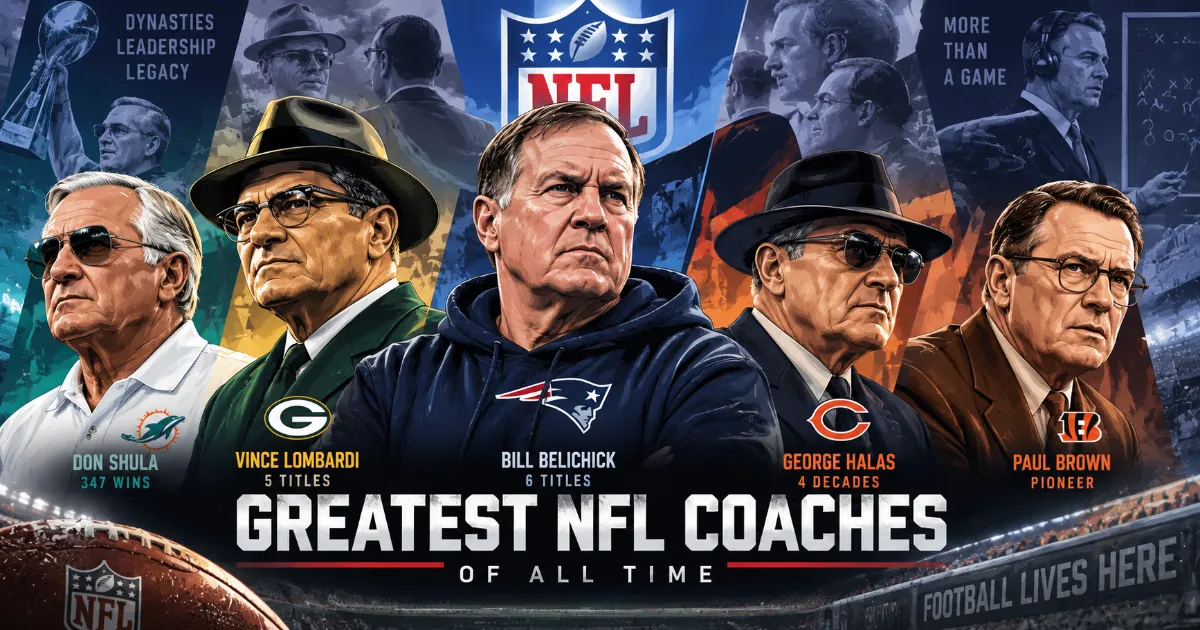
Bill Belichick and Vince Lombardi headline the greatest NFL coaches of all time, though Don Shula still owns the most wins ever recorded.
A Debate That Splits Between Volume and Peak
Ranking the greatest NFL coaches of all time forces a choice most other GOAT debates don’t: do you reward a career’s total accumulated wins, or a shorter stretch of pure, unmatched dominance? Don Shula coached for 33 years and never stopped winning. Vince Lombardi coached for nine and never lost a championship game he reached. Bill Belichick did both — winning at an elite rate for two full decades. Understanding this list means understanding that “greatest” here has always meant several genuinely different things depending on which coach’s supporters you ask.
Inside Michael Jordan’s Most Unforgettable Games and Playoff Runs
Tier 1: The Inner Circle
Bill Belichick is the most decorated coach of the modern era, and by most contemporary rankings, the leading candidate for the top spot outright. Across 24 seasons with the New England Patriots, he won six Super Bowl championships — putting him level with George Halas and Curly Lambeau for the most title-winning seasons in NFL history — while building nine AFC Championship appearances and 17 AFC East division titles. He finishes his Patriots tenure second all-time in career wins (333) and third in regular-season wins (302), having mastered roster construction under the salary cap in a way no other coach of his era managed to replicate. His run came to an end after New England suffered a third losing season in four years, closing the book on one of the most sustained coaching dynasties professional sports has ever produced.
Vince Lombardi built his case in less than a third of the time Belichick needed. In just nine seasons as Green Bay’s head coach, Lombardi won five NFL championships, including the first two Super Bowls, and remains the only coach in history to win five titles in a seven-year span. His Packers are also the last team to win three consecutive NFL championships. Lombardi lost his first-ever playoff game in 1960 and never experienced that feeling again — a perfect postseason record across the rest of his head coaching career that no other coach on this list can claim. His legacy is so complete that the NFL named its championship trophy after him.
Don Shula holds the all-time record for career wins with 347 (328 regular season, 19 playoff), a mark that’s stood since his retirement and remains untouched by Belichick or anyone else. He led the 1972 Miami Dolphins to the only perfect season in NFL history, going 17-0, and became the first coach ever to lead two different franchises — the Colts and the Dolphins — to the Super Bowl. His six career Super Bowl appearances stood as the all-time record until Belichick surpassed it decades later.
George Halas co-founded the NFL itself and remains the only coach in history to win a championship in four different decades, taking his first title in 1921 and his last in 1963. He finishes third all-time in career wins (324) and is credited as the first coach to incorporate daily practice sessions built around film study of opposing teams — a practice so fundamental to modern coaching that it’s easy to forget someone had to invent it.
Paul Brown brought a level of organizational innovation to the sport that still shapes how modern franchises are run, pioneering practices like year-round scouting departments and the modern playbook. He later mentored Bill Walsh, who served as his offensive coordinator in Cincinnati before building his own dynasty in San Francisco — meaning Brown’s coaching influence effectively spans two entirely separate eras of championship football.
Tier 2: Dynasty Architects
Tom Landry coached the Dallas Cowboys for 29 seasons, winning two Super Bowls and appearing in five, while finishing with 270 career wins — building “America’s Team” into a genuine cultural institution as much as a football franchise. Chuck Noll led Pittsburgh’s “Steel Curtain” dynasty to four Super Bowl championships in the 1970s, a title haul that stood as the record until Belichick surpassed it decades later. Bill Walsh revolutionized offensive football entirely, inventing the West Coast offense and winning three Super Bowls with San Francisco while developing Joe Montana into a legend — his coaching influence, through the assistants who trained under him, extends across dozens of subsequent NFL coaching trees. Joe Gibbs won three Super Bowls with Washington using three different starting quarterbacks across three different championship runs, a genuinely unusual accomplishment that speaks to his system-building over any single star player. Curly Lambeau co-founded the Green Bay Packers and won six NFL championships across 29 seasons, standing alongside Halas and Belichick at the top of the all-time title-winning list.
Tier 3: The Winningest and the Nearly-Forgotten
Andy Reid currently ranks fourth all-time in career wins (296, and still climbing as an active coach), and has won multiple Super Bowls with Kansas City after building a Philadelphia team that reached one Super Bowl himself. His development of Patrick Mahomes into a generational quarterback places him firmly in this broader conversation, even if his overall championship total still trails the true inner circle. Marty Schottenheimer finished his career with 205 wins but never won a Super Bowl, a genuinely painful distinction that’s kept him out of most top-tier rankings despite being statistically one of the winningest coaches in league history. Dan Reeves rounds out the top 10 all-time in wins (201) despite never winning a championship as a head coach himself, having reached the Super Bowl four times across stints with Denver and Atlanta without ever closing one out.
The Complete Wins Leaderboard
| Rank | Coach | Total Wins | Super Bowls / Championships |
|---|---|---|---|
| 1 | Don Shula | 347 | 2 |
| 2 | Bill Belichick | 333 | 6 |
| 3 | George Halas | 324 | 6 (pre-Super Bowl era included) |
| 4 | Andy Reid | 296 (active) | 3 |
| 5 | Tom Landry | 270 | 2 |
| 6 | Curly Lambeau | 229 | 6 (pre-Super Bowl era included) |
| 7 | Paul Brown | 222 | 3 (pre-Super Bowl era included) |
| 8 | Chuck Noll | 209 | 4 |
| 9 | Marty Schottenheimer | 205 | 0 |
| 10 | Dan Reeves | 201 | 0 |
Why Win Totals Don’t Settle the Debate Alone
The table above makes clear why this list resists a single, tidy ranking: the coach with the most wins in history (Shula) trails the coach most current evaluators rank first (Belichick) in championships by four. Meanwhile, two coaches inside the top 10 all-time in wins — Schottenheimer and Reeves — never won a single championship, a reminder that career win totals reward longevity in a way that can obscure the difference between a very good, long-tenured coach and a truly great one. This is precisely why most serious rankings weigh championships won, championship win rate, and era-adjusted competitive context alongside the raw win column, rather than treating any single number as decisive on its own.
The Coordinator Tree Question
One dimension of coaching greatness that rarely gets its own category, but arguably should, is how many other successful head coaches a given legend produced through his own coaching staff. Paul Brown’s influence didn’t stop with his own championships — Bill Walsh, Don Shula, and several other Hall of Fame-caliber coaches all trace part of their coaching lineage back through Brown’s organizational philosophy. Bill Walsh’s own coaching tree is even more sprawling: assistants who worked under him in San Francisco went on to lead multiple other franchises, spreading West Coast offensive principles across the league for decades after Walsh’s own retirement. Belichick’s coaching tree has been more mixed by comparison — several former assistants have struggled to replicate his success as full head coaches elsewhere, a pattern that’s become its own subplot in evaluating how much of the Patriots’ dynasty depended specifically on Belichick himself versus a system any sufficiently talented coordinator could have run. This “coaching tree” lens doesn’t change any individual coach’s win-loss record, but it does add a meaningful, often-overlooked dimension to how completely a coach’s influence shaped the sport beyond his own sideline.
The Modern Coaching Landscape
A handful of currently active head coaches are already building résumés that could eventually enter this broader conversation, even if none has come close to the championship volume of the coaches above. Mike Tomlin has never had a losing season across his entire tenure in Pittsburgh, an extraordinary consistency record even without matching Noll’s championship total from the same franchise. Sean McVay and Kyle Shanahan have both reached multiple Super Bowls at unusually young ages for the profession, representing a new generation of offensive-minded head coaches whose long-term legacy is still very much being written. Andy Reid’s continued success into his late 60s, discussed above, already places him closer to the inner circle than any of these younger names, and serves as the clearest active bridge between the sport’s coaching past and its current era.
The Bottom Line
The greatest NFL coaches of all time split cleanly into two overlapping arguments: those who won the most, and those who won the most relative to how long they coached. Belichick and Lombardi represent opposite ends of that spectrum — two decades of sustained dominance against nine years of pure, close-to-perfect championship football — while Shula and Halas anchor the case for total career accomplishment across an era that predates the modern Super Bowl entirely. None of these cases fully cancels out the others, which is exactly why this remains one of the more genuinely unresolved debates in all of professional football, decades after most of these men’s careers actually ended.
Frequently Asked Questions
Who is considered the greatest NFL coach of all time? Bill Belichick is the most commonly cited answer among modern rankings, based on his six Super Bowl championships across 24 seasons with the New England Patriots, though Vince Lombardi and Don Shula remain the strongest historical alternatives.
Who has the most career wins as an NFL head coach? Don Shula holds the all-time record with 347 total wins (328 regular season, 19 playoff), a mark that remains unbroken.
How many Super Bowls did Vince Lombardi win? Lombardi won five NFL championships in nine seasons as Green Bay’s head coach, including the first two Super Bowls ever played, and never lost a championship game after his first season.
Who is the only coach to win a championship in four different decades? George Halas, who coached the Chicago Bears, won championships in 1921, the 1930s, 1940s, and 1963, spanning four different decades of professional football.
Who are the winningest coaches in NFL history without a Super Bowl championship? Marty Schottenheimer (205 wins) and Dan Reeves (201 wins) both rank among the top 10 all-time in career wins despite never winning a Super Bowl as a head coach.
Is Andy Reid considered among the greatest NFL coaches of all time? Yes — Reid currently ranks fourth all-time in career wins and has won multiple Super Bowl championships with Kansas City, while also developing Patrick Mahomes into one of the sport’s greatest quarterbacks.
🔹🔹 Follow us on Facebook 🔹🔹
Maya Bennett — Athlete News Editor
Maya Bennett serves as GridironHoops’ Athlete News Editor, overseeing coverage centered on the athletes themselves — their performances, milestones, career developments, major announcements and stories away from the traditional game-day cycle.
Her coverage crosses sports and leagues, allowing GridironHoops to follow the biggest names in basketball, football, motorsports, swimming, athletics and other major sports. Maya focuses on presenting athlete-related news with context and clarity while keeping the reporting centered on information that matters to sports fans.
She also works across the editorial team to identify important athlete stories and ensure that major developments receive consistent coverage regardless of the sport involved.
Coverage: Athlete news, player developments, career milestones, major announcements and cross-sport stories.