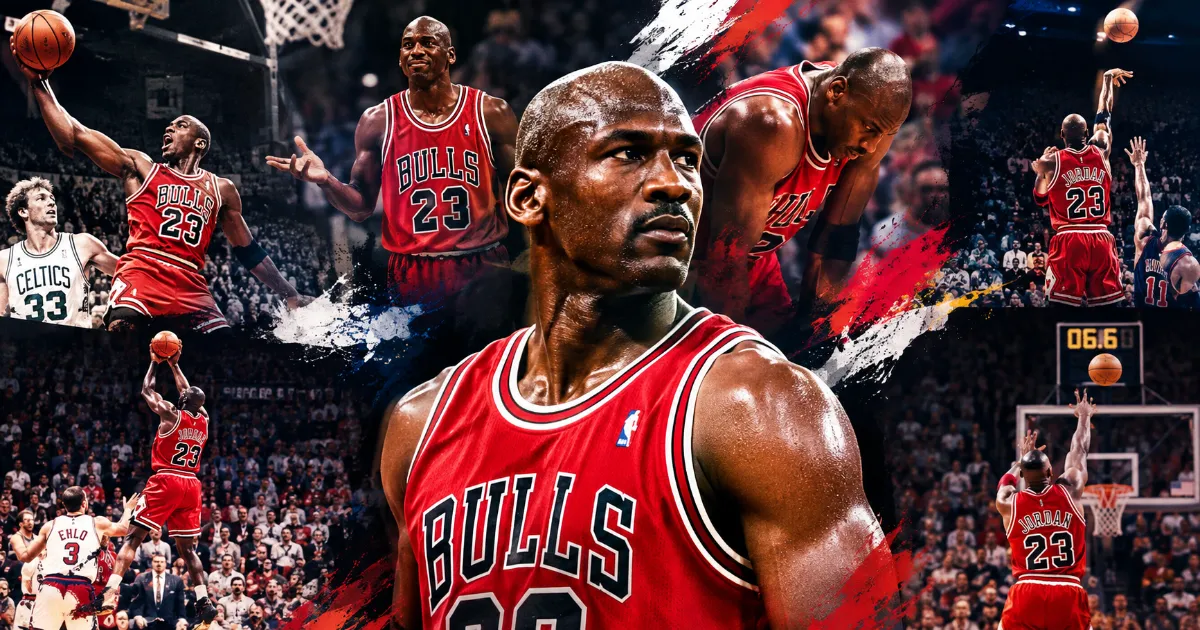
From a 63-point playoff explosion at age 23 to a championship-clinching jumper at 34, these are the games that built the Michael Jordan legend
Statistics tell you Michael Jordan was great. These specific games tell you why people who watched them still talk about them decades later. Each one below isn’t just a box score — it’s a moment where the ordinary flow of a basketball game gave way to something that felt, at the time, like it shouldn’t have been possible.
Michael Jordan Career Stats, Records and Six Championships Explained
NBA Rules Explained, From the Shot Clock to Instant Replay
April 20, 1986 — 63 Points at the Boston Garden
Jordan was 23 years old, playing in only his second NBA season after missing most of it with a broken foot, when he walked into the Boston Garden against a Celtics roster that would go on to win the championship that year. He scored 63 points in a double-overtime playoff loss, a total that remains the highest-scoring playoff game in NBA history nearly four decades later. Larry Bird, on the other bench that night, later described Jordan’s performance as basically God disguised as Michael Jordan — a line that’s been repeated so often it’s become inseparable from how this specific game is remembered. The Celtics won the game, but nobody left the building talking about the final score.
June 3, 1992 — Six Three-Pointers and a Shrug
Game 1 of the 1992 Finals against Portland produced one of the most replayed sequences of Jordan’s career. He made six three-pointers in the first half alone, an outrageous total for a player not generally regarded as a knockdown outside shooter, and after the sixth one, he turned to the broadcast table and shrugged, as if even he couldn’t fully explain what was happening. He finished the half with 35 points. The gesture became so iconic it’s simply referred to as “the shrug” in any conversation about Jordan’s career-defining moments, a spontaneous piece of body language that captured his competitive confidence better than any quote could have.
June 14, 1992 — Clinching the First Three-Peat’s Second Title
Game 6 of that same Finals series delivered the championship, with Jordan closing out Portland to secure his second title in as many years. While not statistically his most explosive performance, the game carries significance as the moment Jordan proved his first championship wasn’t a one-off — that the Bulls’ dynasty was genuinely underway rather than a single lucky run.
June 20, 1993 — Finishing the First Three-Peat
Jordan’s 41.0 points-per-game average across the 1993 Finals against Phoenix remains the highest scoring average in any Finals series in NBA history. Game 6, played in Phoenix, delivered the deciding blow when John Paxson hit a series-clinching three-pointer off a Jordan-drawn double-team, but the entire series had already been defined by Jordan’s individual scoring dominance against a Suns roster that had no realistic defensive answer for him.
June 11, 1997 — The Flu Game
Game 5 of the 1997 Finals against Utah produced what may be the single most mythologized individual performance in NBA history. Jordan was visibly ill — later widely reported as food poisoning, though the exact cause has been debated for years — and appeared physically depleted throughout the broadcast, at times needing support from teammate Scottie Pippen just to stay upright during stoppages in play. He scored 38 points anyway, including a decisive three-pointer late in the fourth quarter, and the Bulls won a road game they had no business winning given his physical condition. The performance became shorthand for competitive will overriding physical limitation, referenced constantly in sports culture well outside basketball circles.
May 7, 1989 — The Shot
Before any of his championships, Jordan delivered a signature moment against the Cleveland Cavaliers in the first round of the 1989 playoffs. With the series tied and time expiring in the decisive Game 5, Jordan received an inbound pass, elevated over Craig Ehlo’s contest, and hit a series-winning jumper that has simply been known as “The Shot” ever since. Jordan’s celebratory fist pump after the shot became one of the most reproduced images of his career, predating his championship years but establishing the clutch reputation that would define the rest of his playoff career.
June 14, 1998 — The Last Shot
Game 6 of the 1998 Finals against Utah produced the signature closing image of Jordan’s Bulls career. With the Bulls trailing late, Jordan stripped Karl Malone on the defensive end, brought the ball up himself, created just enough separation from Bryon Russell with a push-off that remains debated to this day, and hit the championship-clinching jumper with 5.2 seconds remaining. He held his follow-through as the shot dropped, an image that became the defining visual of his entire career and, at the time, appeared to be his final act as a Chicago Bull.
January 21, 1996 — A Statement During the 72-Win Season
Amid the Bulls’ record-breaking 72-win regular season, Jordan delivered a 48-point performance against the Miami Heat that reflected the individual dominance underpinning that historic team run. The 1995-96 season is often remembered primarily through team-level statistics, but games like this one are a reminder that the record-breaking win total was built on nightly individual performances at an extremely high level, not simply strong role-player depth around a merely good star.
May 31 & June 5, 1998 — The “Threepeat” Groundwork
Before the Last Shot closed out the 1998 Finals, Jordan had already delivered two significant individual performances earlier in that series that set the stage. His 45-point outing in Game 5, played in Chicago with the series tied, ensured the Bulls returned to Utah with a chance to close it out rather than facing elimination on their own floor. These earlier-series performances rarely get the same attention as the closing shot itself, but they were the reason Jordan had the opportunity to deliver that final moment at all — a reminder that signature closing shots are usually the product of sustained excellence across an entire series, not an isolated moment of brilliance.
The 1991 Finals: Establishing the Template
Jordan’s first Finals appearance against Magic Johnson’s Lakers in 1991 doesn’t always get grouped with his most statistically explosive performances, but Game 2 deserves specific mention for a single sequence: a driving layup attempt where Jordan, mid-air and seemingly out of options after Sam Perkins closed off his path to the rim, switched the ball from his right hand to his left hand mid-flight and finished anyway. The move became an instantly iconic piece of individual improvisation, frequently replayed as an example of Jordan’s unmatched body control and in-air creativity, and it helped establish the template for the kind of shot-making moments that would define the rest of his championship run.
Regular-Season Performances Worth Remembering
While playoff moments dominate most retrospectives of Jordan’s career, several regular-season performances deserve mention in their own right. His 69-point game against Cleveland in 1990 remains his career-high scoring total in a single game, delivered during a stretch of his career before his first championship, when his individual brilliance still outpaced the Bulls’ team success. This game is sometimes overlooked in broader retrospectives precisely because it came before the championship narrative fully took hold, but the sheer scoring total remains one of the most statistically dominant single-game performances of his entire career, regular season or playoffs included.
Why These Specific Games Endure
What separates this list from a simple ranking of Jordan’s highest individual scoring totals is context. The 63-point game endures not just because of the number, but because it came in a losing effort against a legendary opponent, adding a layer of tragic grandeur rather than simple triumph. The Flu Game endures because of the visible physical struggle, not just the box score. The Last Shot endures because it closed out a chapter of his career at its absolute peak. Raw statistics explain what happened; these specific circumstances explain why people still talk about them.
Playoff Performances Beyond the Signature Moments
Beyond the handful of games that get replayed constantly, Jordan’s broader playoff résumé includes dozens of 40-plus-point performances across his championship runs, reflecting an unusual ability to elevate his production specifically when stakes increased. His playoff scoring average of 33.4 points per game remains the highest in NBA postseason history among players with a substantial sample size, meaning the signature games above weren’t outliers so much as particularly dramatic examples of a genuinely sustained pattern across his entire playoff career.
How These Games Shaped His Cultural Legacy
Several of these individual games have taken on significance well beyond basketball circles, becoming reference points in broader American sports culture. The Flu Game in particular gets invoked regularly as a shorthand for playing through adversity in contexts that have nothing to do with basketball. The Last Shot’s freeze-frame image remains one of the most reproduced sports photographs of the 1990s. This crossover into broader cultural reference is part of what separates Jordan’s signature games from similarly statistically impressive performances by other legendary players — the moments themselves became part of a shared cultural vocabulary, not just basketball history.
How Opponents Remember Facing Him in These Moments
Players who defended Jordan during several of these signature games have spoken publicly over the years about what made those specific nights so difficult to prepare for. Defenders assigned to guard him during his highest-scoring playoff performances have described a level of shot-making difficulty that made conventional defensive strategy largely irrelevant — double-teams simply created better passing angles for his teammates, and single coverage rarely slowed him during these particular peak moments. This contemporary testimony, gathered from opposing players and coaches across multiple decades since these games were played, adds useful context to why these specific performances have retained their mythology so much more durably than similarly high-scoring games by other great players from the same era.
Final Thoughts
Michael Jordan’s greatest games and playoff performances share a common thread: each one arrived at a moment where the stakes, the opponent, or his own physical condition made success seem genuinely uncertain, and each time he delivered anyway. The 63-point loss to Boston, the shrug against Portland, the Flu Game, and the Last Shot don’t just showcase individual scoring talent — they capture a competitor who consistently found another level exactly when circumstances demanded it, which is ultimately why these specific games remain part of basketball’s cultural memory decades after they were played.
Frequently Asked Questions
What is considered Michael Jordan’s greatest single game? His 63-point playoff performance against the Boston Celtics in 1986 is frequently cited as his most statistically remarkable individual game, though the 1997 “Flu Game” is often cited as his most legendary due to the circumstances surrounding it.
What actually happened during the Flu Game? Jordan played Game 5 of the 1997 Finals while visibly ill, widely reported at the time as food poisoning, and scored 38 points including a decisive late three-pointer despite appearing physically depleted throughout the game.
What is “The Last Shot” and when did it happen? It refers to Jordan’s championship-clinching jumper over Bryon Russell in Game 6 of the 1998 Finals, delivered with 5.2 seconds remaining and widely regarded as the defining image of his career with the Chicago Bulls.
What is Michael Jordan’s career-high in a single game? Jordan’s career-high is 69 points, scored in a 1990 regular-season game against the Cleveland Cavaliers, predating his first championship season.
🔹🔹 Follow us on Facebook 🔹🔹