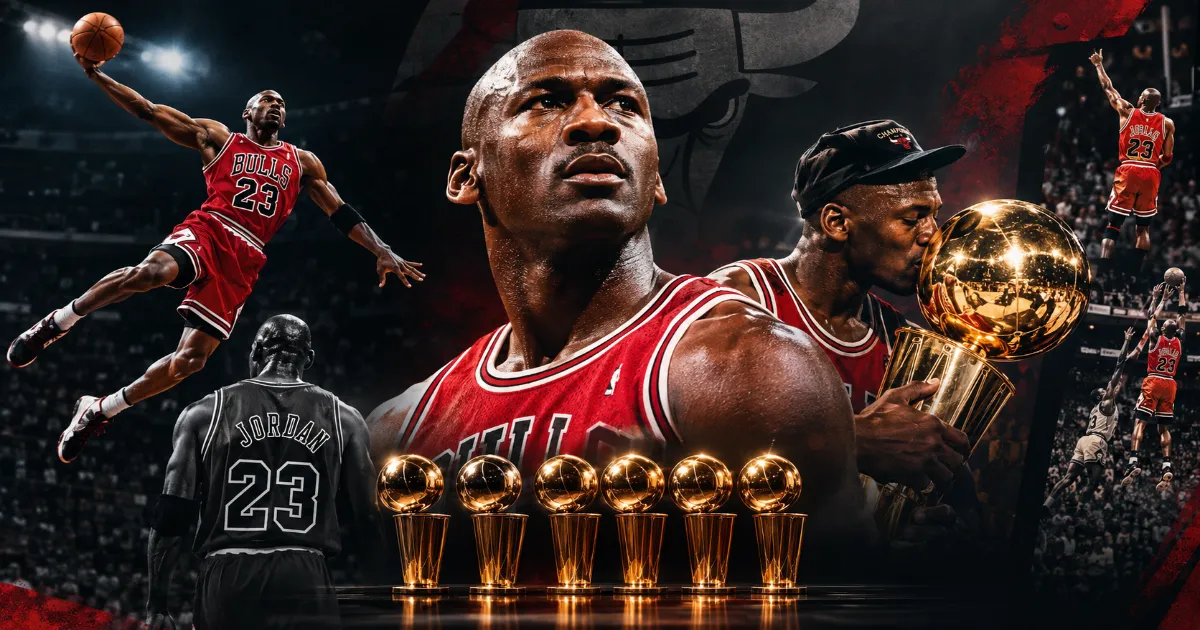
Every number, every award, and every Finals run that built the Michael Jordan legacy, laid out season by season
Michael Jordan’s career is so thoroughly mythologized that the actual numbers behind it sometimes get lost in the storytelling. This is a straight reference breakdown: the career totals, the individual awards, the scoring records, and a Finals-by-Finals accounting of all six championship runs, without the debate-club framing that usually surrounds his name.
NBA Rules Explained, From the Shot Clock to Instant Replay
The Fastest NBA Players Ever: Who Really Owns the Open Court?
Career Totals at a Glance
Across 15 NBA seasons — 13 with the Chicago Bulls plus a brief final stint with the Washington Wizards — Jordan retired with 32,292 career points, a 30.1 points-per-game average that remains the highest in NBA history among players with significant career length, 6,672 career assists, and 6,672 career rebounds. He shot 49.7 percent from the field for his career and 83.5 percent from the free-throw line, efficiency numbers that remain remarkable given how much of his scoring volume came from difficult, contested attempts rather than efficient spot-up looks.
Season-by-Season Scoring Snapshot
| Season | Team | PPG | Notable |
|---|---|---|---|
| 1984-85 | Chicago Bulls | 28.2 | Rookie of the Year |
| 1986-87 | Chicago Bulls | 37.1 | Led league in scoring |
| 1987-88 | Chicago Bulls | 35.0 | MVP + Defensive Player of the Year |
| 1990-91 | Chicago Bulls | 31.5 | First championship, first Finals MVP |
| 1992-93 | Chicago Bulls | 32.6 | Third straight championship |
| 1995-96 | Chicago Bulls | 30.4 | 72-win season, fourth championship |
| 1997-98 | Chicago Bulls | 28.7 | Sixth championship, “The Last Shot” |
Individual Awards Ledger
Jordan’s individual honors form one of the most decorated résumés in league history: five regular-season MVP awards (1988, 1991, 1992, 1996, 1998), six Finals MVP awards (one for every championship run), one Defensive Player of the Year award (1988), ten scoring titles — an NBA record — nine All-Defensive First Team selections, fourteen All-Star selections, and the 1985 Rookie of the Year award. The 1988 season stands out even within this list, since it’s the only time in NBA history a player has won regular-season MVP and Defensive Player of the Year in the same season.
Scoring Records That Still Stand
Beyond his career scoring average, several of Jordan’s individual scoring records remain unbroken decades later. His 63-point playoff performance against the Boston Celtics in 1986 remains the highest-scoring playoff game in NBA history. His ten scoring titles remain the most by any player. And his streak of finishing among the league’s top scorers across nearly his entire healthy career — interrupted only by his mid-career baseball retirement — reflects a level of sustained individual scoring dominance that few players have approached even in shorter bursts.
The Six Championships, Finals by Finals
1991: Chicago Bulls def. Los Angeles Lakers, 4-1
Jordan’s first championship came against Magic Johnson’s Lakers, with Jordan averaging 31.2 points, 11.4 assists, and 6.6 rebounds across the series and capturing his first Finals MVP award. This series is often cited as the moment Jordan proved he could elevate a genuine team success, not just individual scoring numbers.
1992: Chicago Bulls def. Portland Trail Blazers, 4-2
Jordan’s famous six three-pointers in the first half of Game 1, followed by his shrug toward the broadcast table, became one of the signature moments of the series. He averaged 35.8 points across the six games.
1993: Chicago Bulls def. Phoenix Suns, 4-2
This series completed Jordan’s first three-peat, with Jordan averaging 41.0 points per game across the six games — the highest scoring average in any Finals series in NBA history.
1996: Chicago Bulls def. Seattle SuperSonics, 4-2
Following Jordan’s return from his baseball retirement, this championship capped a then-record 72-win regular season, with Jordan capturing regular-season MVP, All-Star Game MVP, and Finals MVP in the same season.
1997: Chicago Bulls def. Utah Jazz, 4-2
This series is remembered largely for Jordan’s “Flu Game” performance in Game 5, in which he scored 38 points while visibly ill, an effort widely regarded as one of the most significant individual performances in Finals history.
1998: Chicago Bulls def. Utah Jazz, 4-2
Jordan’s final championship with the Bulls ended with his game-winning jumper over Bryon Russell in Game 6, delivering his sixth Finals MVP award and, at the time, what appeared to be a permanent retirement from the Bulls.
Finals Record Summary
| Year | Opponent | Result | Finals MVP PPG |
|---|---|---|---|
| 1991 | Los Angeles Lakers | Won 4-1 | 31.2 |
| 1992 | Portland Trail Blazers | Won 4-2 | 35.8 |
| 1993 | Phoenix Suns | Won 4-2 | 41.0 |
| 1996 | Seattle SuperSonics | Won 4-2 | 27.3 |
| 1997 | Utah Jazz | Won 4-2 | 32.3 |
| 1998 | Utah Jazz | Won 4-2 | 33.5 |
Jordan’s Finals record stands at a perfect 6-0, with Finals MVP honors in every single series — the only player in NBA history to accomplish that specific combination at that volume.
The Baseball Retirement’s Effect on the Record Book
Jordan’s decision to retire from basketball in October 1993 to pursue professional baseball directly shaped his career statistics. He missed the entire 1993-94 season and most of 1994-95, seasons that would likely have added significantly to his career point total had he continued playing at his prior scoring pace. This gap is a key reason his career total points figure, while still elite, trails several players with longer, uninterrupted careers, even though his scoring average and per-season dominance remain largely unmatched.
The Wizards Years: A Statistical Footnote
Jordan’s final two NBA seasons, played with the Washington Wizards at ages 38 and 39, add a lesser-remembered chapter to his career statistics. He averaged 22.9 points per game in his first Wizards season and 20.0 in his second, respectable numbers for a player his age but a clear step down from his Bulls-era peak. These seasons are generally treated as a statistical coda rather than a meaningful part of his championship-era legacy, though they do factor into his career-total counting stats.
How Jordan’s Scoring Efficiency Compares to Volume Scorers Since
One of the more statistically unusual aspects of Jordan’s career is how he combined extremely high scoring volume with efficiency numbers that most high-volume scorers since haven’t matched. His 49.7 percent career field-goal percentage is notably higher than most modern high-usage perimeter scorers manage, despite Jordan playing in an era with more physical, hand-checking-heavy defense than exists today. This combination of volume and efficiency is part of why advanced metrics like Player Efficiency Rating continue to rank several of Jordan’s individual seasons among the highest ever recorded, even decades after his retirement and even as the league’s overall pace and scoring environment have changed significantly.
Defensive Statistics Behind the Two-Way Reputation
Jordan’s statistical case extends well beyond scoring. His nine All-Defensive First Team selections and 1988 Defensive Player of the Year award are backed by genuinely strong underlying defensive numbers — he averaged 2.3 steals per game for his career, a figure that ranks among the best of any perimeter player in NBA history, and he remains one of only a handful of players to ever lead the league in steals in a season while also leading the league in scoring the same year. This defensive statistical profile is a significant part of why Jordan is so frequently cited as the most complete two-way player the sport has produced, rather than simply its greatest scorer.
All-Star Game Statistics and Recognition
Jordan’s fourteen All-Star selections were accompanied by consistently strong individual All-Star Game performances, including a Most Valuable Player award in the 1996 All-Star Game, played during his 72-win championship season. His combined All-Star Game scoring average ranks among the highest of any player with double-digit All-Star appearances, reflecting that his competitive intensity carried over even into the league’s showcase exhibition event, an intensity level not every superstar has consistently brought to what is, for many players, a more relaxed midseason exhibition.
The 1988 Season in Full Statistical Context
The 1987-88 season deserves particular statistical attention beyond its unique MVP-and-Defensive-Player-of-the-Year combination. Jordan averaged 35.0 points, 5.9 rebounds, 5.9 assists, 3.16 steals, and 1.6 blocks per game that season, a defensive and offensive statistical profile that remains essentially unmatched by any perimeter player in a single season since. His 3.16 steals per game that year remains one of the highest single-season steal averages ever recorded by a guard, underscoring just how statistically complete that specific season actually was across both ends of the floor simultaneously.
How Jordan’s Records Have Held Up Against Modern Scoring Volume
Given how dramatically three-point shooting volume has reshaped scoring opportunities across the modern NBA, it’s worth noting how well several of Jordan’s records have held up regardless. His career scoring average remains the highest in NBA history despite modern players having access to significantly more three-point attempts than were available during Jordan’s career, when the three-point shot remained a relatively secondary offensive weapon for most perimeter scorers. This suggests his scoring dominance wasn’t simply a product of playing in a lower-competition era, since modern players with access to more efficient scoring tools still haven’t matched his per-game scoring rate across a full career.
Comparing Jordan’s Championship-Era Team Statistics
The Bulls’ team-level statistics during Jordan’s championship seasons also deserve mention as part of his broader statistical legacy. The 1995-96 Bulls’ 72-win regular season remains one of the most statistically dominant team performances in NBA history, with the roster posting a point differential that ranked among the best ever recorded at the time. Jordan’s individual scoring and efficiency numbers that season came within a team context that was itself producing historically unusual statistical dominance, a reminder that his individual records were achieved while also anchoring genuinely historic team-level success rather than compiling numbers on a middling roster.
Final Thoughts
Michael Jordan’s career stats tell a story that the highlight reels only partially capture: ten scoring titles, a perfect 6-0 Finals record with Finals MVP every time, five regular-season MVPs, and a career scoring average that remains the highest in NBA history among players with significant career length. Even accounting for the nearly two full seasons lost to his baseball retirement, the numbers behind Jordan’s six championships remain one of the most complete individual statistical résumés the sport has ever produced.
Frequently Asked Questions
What is Michael Jordan’s career scoring average? Jordan finished his career with a 30.1 points-per-game average, the highest in NBA history among players with significant career length.
How many championships did Michael Jordan win, and did he ever lose a Finals series? Jordan won six championships across six Finals appearances, all with the Chicago Bulls, and never lost a single NBA Finals series.
How many scoring titles does Michael Jordan hold? Jordan led the NBA in scoring ten times, an all-time record that remains unmatched by any other player in league history.
What was Michael Jordan’s highest-scoring Finals series? His 1993 Finals performance against Phoenix remains his highest-scoring Finals series by average, with Jordan putting up 41.0 points per game across six games — the highest scoring average in any Finals series in NBA history.
🔹🔹 Follow us on Facebook 🔹🔹





5 Comments