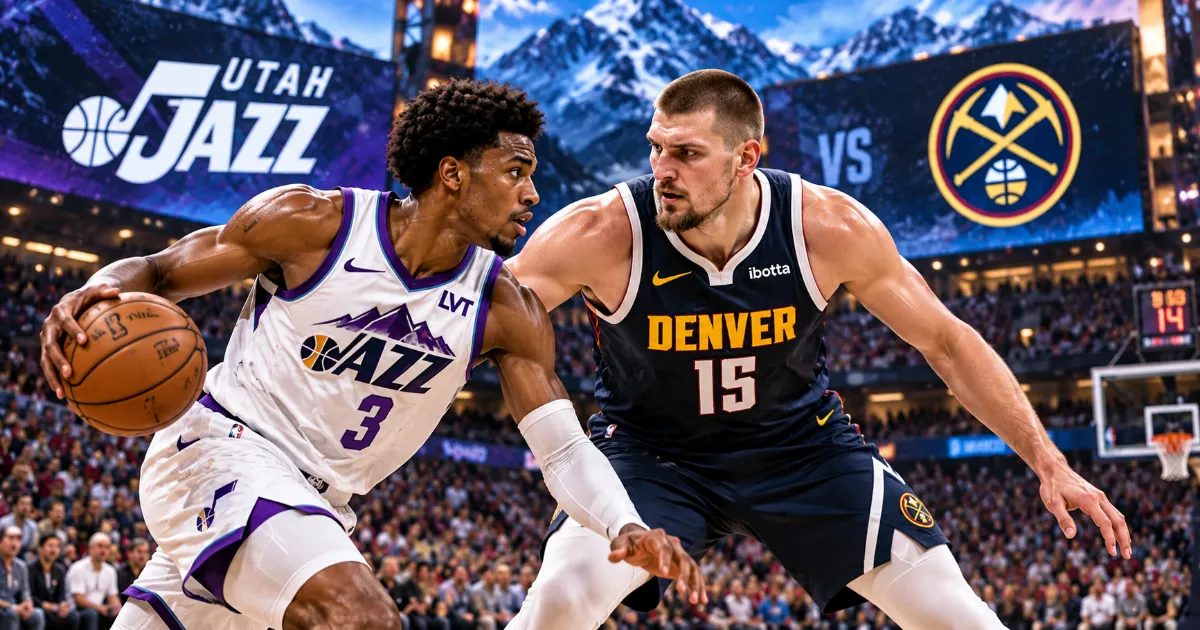
Utah Jazz vs Denver Nuggets: What to Watch in This NBA Preseason Matchup
Denver is the better team, and it is not especially close on paper. But a gap this wide is exactly where a good matchup breakdown earns its keep. The scoreboard tells you who won. The useful questions are how, by how much, and whether the margin is shrinking. For the Jazz, that last question is the whole story of the 2026-27 season.
Here is the baseline. Denver went 54-28 last year, took the third seed in the West and then lost a first-round series to Minnesota in six games. Utah went 22-60 and finished 15th in the conference. Thirty-two wins separate two teams that share a division, and the Nuggets have beaten the Jazz ten straight times. That streak is what Utah is really playing against.
Miami Heat 129, Toronto Raptors 105: Miami Controls NBA Canada Games 2026 Preseason Opener
Last season’s final word
The cleanest picture of the rivalry came on March 27, 2026, at Ball Arena. Denver won 135-129. Utah was a heavy underdog and still scored 129 points, which tells you where its problems were. The Jazz could score. They could not get stops.
Nikola Jokić and Jamal Murray combined for 64 points that night. Utah did a lot right and still lost, because a star pairing in that kind of rhythm can erase most defensive plans. That is the honest takeaway from the March game: the Jazz were competitive offensively, but their margin for error on defense was close to zero.
Denver’s summer: continuity over reinvention
The Nuggets did not rebuild around Jokić this offseason. They tinkered.
The headline move was signing DeMar DeRozan, now 37, to a one-year deal worth $3.9 million. He is a proven scorer and a useful second or third option when Murray or Jokić sits. The tradeoff is spacing. Jokić’s offense works best with shooters stretching the floor, and DeRozan is most effective in the midrange. How Denver pairs him with Murray, Cameron Johnson and Aaron Gordon will decide whether he is a clean fit or a puzzle to solve.
Denver also traded Peyton Watson to Cleveland, which should open more minutes for Christian Braun and Johnson. Gordon, who dealt with a calf problem last season, says he is healthy and ready.
Our read: Denver is betting that Jokić’s gravity papers over the roster’s imperfections, and for most of the regular season that bet pays off. The bigger story hanging over the franchise is Jokić’s long-term future in Denver. Until that is settled, every roster decision and every slump will get more attention than it normally would.
Utah’s summer: the rebuild starts to look like a roster
For years the Jazz were building toward a future. This summer the future arrived in part.
- Jaren Jackson Jr. came over at the trade deadline and carries a $49 million salary in 2026-27. He is a former Defensive Player of the Year and a rare big who protects the rim and can shoot.
- Lauri Markkanen earns $46.1 million this season and remains the franchise’s most accomplished scorer.
- Darryn Peterson, the Kansas guard, went No. 2 overall in June. He is 19 and will share backcourt duties with Keyonte George.
- Keyonte George had a breakout season, averaging 23.6 points and 6.1 assists per game.
- Ace Bailey made the NBA All-Rookie Second Team and now enters his second year.
- Jusuf Nurkić was re-signed, Walker Kessler was moved in a sign-and-trade, and Utah added Jaxson Hayes and Josh Okogie.
We expect coach Will Hardy to open with George, Peterson, Markkanen, Jackson and Nurkić. That is a far more talented group than the one Utah began last season with. It is also a young group with open questions about shot distribution, perimeter defense and how many creators one offense can support.
Utah Jazz vs Denver Nuggets: The Five Matchup Factors That Matter
Games between teams at different stages tend to turn on the same handful of variables. Here are the five we are watching.
1. Pace and shot quality
Utah wants to play fast. Denver can score in any tempo. Normally extra possessions help the underdog, but against an offense as efficient as Denver’s, extra possessions can just as easily become extra Nuggets points. Utah’s smartest approach is controlled speed. Get out on the break when a stop or a turnover gives you a numbers advantage, but do not turn every possession into a track meet.
2. Defensive consistency
Defense was Utah’s biggest weakness last year, and it is the number to watch in the first month. Jackson raises the ceiling, but young teams rarely improve defensively in a straight line. The usual pattern is a rough stretch, followed by a rotation that settles and a scheme that sticks. Early-season defensive rating will show whether the Jazz have reached that point.
3. Altitude and travel
Denver sits at 5,280 feet. Salt Lake City is around 4,200. Both teams are used to thin air, which blunts the advantage Denver has over most visitors. It still matters late in games and on the second night of back-to-backs, but it is less decisive here than in a typical Nuggets home game.
4. Young-player variance
Peterson and Bailey have star upside, and young players are volatile against playoff-caliber opponents. A big night from either can swing a game. A rough one can sink it. That variance is the biggest wildcard in any single meeting.
5. Health and rotation depth
Denver relies on a short list of stars, so injuries matter more to the Nuggets than to most contenders. If Jokić or Murray sits, the gap shrinks noticeably. Utah has more bodies, though less proven quality, and its own injury report matters just as much.
The calendar: where the answers will show up
The schedule gives us useful data early.
- October 4: Preseason opener in Boulder, Colorado.
- October 6: A second preseason game at the Delta Center, 9 p.m. ET.
- November 27: Denver visits Utah in an Emirates NBA Cup game. Both teams are in West Group A with Dallas, Houston and Phoenix, and this game closes out group play for the Jazz. Tip-off is 9:30 p.m. ET.
- December 12: Denver visits the Delta Center again, 9:30 p.m. ET.
Preseason results are not worth much. Preseason minutes are. Watch who plays together and how Hardy splits ball-handling between George and Peterson.
The November and December games are more telling. Two meetings in about two weeks make it easy to see whether Utah adjusts. A bad loss on November 27 followed by a competitive December 12 would point to a team that learns quickly. The same problems showing up twice would point to something structural. The Cup game also affects group standings, so both teams have a real reason to care. Check the official NBA schedule for the games in Denver.
How Denver should play it
The Nuggets do not need a clever plan. Run the offense through Jokić, protect the ball, close out on shooters and let the talent gap build. The real danger is complacency. Teams with a big talent edge sometimes coast through stretches against opponents they expect to beat, and a young, athletic team like Utah can punish a lazy quarter.
The tactical question is how the new pieces fit. If DeRozan and Murray share the floor with Jokić, spacing could get tight. Expect Denver to experiment early in the season and settle on lineups by December.
How Utah should play it
Utah’s job is harder. It has to limit transition points, keep Denver’s role players from getting comfortable, win the turnover battle and hit enough threes to stay within reach. None of those is unrealistic. The challenge is doing all of them for 48 minutes.
Jackson is the biggest lever. A rim protector who can also space the floor changes how Utah defends Jokić’s actions and gives the Jazz a chance to hold up in the half-court. The young guards carry the other half. If Peterson and George can score and defend with effort, the backcourt becomes an asset instead of a liability.
What the matchup says about the West
The West is deep at the top, which makes Utah Jazz vs Denver Nuggets games a handy calibration tool. For Denver, they are games it is expected to win, so the interesting data is how efficiently. For Utah, they are a measuring stick. Competing for three quarters against a playoff team is progress. Snapping a ten-game losing streak would be a statement.
The bigger question is how the gap closes: through Utah getting better or Denver getting worse. Denver’s window is tied to Jokić’s prime. Utah’s depends on whether Peterson, Bailey and George grow into their roles alongside Markkanen and Jackson. Those timelines are independent, which is why the matchup should stay interesting even when the standings look lopsided.
The bottom line
Denver is still the better team. Fifty-four wins, a top-three seed and ten straight head-to-head victories make that clear. But the gap is narrower than last year’s records suggest. Utah has added Jackson, drafted Peterson and kept Markkanen and George. The offense has already shown it can trade baskets with the Nuggets. What Utah needs is a defense that can finish possessions.
Our advice is to judge the series over several games, not one. If the Jazz defend well early and their rotation settles, the November and December meetings could be closer than the history suggests. If not, Denver’s depth and Jokić’s gravity should keep the margin where it has been.
🔹🔹 Follow us on Facebook 🔹🔹