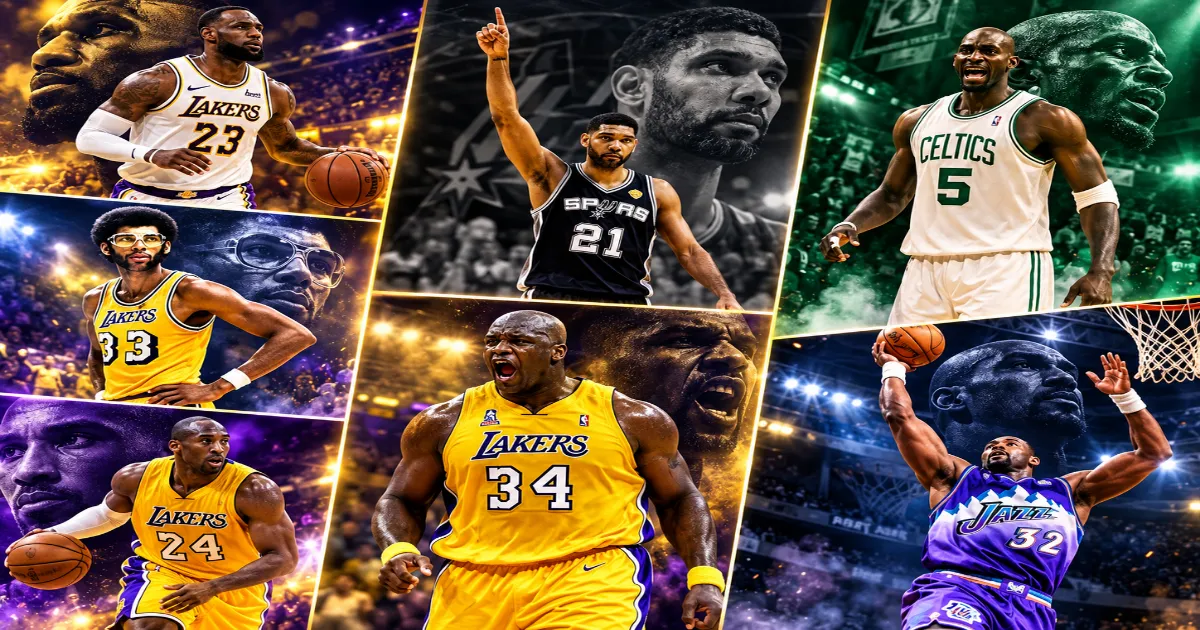
Most All-Star Selections in NBA History: The Complete Rankings
Unlike single-season statistical records, All-Star selections accumulate only one at a time, once per year, meaning this specific record rewards a combination that’s genuinely rare: being good enough to make the roster and staying good enough, for long enough, to keep doing it year after year. This is the complete breakdown of the players who’ve done that more than anyone else.
Most Playoff Wins by an NFL Quarterback: Tom Brady’s 35
Career All-Star Selection Leaders
| Rank | Player | All-Star Selections |
|---|---|---|
| 1 | LeBron James | 20 |
| 2 (tie) | Kareem Abdul-Jabbar | 19 |
| 2 (tie) | Kobe Bryant | 18 |
| 4 (tie) | Tim Duncan | 15 |
| 4 (tie) | Shaquille O’Neal | 15 |
| 4 (tie) | Kevin Garnett | 15 |
| 7 | Karl Malone | 14 |
LeBron James’s twenty selections mean he was chosen as an All-Star in all but one season of a career that has now spanned more than two decades, a rate of selection nearly unmatched by any other player given how long he has sustained it.
Why This Record Rewards Sustained Relevance More Than Peak Dominance
Unlike scoring or rebounding records, which can be built through either a short, explosive peak or a long, consistent accumulation, All-Star selections almost exclusively reward the latter. A player can post historically dominant individual statistics for two or three seasons and still finish well behind someone with a longer career of merely very-good, all-star-caliber production. This is part of why the top of this list skews so heavily toward players with careers of eighteen seasons or longer, since even a decade of elite play typically caps out around ten to twelve selections.
Kareem Abdul-Jabbar’s Nineteen Selections in Context
Abdul-Jabbar’s nineteen All-Star selections came across a twenty-season career, meaning he missed the roster only once in his entire time in the league — a rookie-adjustment season early in his career. His sustained selection rate reflects the same career-long consistency that produced his record six regular-season MVP awards, reinforcing that his case for being among the sport’s most durable, consistently excellent players extends across nearly every major recognition category the league offers.
LeBron James’s Twenty Selections in Full Statistical Context
James’s twenty All-Star selections deserve particular attention given the era he’s played in, one featuring significantly deeper overall talent distribution than existed during Abdul-Jabbar’s or even Bryant’s careers, given the league’s continued international expansion and improved global scouting over the past two decades. Sustaining All-Star-caliber recognition across twenty consecutive eligible seasons, against a demonstrably deeper competitive pool at his position each year, arguably represents an even more difficult version of the same durability achievement Abdul-Jabbar’s nineteen selections reflect, even though both players missed only a single season each across careers of comparable length.
Comparing Selection Totals to Career Length
Looking at selection totals as a percentage of eligible seasons offers another useful lens on this record. James has been selected in 95 percent of his eligible seasons, missing only his second year in the league. Abdul-Jabbar’s rate sits at the same 95 percent mark across his twenty seasons. Bryant’s eighteen selections across twenty seasons produce a 90 percent rate, slightly lower due to his two missed seasons. This near-identical selection rate between James and Abdul-Jabbar, despite playing in eras separated by several decades of increasing competitive depth, reinforces just how similarly durable both careers have been relative to the specific competitive landscape each player faced.
How Selection Criteria Have Changed Over Time
All-Star selection methodology has evolved significantly since the game’s introduction in 1951, shifting from a purely media-voted process to a combination of fan voting, media panels, and player input for reserve selections. These changes mean that comparing selection totals across dramatically different eras requires some caution, since the specific voting mechanisms that produced Abdul-Jabbar’s or even early-career LeBron James’s selections differ meaningfully from the current hybrid system. Fan voting in particular has occasionally produced starter selections for popular players during down seasons that a pure performance-based system might not have selected, though this dynamic affects starting selections more than the overall honor of making the roster.
Kobe Bryant’s Case as the Closest Modern Challenger
Kobe Bryant’s eighteen selections across his twenty-season career place him just behind Abdul-Jabbar, having missed the roster only twice — once early in his career before he’d fully established himself as a starter, and once during an injury-shortened season late in his career. His selection total reflects the same two-era consistency that defines much of his broader statistical legacy, remaining a perennial All-Star both as Shaquille O’Neal’s co-star and later as the Lakers’ unquestioned leader.
Why Big Men Historically Dominate This List
The top of the all-time selection list skews notably toward centers and power forwards — Abdul-Jabbar, Duncan, O’Neal, Garnett, and Malone all rank among the leaders — a pattern that partly reflects the historical scarcity of dominant big men relative to guards and wings. Because elite centers have often been rarer than elite perimeter players in a given season, teams and fans have frequently continued selecting proven veteran big men to All-Star rosters even during seasons when a statistically comparable guard might have faced tougher competition for a roster spot from a deeper overall pool of talent at that position.
The Injury Factor Behind Near-Miss Seasons
Several players on this broader list have had their selection streaks interrupted not by declining performance but by injury, a distinction worth separating from pure competitive displacement. Tim Duncan and Kevin Garnett both missed at least one selection during otherwise-qualifying seasons due to games missed from injury, since All-Star selection has historically required a meaningful threshold of games played before a player becomes eligible for consideration. This means a player’s final selection total sometimes understates their true peak-level relevance across a full career, since a single unlucky injury-shortened season can permanently cap an otherwise-active streak that might have otherwise continued uninterrupted.
Active Players Building Toward This List
Beyond the established names above, several active players are steadily building selection totals that could eventually place them among the all-time leaders. Stephen Curry, Kevin Durant, and Giannis Antetokounmpo have all sustained near-annual selection rates throughout their primes, and each has a realistic path toward the top ten all-time if their current level of play continues for several more seasons. Nikola Jokic’s selection pace, aided by his historically unusual statistical profile for a center, suggests he could climb this list unusually quickly relative to his total seasons played, mirroring the rapid rise his broader statistical and award résumé has shown across a relatively short career so far.
Final Thoughts
Most All-Star selections in NBA history rewards a specific combination that’s genuinely difficult to sustain: elite-enough play to make the roster, repeated year after year, across a career long enough to accumulate a truly significant total. LeBron James’s twenty selections, Kareem Abdul-Jabbar’s nineteen, and Kobe Bryant’s eighteen all reflect careers defined as much by remarkable consistency and longevity as by any single dominant season, reinforcing that this particular record measures durability and sustained relevance above nearly any other individual statistical category in the sport.
Frequently Asked Questions
Who has the most All-Star selections in NBA history? LeBron James, with twenty selections across a career spanning more than two decades, the most in league history.
How many times was Kareem Abdul-Jabbar selected as an All-Star? Nineteen times across his twenty-season career, missing the roster only once, during an early rookie-adjustment period.
Why do centers and power forwards dominate the top of this list? Elite big men have historically been rarer than elite guards and wings in a given season, meaning proven veteran centers and forwards have often continued earning selections even during seasons when competition at other positions was considerably deeper.
What percentage of his eligible seasons has LeBron James been selected as an All-Star? Roughly 95 percent, having missed the roster only once across more than twenty eligible seasons, a rate matched almost exactly by Kareem Abdul-Jabbar despite the two players competing in eras separated by several decades.
🔹🔹 Follow us on Facebook 🔹🔹



One Comment