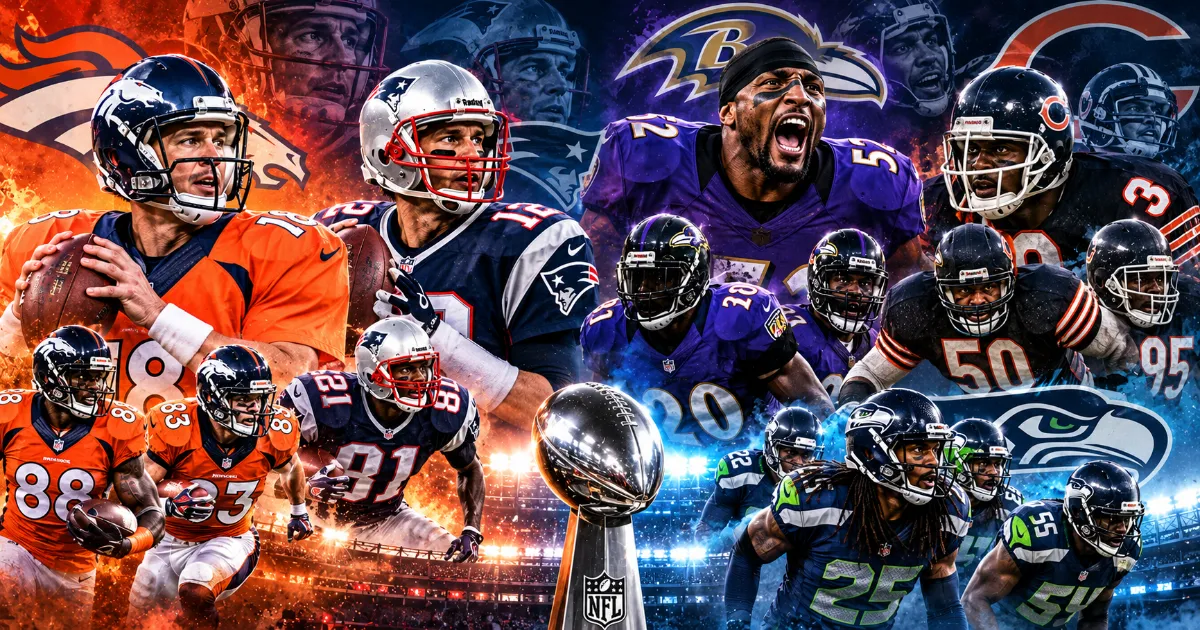
Exploring the record-breaking teams that define the Best NFL Offenses & Defenses Ever across different eras of football
Every era of NFL football produces teams that stretch the boundaries of what an offense or defense is capable of, but a handful of units have separated themselves so clearly from the rest of the league that they’re still the standard other teams get measured against decades later. Here’s a look at the greatest single-season offenses and defenses in NFL history, and what made each one so difficult to stop.
Biggest NFL Contracts Ever: Mahomes’ $450M Deal Still Leads
Most Successful NFL Teams of All Time: Packers Lead With 13 Titles
The Greatest Offense: 2013 Denver Broncos
No offense in NFL history has scored more points in a season than the 2013 Denver Broncos, who put up 606 points — an average of 37.9 per game, also the highest scoring average the league has ever seen. Led by Peyton Manning in his second season with the team, the Broncos set NFL single-season records for passing yards (5,477) and passing touchdowns (55), both of which still stand. Denver scored more than 40 points in six different games that season and topped 50 points three times, including in back-to-back contests. The Broncos’ 606 points came in more than 160 points ahead of the league’s second-best offense that year, a gap that underscores just how far ahead of the field that unit was.
The Previous Record-Holder: 2007 New England Patriots
Before the Broncos broke the mark, the record for points in a season belonged to the 2007 New England Patriots, who scored 589 points en route to a 16-0 regular season, the only perfect regular season in the Super Bowl era. Tom Brady threw 50 touchdown passes that year, a record at the time, and Randy Moss caught 23 of them, also a single-season record. What separated the 2007 Patriots from most other historically great offenses wasn’t just the raw point total — it was that the team paired it with a perfect record, giving the offense a case as the most dominant single-season unit in modern history even after Denver’s 2013 team topped its scoring total.
The Other Contenders: 1999 Rams and 1998 Vikings
Two other offenses are frequently included in any serious conversation about the league’s greatest units. The 1999 St. Louis Rams, nicknamed “The Greatest Show on Turf,” combined Kurt Warner, Marshall Faulk, Isaac Bruce and Torry Holt into arguably the most explosive skill-position group ever assembled, en route to a Super Bowl title in a season that began with Warner as a little-known backup. The 1998 Minnesota Vikings, led by Randall Cunningham and a rookie Randy Moss, averaged 31.3 points per game — a figure that, relative to the league scoring average of that specific season, actually rates as more dominant than several teams that posted higher raw point totals in more pass-friendly later eras.
Adjusting for Era: Why Raw Point Totals Don’t Tell the Whole Story
Comparing offenses across different decades gets complicated because the league’s overall scoring environment has changed dramatically. Rule changes throughout the 2000s and 2010s made it considerably easier to move the ball through the air, which means a team scoring 30 points a game in the 1990s was often doing something more statistically rare, relative to its league-wide competition, than a team scoring the same total in the 2010s. Measured strictly by how far a team outscored the league average that season, the 2007 Patriots actually rate ahead of the record-setting 2013 Broncos, since New England scored roughly 70% more than the league average that year compared to the Broncos’ 62% margin — a reminder that raw record totals and true dominance relative to the era aren’t always the same thing.
The Greatest Defense: 2000 Baltimore Ravens
On the other side of the ball, the 2000 Baltimore Ravens are widely regarded as the standard-bearer for defensive dominance in the modern NFL. Led by Ray Lewis and safety Rod Woodson, the Ravens allowed just 165 points across a 16-game regular season, still the fewest in NFL history for a full 16-game slate, and held opponents to just 10.3 points per game — less than half the league scoring average that year. Baltimore’s defense carried an offense that scored 16 points or fewer in nine of its 20 games that season, including the playoffs, and the unit still won three consecutive road playoff games before dominating the New York Giants 34–7 in Super Bowl XXXV.
The Other Historic Defenses: 1985 Bears and 2013 Seahawks
The 1985 Chicago Bears remain the most iconic defense in NFL history for many fans, a unit built around Hall of Famers Dan Hampton and Richard Dent, alongside Mike Singletary and Otis Wilson, that collected 34 interceptions and 64 sacks across the season. Chicago shut out two of its three playoff opponents en route to Super Bowl XX, including a 24-0 win over the Rams, before holding the Patriots to just 7 rushing yards in a 46–10 Super Bowl blowout — one of the most complete defensive performances in league history.
The 2013 Seattle Seahawks’ “Legion of Boom,” anchored by Richard Sherman, Earl Thomas and Kam Chancellor in the secondary alongside linebacker Bobby Wagner, led the NFL in scoring defense, total defense, pass defense and takeaways that season. Seattle’s defining performance came in Super Bowl XLVIII, where it held Peyton Manning’s record-setting 2013 Broncos offense — the very unit discussed above — to a single touchdown in a 43–8 rout, arguably the most emphatic Super Bowl defensive performance of the past two decades.
Offense vs. Defense: Which Type of Dominance Matters More
There’s a long-running debate in football about whether a historically great offense or a historically great defense is more valuable to a championship team, and the sport’s history doesn’t offer a clean answer. The record-setting 2013 Broncos offense lost the Super Bowl in a blowout to Seattle’s defense, while the 2007 Patriots’ perfect regular season ended in a Super Bowl upset loss to the Giants despite New England’s historic offensive numbers. Meanwhile, the 1985 Bears and 2000 Ravens both rode dominant defenses to Super Bowl titles, arguably with less individually spectacular offensive talent than their opponents. If anything, the clearest pattern across NFL history is that a truly dominant defense has a stronger track record of translating directly into championships than a historically great offense operating on its own.
The Bottom Line
The 2013 Broncos hold the all-time scoring record and the 2007 Patriots remain the standard for combining an unstoppable offense with a perfect season, while the 2000 Ravens and 1985 Bears represent the clearest examples of a defense so dominant it single-handedly carried a team to a championship. Measuring greatness across different eras requires accounting for how much the league’s scoring environment has shifted, but by any reasonable measure, these units remain the benchmarks the rest of NFL history gets compared against.




3 Comments