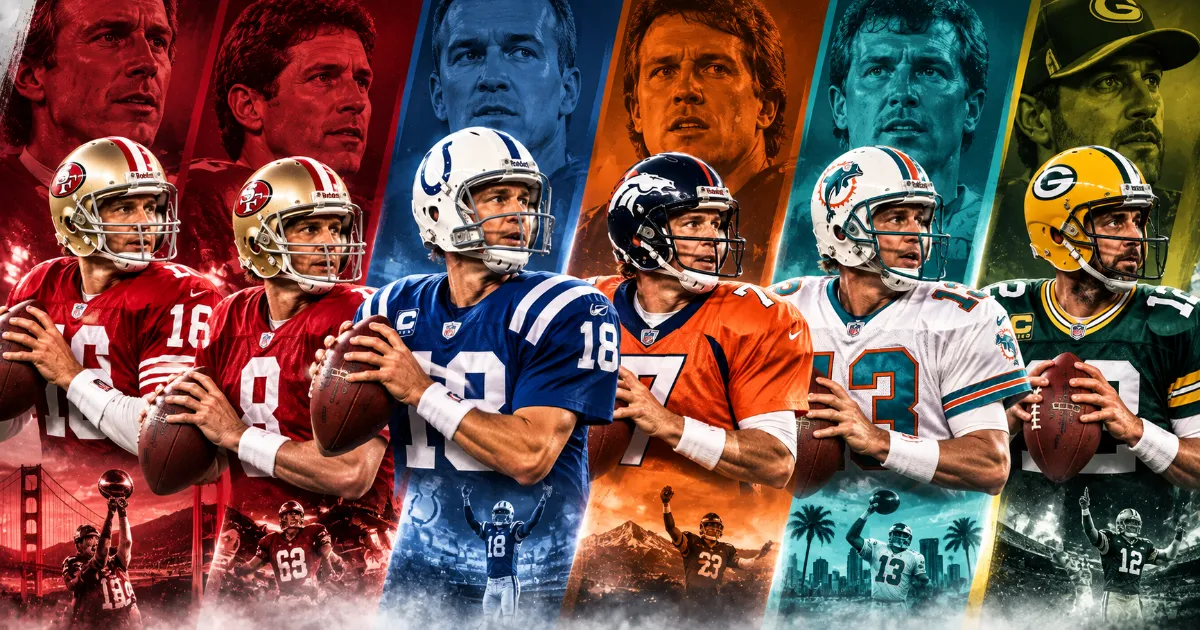
Before Patrick Mahomes and before the Brady-vs-everyone conversation swallowed most quarterback debates whole, a different argument dominated NFL barstools for decades: who was the best quarterback of the pre-Brady era? Six names anchor that debate — Peyton Manning, Joe Montana, Aaron Rodgers, Dan Marino, John Elway and Steve Young — and each brings a genuinely different case to the table. None of them is a clean-cut, unanimous answer, which is exactly why the argument has stayed alive for so long.
Presidents Cup 2026 Results: USA Completes Epic Comeback
Joe Montana: The Standard for Winning
Joe Montana’s case starts and ends with championships. He went 4-0 in Super Bowls, throwing 11 touchdowns against zero interceptions across those four games, and won three Super Bowl MVP awards, a total no other quarterback has matched. His Super Bowl XXIV performance — 5 touchdowns, zero interceptions, a 76% completion rate in a 55-10 win over Denver — is still regarded by many analysts as the single greatest quarterback performance in Super Bowl history. Montana also authored “The Drive,” a 92-yard, game-winning touchdown drive in the final minutes of the 1988 NFC Championship Game, cementing his reputation as the most clutch quarterback of his generation. His critics point out that he played behind Bill Walsh’s innovative West Coast offense and one of the most talented supporting casts in NFL history, including Jerry Rice, making it harder to isolate exactly how much of San Francisco’s success was Montana specifically.
Steve Young: The Efficiency Argument
Steve Young’s case is built on a different foundation entirely: pure statistical dominance relative to his era. Young won two NFL MVP awards, led the league in passing touchdowns four times, and set a Super Bowl record with six touchdown passes in Super Bowl XXIX, a mark that still stands. He also retired with the highest career passer rating in NFL history at the time. What complicates his case is longevity and team-building context — Young didn’t become a full-time starter until age 29, spending years as Montana’s backup in San Francisco, and he inherited an already-loaded 49ers roster rather than building one from scratch the way some of his rivals did.
John Elway: The Legacy Redemption Story
John Elway’s résumé is defined by an unusual arc: three Super Bowl losses early and in the middle of his career, followed by back-to-back Super Bowl wins to close it out. He was named NFL MVP in 1987, made nine Pro Bowls, and is remembered as one of the most physically gifted quarterbacks ever to play the position, with an arm strength that became the standard other scouts measured prospects against for years. Elway also built a reputation as one of the most clutch quarterbacks in league history, orchestrating dozens of fourth-quarter comebacks and game-winning drives across his career, “The Drive” against Cleveland in the 1986 AFC Championship Game chief among them. His critics note that his statistical peak came relatively late, and that his early-career Super Bowl losses were often lopsided.
Dan Marino: The Statistical Pioneer Without a Ring
Dan Marino is the most statistically dominant name on this list in terms of pure passing production relative to his era, and also the only one without a Super Bowl title. He won NFL MVP in 1984, his second season, after setting single-season records of 5,084 passing yards and 48 touchdown passes — numbers that stood as the standard for two decades in an era with far less rule protection for quarterbacks and passing offenses than the modern game provides. Marino retired with more than 40 NFL passing records, and his career total of 61,361 passing yards briefly stood as the all-time record. The absence of a championship is the central weakness in his case, and it’s a significant one in a debate where three of his rivals combined for 11 Super Bowl wins.
Peyton Manning: The Career-Long Statistical Ceiling
Peyton Manning’s case rests on unmatched career-long production and recognition: five NFL MVP awards, still the most in league history, along with 14 Pro Bowl selections and two Super Bowl titles with two different franchises, the Indianapolis Colts and Denver Broncos. Manning also set the single-season passing yardage and touchdown records in 2013 with the Broncos before Mahomes and others eventually surpassed those marks. His case is less about individual iconic moments and more about an unrelenting, decade-and-a-half stretch of being the league’s most consistently dominant quarterback, reflected in his unprecedented MVP total. Critics point to a well-documented pattern of underwhelming playoff performances relative to his regular-season numbers, including a losing career playoff record.
Aaron Rodgers: The Peak Efficiency Argument
Aaron Rodgers’ case centers on peak statistical efficiency arguably unmatched by anyone on this list. He’s a four-time NFL MVP, and across several individual seasons posted touchdown-to-interception ratios that remain among the best the league has ever seen — including a 2020 season with 48 touchdowns against just 5 interceptions. Rodgers won a Super Bowl with the Green Bay Packers following the 2010 season, earning Super Bowl MVP honors in that game. His critics point to a career largely defined by individual brilliance without matching postseason volume — a single championship across more than 15 years as a starter, along with several high-profile playoff disappointments despite historically strong regular seasons.
Comparing the Six Résumés
| Quarterback | Super Bowls Won | Super Bowl MVPs | NFL MVPs | Career Passing Yards |
|---|---|---|---|---|
| Joe Montana | 4 | 3 | 2 | 40,551 |
| Steve Young | 1 | 1 | 2 | 33,124 |
| John Elway | 2 | 0 | 1 | 51,475 |
| Dan Marino | 0 | 0 | 1 | 61,361 |
| Peyton Manning | 2 | 1 | 5 | 71,940 |
| Aaron Rodgers | 1 | 1 | 4 | 59,055 (active) |
Why This Debate Doesn’t Have a Clean Answer
What makes this particular argument more genuinely unresolved than most quarterback debates is that each name represents a different, legitimate axis of greatness. Montana and Elway represent championship pedigree and clutch performance. Marino and Rodgers represent statistical brilliance largely uncoupled from title counts. Manning represents sustained, decade-plus dominance recognized more by his peers and the MVP voters than by championship rings. And Young represents pure efficiency, even if his path to a starting job wasn’t conventional. Ranking these six ultimately depends on how much weight a given fan or analyst assigns to championships versus individual statistical dominance versus longevity — three measures that, in this particular group, rarely point to the same name.
The Bottom Line
There’s no single correct answer to who was the best quarterback of the pre-Mahomes, non-Brady era — the honest answer is that it depends entirely on what you value most. Montana’s championship résumé, Manning’s MVP dominance, Marino’s statistical brilliance without a ring, Elway’s redemption arc, Young’s efficiency, and Rodgers’ peak seasons each hold up under a different lens, and that lack of a clean consensus is exactly what’s kept this debate alive for as long as it has.

One Comment