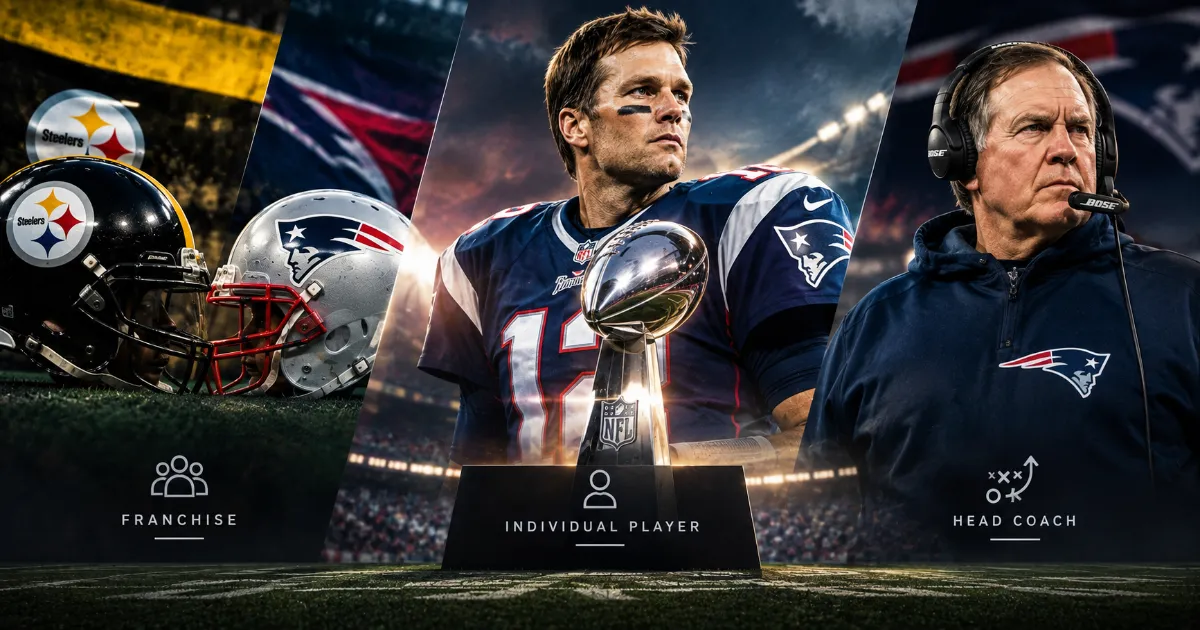
The record for most Super Bowl wins looks completely different depending on whether you’re counting by franchise, by player, or by head coach.
One Question, Three Different Answers
“Who has the most Super Bowl wins?” sounds like a question with a single, clean answer. It isn’t. Ask it about franchises, and you get one answer. Ask it about individual players, and you get a different one entirely — because of a quirk in NFL history that allowed one man to win championships with two separate organizations. Ask it about head coaches, and the answer changes again. All three lists are legitimate, all three matter, and understanding why they diverge tells you something real about how team success and individual greatness aren’t always the same thing in football.
Super Bowl Winners List: Every Champion From Super Bowl I to LX
By Franchise: Patriots and Steelers, Tied at the Top
At the team level, the record is shared. The Pittsburgh Steelers and New England Patriots have each won six Super Bowl championships — Pittsburgh across Super Bowls IX, X, XIII, XIV, XL, and XLIII, and New England across Super Bowls XXXVI, XXXVIII, XXXIX, XLIX, LI, and LIII. This tie very nearly ended in February 2026: the Patriots reached Super Bowl LX as favorites to claim a record-breaking seventh championship and sole possession of the most successful-franchise title in NFL history. Instead, the Seattle Seahawks’ defense throttled New England 29-13, sacking quarterback Drake Maye six times and forcing three turnovers, leaving the Patriots and Steelers tied at the top for at least another season.
| Rank | Franchise | Super Bowl Wins |
|---|---|---|
| T-1 | Pittsburgh Steelers | 6 |
| T-1 | New England Patriots | 6 |
| T-3 | Dallas Cowboys | 5 |
| T-3 | San Francisco 49ers | 5 |
| T-5 | Green Bay Packers | 4 |
| T-5 | New York Giants | 4 |
| T-5 | Kansas City Chiefs | 4 |
| T-8 | Seattle Seahawks | 2 |
By Individual Player: Tom Brady Stands Alone
Shift the lens to individual players, and the record no longer belongs to anyone associated with the Steelers at all. Tom Brady has seven Super Bowl championships — one more than either the Patriots or the Steelers have won as a franchise — because Brady did something almost no other player in NFL history has managed: he won championships with two different teams. Six of his titles came with New England; his seventh came in 2021 with the Tampa Bay Buccaneers, a franchise that had won exactly one Super Bowl in its entire prior history before Brady arrived.
This is precisely why the individual and franchise leaderboards can’t simply mirror each other. A player who spends their entire career with one dominant organization is capped at that franchise’s total no matter how great they are individually — which is why no Pittsburgh player, however decorated, has more than the Steelers’ own six championships. Brady’s decision to leave New England in free agency after the 2019 season, something almost unthinkable for a quarterback of his stature at the time, is the specific event that allowed him to separate his personal total from any single franchise’s ceiling.
By Head Coach: Belichick’s Six, and a Very Different Runner-Up
Among head coaches, Bill Belichick sits alone at the top with six Super Bowl championships, all won with the Patriots across the Brady era. Chuck Noll, who led Pittsburgh’s 1970s dynasty, holds the second position with four championships — an accomplishment that once stood as the standard for coaching greatness until Belichick’s Patriots run eventually surpassed it. No other head coach in NFL history has won more than three Super Bowls, making this specific leaderboard the most top-heavy of the three main categories: two men account for ten combined championships, a level of concentration that dwarfs even the most dominant individual players outside of Brady.
Why These Three Lists Will Probably Never Fully Align
The gap between these three leaderboards isn’t a coincidence — it reflects a genuine structural difference in how football success is built. A franchise’s championship total is essentially permanent infrastructure: stadiums, ownership continuity, and organizational culture that persists across generations of players and coaches. A head coach’s total depends on staying with (or being retained by) a single, successful organization long enough to compound multiple championship runs, which is precisely why Belichick and Noll — both extraordinarily long-tenured with one team — sit atop that list. A player’s total, however, depends only on where they’re on the roster when a championship is actually won, which is the one variable flexible enough to let a player like Brady exceed even his own former franchise’s all-time mark.
This is also why “most championships” as a category tends to reward longevity above nearly everything else across all three lists. Every name at the top of every version of this leaderboard — the Steelers’ and Patriots’ sustained runs, Brady’s 23-year career, Belichick’s two-decade partnership with his own quarterback — represents an extended period of success rather than a single transcendent season. Football’s champion-crowning format, with only one team winning it all per year, makes stacking multiple titles inherently a test of sustained organizational and individual excellence rather than one great year.
The Near-Miss That Made 2026 Historic
Super Bowl LX carried unusually high stakes for exactly this reason: had New England won, it would have simultaneously broken the franchise tie with Pittsburgh and reopened questions about where that Patriots era — this time without Brady or Belichick, led instead by young quarterback Drake Maye — fit into the franchise’s broader dynasty legacy. Seattle’s win instead preserved the Steelers-Patriots tie at the franchise level while adding an entirely different storyline to the individual and team conversation: head coach Mike Macdonald, in just his first season in Seattle, and quarterback Sam Darnold, completing one of the more notable redemption arcs in recent NFL memory after being written off by multiple previous franchises, delivered the Seahawks’ second championship in franchise history. Neither Macdonald nor Darnold is anywhere near threatening any of the leaderboards above yet, but Super Bowl LX is a reminder that these lists are still actively being written, one upset at a time.
What It Would Take to Change Any of These Lists
For the franchise record to change outright, either Pittsburgh or New England would need to win a seventh championship before the other, or a third franchise would need an extraordinary run to catch both at six — a tall order given that only the Cowboys and 49ers, at five apiece, sit within realistic single-title striking distance. For the individual player record to change, another quarterback would need to both sustain Brady-level championship success and, like Brady, potentially win with more than one organization — a combination so specific that it’s never been fully replicated even once in NFL history before Brady did it himself. For the coaching record to change, a currently active coach would need to both remain with a single franchise for the better part of two decades and sustain the kind of championship-level roster-building that allowed Belichick to compound six titles across that span — a bar that has proven just as difficult to clear as either of the other two records.
Other Multi-Championship Players Worth Knowing
Brady’s total is so far ahead of the pack that it’s easy to overlook the players clustered just behind him, several of whom built genuinely remarkable championship résumés of their own. Charles Haley won five Super Bowl rings across stints with both the San Francisco 49ers and Dallas Cowboys in the late 1980s and 1990s, making him the first player in NFL history to win championships with two different franchises — a distinction Brady would later match and then surpass in total number. On the coaching side, Bill Walsh and Joe Gibbs each won three Super Bowls in relatively short windows, with Walsh in particular credited for a wider offensive influence — the West Coast offense — that arguably shaped the sport more broadly than his championship count alone suggests. These names rarely dominate the conversation the way Brady, Belichick, the Patriots, or the Steelers do, but they represent the tier of sustained multi-championship success that sits just below the true outliers at the very top of each list.
Why Team Success and Individual Legacy Aren’t the Same Conversation
The gap between these leaderboards ultimately illustrates something worth remembering whenever “most championships” gets used as a stand-in for “greatest ever” in any sport: team success depends on dozens of moving parts working simultaneously across an entire organization, while individual legacy depends heavily on which teams a player happens to be part of at the right moments. Brady’s case is instructive here — his six championships in New England reflect one of the most stable, sustained organizational partnerships in football history, while his seventh with Tampa Bay reflects something closer to individual greatness landing in the right situation for one additional season. Both are real achievements, but they’re not really measuring the same thing, which is exactly why serious evaluators tend to look at all three versions of this record — franchise, player, and coach — rather than collapsing them into one number.
The Bottom Line
Most Super Bowl wins isn’t really one record — it’s three separate, equally legitimate records that happen to get discussed as if they’re interchangeable. The Steelers and Patriots share the franchise crown at six, a tie New England came within one game of breaking in February 2026. Tom Brady owns the individual record outright at seven, a total no single franchise can even match, built on the unprecedented decision to chase a championship with a second organization late in his career. And Bill Belichick sits alone among coaches at six, a testament to how rare it is for any coach-quarterback partnership to sustain success as long as his did with Brady. All three records point to the same underlying truth about the Super Bowl era: real, sustained dominance is rare enough that it takes a genuinely different set of achievements to lead each version of this list.
Whichever version of the record matters most to a given conversation, the underlying lesson is the same: championships in the NFL are hard enough to win once that stacking multiple titles, by any measure, remains one of the rarest achievements in professional sports. Sixty Super Bowls have been played, and only a handful of franchises, players, and coaches have ever managed to do it more than a couple of times — a scarcity that’s precisely what keeps every one of these leaderboards worth watching, season after season.
Frequently Asked Questions
Which NFL team has the most Super Bowl wins? The Pittsburgh Steelers and New England Patriots are tied for the most Super Bowl championships won by a franchise, with six each.
Who has the most Super Bowl wins as an individual player? Tom Brady holds the individual record with seven Super Bowl championships — six with the New England Patriots and one with the Tampa Bay Buccaneers — more than any single franchise has won.
Which head coach has won the most Super Bowls? Bill Belichick holds the record among head coaches with six Super Bowl championships, all won with the New England Patriots.
Did the Patriots almost set a new record for most Super Bowl wins in 2026? Yes — a win in Super Bowl LX would have given New England a record seventh championship as a franchise, but the Seattle Seahawks won 29-13, keeping the Patriots tied with the Steelers at six.
Why does Tom Brady have more championships than any team he played for? Brady won six championships with the Patriots and left in free agency after the 2019 season, then won a seventh with the Tampa Bay Buccaneers in 2021 — meaning his personal total combines success from two different organizations.
Who is second on the all-time head coaching Super Bowl wins list? Chuck Noll, who led the Pittsburgh Steelers’ dynasty in the 1970s, ranks second among head coaches with four Super Bowl championships.
🔹🔹 Follow us on Facebook 🔹🔹
Maya Bennett — Athlete News Editor
Maya Bennett serves as GridironHoops’ Athlete News Editor, overseeing coverage centered on the athletes themselves — their performances, milestones, career developments, major announcements and stories away from the traditional game-day cycle.
Her coverage crosses sports and leagues, allowing GridironHoops to follow the biggest names in basketball, football, motorsports, swimming, athletics and other major sports. Maya focuses on presenting athlete-related news with context and clarity while keeping the reporting centered on information that matters to sports fans.
She also works across the editorial team to identify important athlete stories and ensure that major developments receive consistent coverage regardless of the sport involved.
Coverage: Athlete news, player developments, career milestones, major announcements and cross-sport stories.