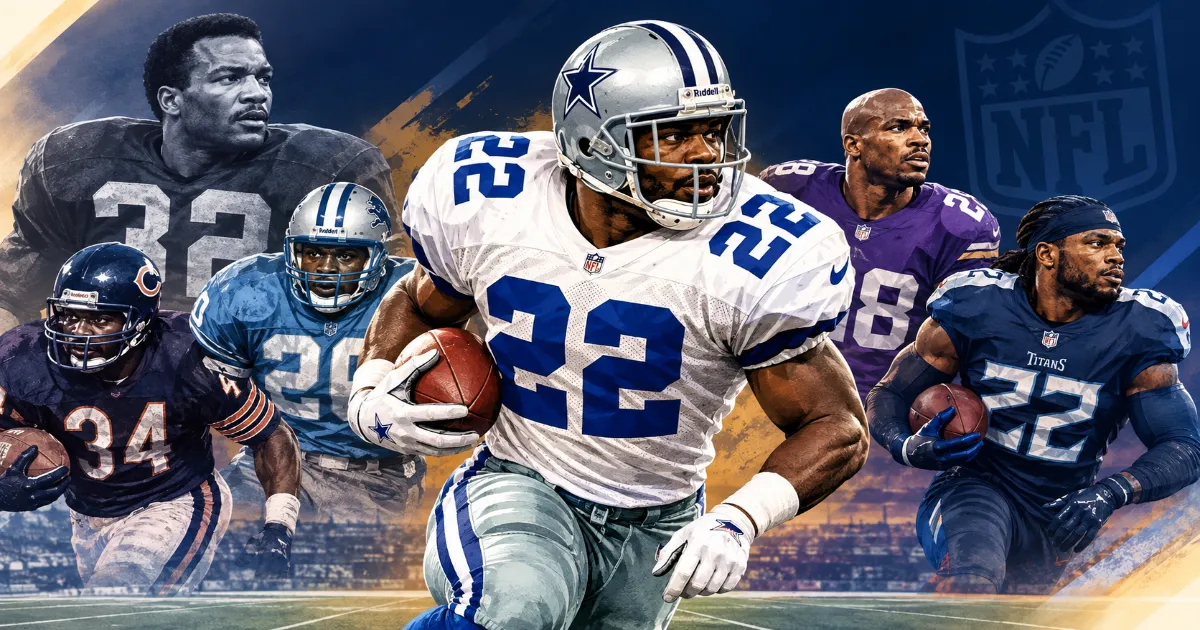
Two decades after it was set, the list of most rushing yards in NFL history is being protected less by talent and more by how the position itself has changed.
A Record That’s Slower Than Most, By Design
Unlike passing records, which can balloon in a single explosive season thanks to rule changes and pass-friendly offensive schemes, the record for most rushing yards in NFL history has always been earned differently — a few yards at a time, over a decade or more, against defenders whose entire job is to prevent exactly that. That structural difference is worth understanding before looking at the leaderboard itself, because it explains why this particular record has moved so much slower than its passing counterparts, and why the current gap at the top may be more permanent than any other major statistical record in the sport.
Most Passing Yards in NFL History: Ranking the Top 10 Career Leaders
The Current Leaderboard
| Rank | Running Back | Career Rushing Yards | Seasons | Status |
|---|---|---|---|---|
| 1 | Emmitt Smith | 18,355 | 1990-2004 (15) | Retired (all-time record) |
| 2 | Walter Payton | 16,726 | 1975-1987 (13) | Retired |
| 3 | Frank Gore | 16,000 | 2005-2020 (16) | Retired |
| 4 | Barry Sanders | 15,269 | 1989-1998 (10) | Retired |
| 5 | Adrian Peterson | 14,918 | 2007-2021 (15) | Retired |
| 6 | Curtis Martin | 14,101 | 1995-2005 (11) | Retired |
| 7 | LaDainian Tomlinson | 13,684 | 2001-2011 (11) | Retired |
| 8 | Jerome Bettis | 13,662 | 1993-2005 (13) | Retired |
| 9 | Eric Dickerson | 13,259 | 1983-1993 (11) | Retired |
| 10 | Tony Dorsett | 12,739 | 1977-1988 (12) | Retired |
Jim Brown, at 12,312 career yards, sits just outside this top 10 — a placement that looks unremarkable until you consider he retired after just nine seasons, a detail that changes this entire conversation considerably.
Why Career Length Tells Only Half the Story
The single most important thing to understand about this list is that raw yardage totals obscure enormous differences in how much football each player actually played to get there. Emmitt Smith’s record required 15 seasons. Walter Payton’s total came in 13. Barry Sanders reached fourth place in just 10 seasons before retiring while still near his statistical peak — meaning his per-season pace, had he played even three or four more years at a similar level, would have put him within realistic range of Smith’s record, or possibly past it.
Jim Brown is the most extreme version of this pattern. His 12,312 yards came across just nine seasons, an average of over 1,368 rushing yards per season — a pace that, if merely maintained rather than exceeded, would have carried him past 18,000 yards by his 13th season, roughly matching Smith’s total in two fewer years. Brown retired voluntarily at the peak of his career to pursue an acting and activism career, leaving one of the sport’s most tantalizing “what if” questions permanently unresolved. Judged purely on rate of production rather than career accumulation, a case can be made that Brown remains the most dominant pure rusher the position has ever seen, even 60 years after his final carry.
The Workhorse Era That Built This List
Look closely at the seasons played by nearly everyone in the top 10, and a pattern emerges: almost all of this era’s greatest rushers played through the 1970s, ’80s, ’90s, and early 2000s — a period when a single feature back might realistically carry the ball 300-plus times in a season, absorbing a workload that today’s NFL simply doesn’t ask of any one player. Eric Dickerson’s 1984 season alone produced 2,105 rushing yards, still the single-season record, built on a workload distribution that modern coaching staffs would consider borderline reckless given what’s now understood about long-term durability and injury risk.
That workhorse approach is precisely what allowed backs like Smith, Payton, and Martin to accumulate such enormous career totals — not necessarily because they were more talented than today’s backs, but because the offensive systems of their eras were built to feed one primary ball carrier the overwhelming majority of a team’s rushing attempts, year after year, for a decade or more.
Why the Modern Game Has Frozen This List in Place
The single biggest reason Smith’s record has now stood for more than two decades without a serious challenge isn’t a decline in running back talent — it’s a wholesale change in how NFL teams build their backfields. The “running back committee” approach, where two or three backs split carries based on matchup, situation, and load management, has become the dominant team-building philosophy across almost the entire league, driven partly by a growing understanding of injury risk and partly by how thoroughly the passing game has come to dominate offensive play-calling.
This shift has had a direct, measurable effect on career rushing totals: it’s simply much harder for any individual back to accumulate 300-plus carries in a season today than it was for Dickerson, Payton, or Smith in their primes, which means the path to Smith’s total now requires either an unusually long career at a committee-reduced workload, or a rare team willing to buck the league-wide trend and commit to a true workhorse back deep into his 30s. Neither scenario has presented itself convincingly since Smith retired in 2004, which is precisely why no player has come within 1,600 yards of his total in the two decades since.
Derrick Henry: The Active Standard-Bearer
If any active running back is going to make a serious run at this record, Derrick Henry represents the strongest remaining case, sitting 18th on the all-time list with 11,665 career rushing yards as the active leader following his move to the Baltimore Ravens. Henry has built his career on precisely the kind of workhorse workload that’s become increasingly rare across the rest of the league, and his continued elite production well into his 30s — an age at which most modern running backs have either retired or been reduced to a committee role — makes him the exception to nearly every trend currently working against this record’s future.
Even with that said, the math remains difficult: Henry would need several more highly productive seasons, at an age where running back production has historically declined sharply, to have any realistic shot at Smith’s total. Barring an unusually durable final stretch to his career, Henry’s more realistic ceiling is a firm place inside the all-time top 10, rather than a genuine threat to the record itself.
What Made Smith’s Record Different From a Pure Talent Ranking
It’s worth being direct about something that often gets lost in career-yardage conversations: Emmitt Smith’s status as the all-time rushing leader has never been universally accepted as proof he was the most talented pure runner the position has ever produced. Barry Sanders’ combination of vision and elusiveness, and Jim Brown’s per-season dominance, are both frequently cited by historians and former players as a more awe-inspiring pure running talent than Smith’s more patient, technically sound style. What separated Smith wasn’t raw explosiveness — it was a rare combination of durability, offensive line quality in Dallas throughout the 1990s, and a coaching staff committed to feeding him a heavy workload for over a decade, missing only seven total games across an 11-year stretch from 1991 to 2001. The record, in other words, measures accumulated career production specifically, not a definitive answer to “who was the best running back ever” — a distinction worth keeping in mind whenever this list gets cited as the final word on running back greatness.
Barry Sanders: The Great “What Could Have Been”
No conversation about this record is complete without dwelling on Barry Sanders, whose fourth-place finish at 15,269 yards remains one of the most debated retirements in NFL history. Sanders walked away from the game in 1998 at just 30 years old, still performing at an elite level and coming off a 2,053-yard season — the third-highest single-season total ever recorded at the time. Had he played even three or four more seasons at a level anywhere close to his career average of roughly 1,527 yards per season, Sanders would have finished with a career total rivaling or exceeding Smith’s record entirely. His early retirement, driven by frustration with the direction of the Detroit Lions organization rather than any decline in his own ability, means the rushing record technically belongs to the back who played the longest at a high level, not necessarily the back most evaluators consider the most talented pure runner to ever touch a football.
A Record Built on a Different Kind of Team Support
It’s also worth acknowledging how much offensive infrastructure mattered to Smith’s total specifically. Dallas fielded one of the most dominant offensive lines in NFL history throughout Smith’s prime seasons in the early-to-mid 1990s, a unit that helped pave the way for three Super Bowl championships and gave Smith a level of consistent blocking support that few running backs in history have enjoyed for as long a stretch. This isn’t a knock on Smith’s own remarkable vision, patience, and durability — all essential qualities that separated him from backs with similar talent but shorter or less productive careers — but it’s a reminder that no rushing record, however individually earned, exists independent of the system and personnel surrounding the player who set it.
The Postseason Record Tells a Similar Story
Smith’s dominance extends to the postseason as well, where he also holds the all-time career rushing yardage record with 1,586 yards — meaning he holds both the regular-season and playoff versions of this record simultaneously, a distinction shared by very few players across any major statistical category in NFL history. That combination underscores just how complete his statistical dominance was across the entirety of his career, not merely during the regular season.
The Bottom Line
The list of most rushing yards in NFL history is, more than almost any other record in the sport, a story about opportunity as much as ability. Emmitt Smith’s 18,355 yards represent an extraordinary combination of talent, durability, and a coaching philosophy that no longer exists in the modern NFL, which is exactly why this record has aged into one of the most secure in professional sports — not because no one since has been talented enough to threaten it, but because the league itself has fundamentally changed how it distributes the workload that made such a total possible in the first place.
What makes this record genuinely different from the passing marks discussed elsewhere in NFL record books is the direction the sport is moving. Passing records keep getting more attainable as rules and schemes favor the quarterback position further every year. The rushing record is moving the opposite way — becoming harder, not easier, to approach with each passing season, as offensive coordinators lean further into committee backfields and pass-heavy game plans. Barring a genuine philosophical reversal in how NFL teams build their offenses, Emmitt Smith’s name may occupy the top of this list for a great deal longer than the two decades it’s already held.
Frequently Asked Questions
Who holds the record for most rushing yards in NFL history? Emmitt Smith holds the record with 18,355 career rushing yards, accumulated across 15 seasons primarily with the Dallas Cowboys between 1990 and 2004.
Is Emmitt Smith’s rushing record likely to be broken? Most analysts consider it highly unlikely in the near term. No player has come within 1,600 yards of the record in over two decades, largely due to the NFL’s shift toward running-back-committee systems that reduce individual workload.
Who is the active NFL leader in career rushing yards? Derrick Henry leads all active players with 11,665 career rushing yards, currently playing for the Baltimore Ravens after a long run with the Tennessee Titans.
Why does Jim Brown rank outside the top 10 despite being considered one of the greatest running backs ever? Brown retired after just nine seasons to pursue an acting and activism career, meaning his 12,312 career yards came in far fewer seasons than everyone ranked above him — his per-season average remains higher than nearly every other back on the all-time list.
How many rushing yards did Emmitt Smith have in the playoffs? Smith also holds the NFL’s all-time career playoff rushing yardage record, with 1,586 yards, making him the all-time leader in both the regular season and postseason simultaneously.
Why has the rushing yards record been so much harder to break than passing records? Rushing production depends heavily on how many carries a single back receives, and modern NFL teams increasingly split carries between multiple backs rather than relying on one workhorse runner, making it structurally harder for any individual player to accumulate the volume needed to threaten the record.
🔹🔹 Follow us on Facebook 🔹🔹