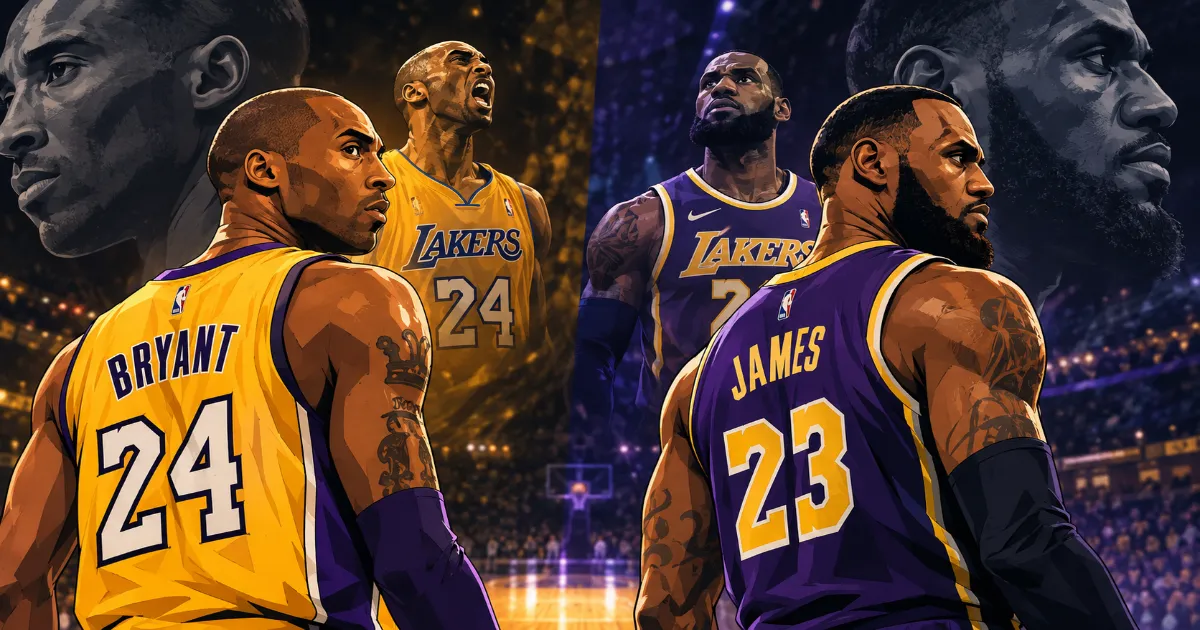
One built a legacy on obsessive scoring perfection, the other on two decades of relentless production — the LeBron James vs Kobe Bryant debate is closer than it looks
Few debates carry as much emotional weight in NBA circles as LeBron James vs Kobe Bryant, a comparison made even more poignant by Bryant’s tragic passing in 2020 and James’s decision to honor his rival-turned-friend by wearing the number 24 during his own Lakers tenure. The two spent nearly a decade and a half as direct era-mates and, for several years, actual teammates on the same Los Angeles Lakers roster during the twilight of Bryant’s career, giving this rivalry a personal texture that few other greatest-of-all-time debates possess.
The Greatest NBA Players of All Time, Judged by Every Standard That Matters
The Fastest NBA Players Ever: Who Really Owns the Open Court?
Unlike some generational comparisons, LeBron James vs Kobe Bryant isn’t really a story of two entirely different eras — it’s a story of two players who took dramatically different approaches to greatness while operating in largely overlapping timelines, both chasing the shadow of Michael Jordan in their own ways.
The Scoring Obsession vs. The Complete Package
Kobe Bryant’s entire basketball identity was built around an almost obsessive commitment to scoring the basketball at an elite, high-difficulty level. His 81-point game against the Toronto Raptors in 2006 remains the second-highest single-game scoring total in NBA history, trailing only Wilt Chamberlain’s legendary 100-point performance. Bryant’s footwork, fadeaway jumper, and shot-creation ability were deliberately modeled after Jordan’s game, and he became renowned across the league for his willingness to take — and often make — some of the most difficult shots basketball allows.
LeBron James, by contrast, built his game around a more complete statistical profile from the very start of his career. Rather than being purely a scorer, James combined elite scoring with historically great passing and playmaking for a player his size, evidenced by his position among the NBA’s all-time assist leaders despite spending most of his career as a primary scoring option. Where Bryant’s game was built on relentless shot difficulty, James’s game was built on efficiency, versatility, and an ability to fill a box score in nearly every meaningful statistical category.
Championship Résumés
Kobe Bryant won five NBA championships across his twenty-year career, all with the Los Angeles Lakers, split into two distinct three-peats separated by a rebuilding stretch in the mid-2000s. His first three titles came alongside Shaquille O’Neal in the early 2000s, while his final two came as the unquestioned leader of the franchise in 2009 and 2010, a distinction Bryant himself valued highly as proof he could win without O’Neal’s dominant interior presence.
LeBron James has won four championships across three different franchises — the Miami Heat, Cleveland Cavaliers, and Los Angeles Lakers — a level of multi-team championship success that stands in contrast to Bryant’s single-franchise loyalty. James’s 2016 championship with Cleveland is often cited as one of the most significant individual achievements in Finals history, as he led a comeback from a 3-1 series deficit against a Golden State Warriors team that had won a record 73 regular-season games.
Longevity and Statistical Accumulation
This category represents one of the clearest advantages in the LeBron James vs Kobe Bryant comparison. James has maintained elite, All-NBA-caliber production for over twenty seasons and became the NBA’s all-time leading scorer, a record that once belonged to Kareem Abdul-Jabbar. Bryant retired as the third all-time leading scorer at the time, a mark James would eventually surpass, but Bryant’s twenty-season career was itself remarkable, especially considering the physical toll of his scoring-heavy, high-usage playing style.
James’s ability to sustain top-tier efficiency well into his late 30s, a stretch of his career where most comparable stars — including Bryant — had already experienced significant statistical decline, remains one of the most historically unusual aspects of his entire résumé.
Individual Awards and Recognition
Kobe Bryant won a single regular-season MVP award in 2008, a number that surprises casual fans given his overall standing in the sport, largely because he spent much of his prime competing against other historically great players for that specific honor. He did win two Finals MVP awards, both during his post-O’Neal championship runs, along with twelve All-Defensive team selections that reflect a level of two-way commitment often underappreciated relative to his offensive reputation.
LeBron James has won four regular-season MVP awards, four Finals MVP awards, and has been selected to more All-NBA First Teams than almost any player in league history. James’s individual award haul, when combined with his longevity, gives him a statistical and honors-based edge in most direct comparisons, though Bryant supporters often argue that raw award counts undersell how dominant Bryant looked to opposing players and coaches during his true prime years.
The Mamba Mentality Factor
Part of what makes LeBron James vs Kobe Bryant such an enduring debate is Bryant’s cultural legacy extending well beyond statistics. The “Mamba Mentality” — Bryant’s relentless, almost obsessive work ethic and competitive drive — became a cultural phenomenon that influenced an entire generation of athletes across multiple sports, not just basketball. Stories of Bryant’s pre-dawn practice sessions and refusal to accept anything less than maximum effort became foundational parts of his legend, arguably as influential on younger players as his actual statistical output.
James has built his own significant off-court legacy, particularly around business ventures, media ownership, and social activism, but it operates in a fundamentally different register than Bryant’s — less about singular competitive obsession and more about building sustained institutional influence across business, politics, and culture.
Head-to-Head Statistical Comparison
| Category | LeBron James | Kobe Bryant |
|---|---|---|
| Championships | 4 | 5 |
| Regular-Season MVPs | 4 | 1 |
| Finals MVPs | 4 | 2 |
| Career Points | All-time NBA leader | 4th all-time (at retirement, 3rd) |
| All-NBA First Team Selections | More | Fewer |
| All-Defensive Selections | 6 | 12 |
| Career Length | 20+ seasons | 20 seasons |
| Career High (Single Game) | 61 points | 81 points |
The Teammate Chapter
An often-overlooked wrinkle in the LeBron James vs Kobe Bryant story is that the two were briefly teammates on the 2012 and 2016 U.S. Olympic and national team rosters, giving fans a rare glimpse of mutual respect between two players usually discussed as rivals. Bryant has spoken publicly about pushing James in practice specifically to make him a better competitor, while James has consistently credited Bryant’s influence and work ethic as a driving force in his own approach to preparation, particularly in the second half of his career.
The Shaquille O’Neal Factor
No LeBron James vs Kobe Bryant conversation is complete without addressing how Bryant’s early championship success intertwined with Shaquille O’Neal’s dominance. The Lakers’ three consecutive titles from 2000 to 2002 were built around O’Neal as the primary offensive engine, with Bryant developing into a superstar alongside him before their well-documented rift eventually led to O’Neal’s departure. Bryant’s subsequent championships in 2009 and 2010, won without O’Neal and instead alongside Pau Gasol, are frequently cited by his supporters as proof he could lead a franchise as the unquestioned number-one option, addressing a criticism that had followed him through the earlier part of his career.
James, notably, has never won a championship as the clear, singular best player on his roster in quite the same contested way — his title runs in Miami came alongside Dwyane Wade and Chris Bosh, his 2016 Cleveland title came with Kyrie Irving playing an enormous complementary role, and his 2020 Lakers championship came alongside Anthony Davis. This has led to an inverse critique from some corners of the debate: that James has more frequently shared top-tier co-stars across his championship runs than Bryant did during his second three-peat.
Injury History and Physical Toll
Durability plays a quiet but meaningful role in the LeBron James vs Kobe Bryant comparison. Bryant’s career included several significant injuries, most notably a torn Achilles tendon suffered in 2013 at age 34, an injury from which he never fully returned to his prior level of dominance, playing out the final two seasons of his career at diminished capacity before retiring in 2016 with an iconic 60-point farewell performance.
James, meanwhile, has been remarkably durable relative to his workload and playing style, rarely missing extended stretches to injury despite a physically demanding, downhill-attacking game maintained across two full decades. This durability is a meaningful part of why James has been able to accumulate statistical totals that Bryant, even with a twenty-season career of his own, was ultimately unable to match.
Post-Career and Off-Court Legacy
Kobe Bryant’s post-playing legacy took on a different shape than most retired superstars, as he pursued storytelling and youth basketball development through his Mamba Sports Academy and won an Academy Award for the animated short film “Dear Basketball” before his death in a 2020 helicopter crash alongside his daughter Gianna. That tragedy transformed Bryant’s legacy into something larger than basketball statistics alone, with the “Mamba Mentality” phrase becoming a broader cultural touchstone referenced across sports, business, and self-improvement contexts far beyond the NBA.
James’s off-court legacy continues to evolve in real time, anchored by significant business ventures, a media production company, and the founding of the I PROMISE School in his hometown of Akron, Ohio, which focuses on supporting at-risk students. Where Bryant’s legacy is now fixed and complete, James’s remains an active, ongoing story that will likely continue reshaping how this comparison is discussed for years to come.
How Fans and Players Weigh In
Surveys of active and former NBA players over the years have produced mixed results in the LeBron James vs Kobe Bryant conversation, often splitting along generational lines. Players who competed directly against Bryant in his early-to-mid prime frequently cite his shot-making difficulty and competitive fire as unmatched in their own experience, while players who have shared the court with James more recently point to his combination of size, vision, and sustained production as something they’ve never seen replicated. Neither perspective is more “correct” than the other — they simply reflect different eras of direct competitive exposure, which is part of why this debate resists easy resolution even among the people best positioned to judge it firsthand. Media panels and Hall of Fame voters have leaned somewhat more toward Bryant historically, largely on the strength of his five championships and his stylistic resemblance to Jordan, though James’s continued statistical accumulation has steadily shifted more recent polling in his direction.
Final Thoughts
The LeBron James vs Kobe Bryant debate ultimately reflects two distinct visions of basketball greatness that happened to unfold during roughly the same two decades. Bryant’s legacy is built on scoring artistry, single-franchise loyalty, and a competitive mythology that transcended basketball entirely. James’s legacy is built on statistical completeness, championship success across multiple franchises, and a level of sustained excellence that has no real historical precedent. Both men chased Michael Jordan’s shadow throughout their careers, and both, in different ways, managed to build legacies substantial enough to be discussed in the same breath as basketball’s very best.
Frequently Asked Questions
Who scored more points in a single game, LeBron James or Kobe Bryant? Kobe Bryant holds the higher single-game total with his 81-point performance against Toronto in 2006, compared to LeBron James’s career-high of 61 points.
Did LeBron James and Kobe Bryant ever play on the same team? They were never NBA teammates, but they played together on U.S. national team rosters, including the 2012 and 2016 Olympic teams.
Who has won more championships, LeBron James or Kobe Bryant? Kobe Bryant won five NBA championships, all with the Los Angeles Lakers, while LeBron James has won four championships across three different franchises.
🔹🔹 Follow us on Facebook 🔹🔹
Greatest NFL Players of All Time: Legends, Criteria, and the Case for Each Era


One Comment