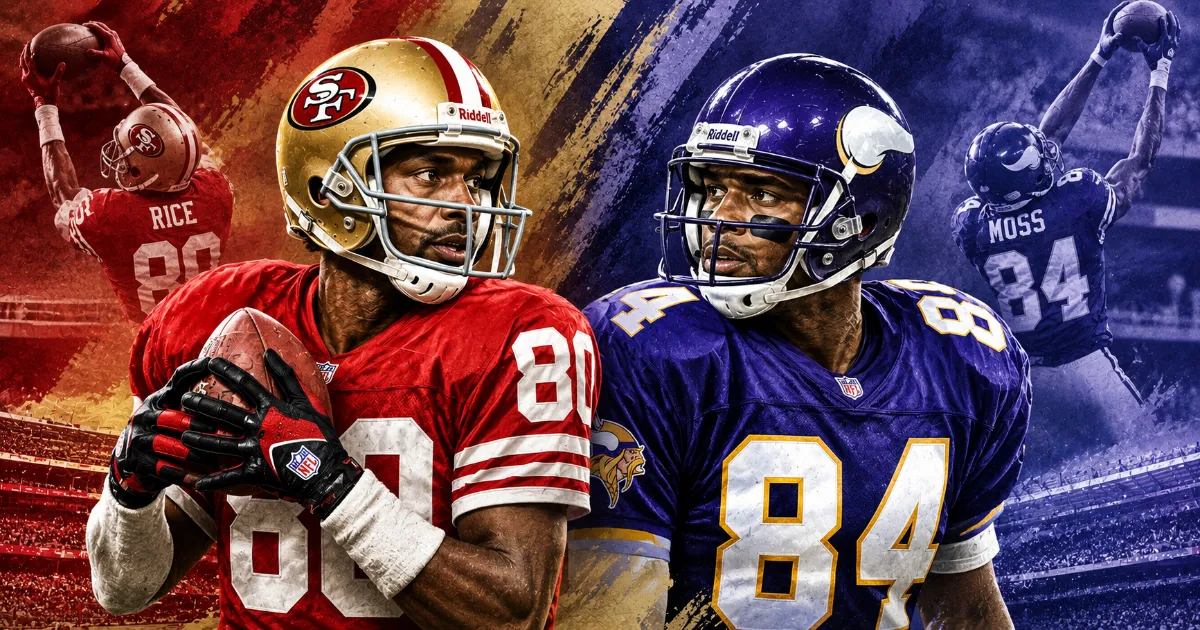
When Randy Moss called himself the greatest receiver ever, Jerry Rice fired back with numbers — but the real Jerry Rice vs Randy Moss debate is about skill sets, not just stats.
The Feud That Reopened an Old Debate
In December 2020, Randy Moss went on Terrell Owens’ podcast and said the quiet part out loud: he considers himself the greatest wide receiver in NFL history, with Owens second and Jerry Rice third or fourth. Rice, never one to let a challenge to his legacy go unanswered, responded on Instagram with a side-by-side stat comparison — seasons, receptions, yards, touchdowns, championships — and closed with the exact phrase Moss himself made famous as a broadcaster whenever one player thoroughly outplays another: “You just got Mossed.”
It was a genuinely entertaining moment between two Hall of Famers, but it also oversimplified a debate that deserves better than a single Instagram post. Rather than settle this with career totals alone, the more useful approach is breaking down exactly what each player did better — skill by skill — because the honest answer is that these two players excelled in almost opposite ways.
Cowboys vs Eagles: Everything You Need to Know About the NFL’s Nastiest Rivalry
Route Running & Technical Polish: Advantage Rice
This isn’t close, and even Moss’s own mentor agrees. Cris Carter, who coached alongside Moss in Minnesota, has said directly that Rice was the more complete route runner and that the term “yards after the catch” essentially entered football vocabulary because of how Rice used it. Rice ran every route in the route tree with equal precision, forcing defenses to respect the entire field rather than sitting on a handful of favorite concepts. Former NFL cornerback Eric Davis, who covered both players during his career, has made the same point: defending Rice meant defending the whole field, because there was no route he couldn’t run at an elite level.
Vertical Speed & Big-Play Explosiveness: Advantage Moss
Here’s where the debate flips entirely. Moss possessed a combination of size, straight-line speed, and vertical leap that made him a genuine threat to score from anywhere on the field on any given play — a different kind of fear than Rice generated, according to Carter, who coached both receivers’ skill sets up close. Moss’s yards-per-catch average (15.6) actually edges out Rice’s (14.8) across their careers, a reflection of how much more of Moss’s production came from explosive, field-flipping plays rather than the shorter, high-percentage route concepts that defined more of Rice’s game.
Touchdown Production: A Near Dead Heat, With an Edge to Moss Per Game
Moss actually out-produced Rice on a per-game touchdown basis across their careers — 0.71 touchdowns per game to Rice’s 0.65 — a genuinely remarkable rate given the quality of quarterback play Moss often had to work with. His 2007 season with New England, 23 touchdown receptions, remains the single-season NFL record, breaking the mark Rice himself had set two decades earlier. Rice’s own signature season came in the strike-shortened 1987 campaign, when he scored 22 touchdowns in just 12 games — a pace that, prorated to a full 16-game season, would have obliterated any record either player ever set.
Career Longevity & Consistency: Advantage Rice, Overwhelmingly
This is the category that ultimately decides most versions of this debate. Rice played 21 NFL seasons; Moss played 14. More strikingly, Rice remained genuinely productive deep into his late 30s — he posted over 9,000 receiving yards after turning 33 years old, a number that exceeds the entire career output of dozens of Hall of Fame receivers. Moss’s decline, by contrast, came considerably earlier and steeper: his worst statistical season came at age 33, he didn’t play at all at 34, and he was a part-time backup at 35 before retiring. Rice’s dedication to offseason conditioning and nutrition has been repeatedly cited by teammates as the specific reason his career aged so differently than Moss’s.
Hands & Catch Radius: A Genuine Toss-Up
Both players are frequently cited among the best pure hands-catchers the position has ever produced, just in different ways. Rice’s hands were defined by reliability and concentration through contact — he rarely dropped a catchable ball, regardless of coverage or route difficulty. Moss’s catch radius, powered by his size and vertical explosiveness, allowed him to high-point contested balls in a way few receivers before him could, turning 50-50 jump balls into a near-automatic weapon for whichever quarterback was throwing him the ball.
Championship Impact: Advantage Rice, By a Wide Margin
Rice won three Super Bowl championships with San Francisco and earned Super Bowl MVP honors in Super Bowl XXIII. Across those three championship runs, he caught 28 passes for 512 yards and seven touchdowns — genuinely elite production on the sport’s biggest stage, not just a passenger on a stacked roster. Moss reached one Super Bowl, with New England in the 2007 season, and came away without a ring, catching five passes for 62 yards and a touchdown in a losing effort. It’s worth noting this category is also the most heavily influenced by circumstances outside either receiver’s control — Rice played the bulk of his prime with back-to-back Hall of Fame quarterbacks in Joe Montana and Steve Young, while Moss spent significant portions of his career elevating middling quarterback play in Minnesota, most notably Randall Cunningham’s career-best season immediately after Moss arrived in 1998.
Draft Pedigree & Backstory: A Surprising Parallel
Beyond the on-field skill breakdown, there’s a genuinely interesting parallel in how both players entered the league that’s easy to overlook. Neither attended a major college football program — Rice played at Mississippi Valley State, a historically Black college far outside the mainstream scouting spotlight of the mid-1980s, while Moss attended Marshall, a program that had little national profile before his arrival. Both were also considered slight draft risks for reasons beyond talent: Rice fell to 16th overall only after San Francisco traded up a single spot ahead of Dallas, who were reportedly prepared to draft him themselves, while character concerns dropped Moss to 21st overall in 1998 despite talent that many evaluators considered worthy of a top-five selection. Both players spent their rookie seasons proving doubters wrong almost immediately, a shared origin story that makes their eventual rivalry as the two most statistically dominant receivers in NFL history feel less like coincidence and more like two supremely talented outsiders who simply refused to be overlooked twice.
The Complete Statistical Picture
| Category | Jerry Rice | Randy Moss |
|---|---|---|
| Seasons | 21 | 14 |
| Receptions | 1,549 | 982 |
| Receiving Yards | 22,895 | 15,292 |
| Touchdowns | 197 | 156 |
| Yards Per Catch | 14.8 | 15.6 |
| Super Bowl Titles | 3 | 0 |
| Super Bowl MVPs | 1 | 0 |
| Single-Season TD Record | 22 (1987, 12 games) | 23 (2007, still stands) |
What Rice’s Teammates and Peers Actually Say
The weight of expert opinion leans heavily toward Rice, and not simply out of reflexive respect for career statistics. Cowboys Hall of Fame receiver Michael Irvin has argued that Rice was arguably the least physically gifted of the era’s top receivers — not the fastest, not the biggest, not the best vertical leaper — yet still became the most accomplished, a distinction Irvin considers proof of Rice’s superiority precisely because it wasn’t built on physical tools alone. Eric Davis, who had the rare vantage point of covering both players across a 13-year NFL career, has echoed the same conclusion: Rice’s complete command of every route concept made him uniquely difficult to defend regardless of matchup or game plan.
Making the Case for Moss Anyway
None of this means Moss’s claim is baseless. His argument, made most forcefully by those who emphasize pure talent and impact over accumulated career volume, is that at his absolute peak, no receiver in NFL history was more physically dominant or more capable of instantly flipping a game with a single play. Moss also built his numbers while frequently serving as the focal point of an entire offensive game plan, absorbing double and triple coverage in a way Rice, playing alongside other elite weapons in San Francisco for much of his prime, didn’t always have to. There’s also a fair argument that Rice’s system — Bill Walsh’s West Coast offense, one of the most quarterback-and-receiver-friendly schemes ever designed — provided a level of structural advantage that Moss’s various offenses rarely matched.
There’s a specific statistical case for Moss worth taking seriously here too: some analysts have pointed out that Moss produced his numbers across five different franchises — Minnesota, Oakland, New England, Tennessee, and San Francisco — several of which offered considerably less offensive infrastructure and quarterback stability than Rice enjoyed for the bulk of his career in San Francisco. Elevating multiple different situations, rather than accumulating numbers within one stable, high-functioning system for two decades, is its own kind of case for individual greatness, even if it didn’t ultimately produce the same career totals or championship hardware.
The Verdict
Statistically and by championship résumé, this isn’t especially close: Rice’s career volume, longevity, and title count put him clearly ahead by any traditional measure, which is exactly the argument his own Instagram comeback was built on. But reducing this debate to “Rice won, case closed” misses what makes the Jerry Rice vs Randy Moss conversation worth having in the first place — Moss represented a different, in some ways more explosive kind of receiving talent, one capable of single-handedly winning a game in a way Rice’s more complete, technically precise game rarely needed to. Rice built the greater career. At his absolute peak, a reasonable case exists that Moss was the more terrifying player to defend.
The Bottom Line
Jerry Rice vs Randy Moss isn’t really a debate about who was better — the numbers settle that argument fairly decisively in Rice’s favor. It’s a debate about which type of greatness matters more: two decades of nearly unmatched consistency and technical mastery, or a shorter career built on a level of pure, position-redefining explosiveness that few receivers before or since have ever matched. Rice got “Mossed” in the internet-comment sense of the phrase for exactly one thing: letting the numbers speak instead of simply saying it himself. The rest of the argument, numbers included, was never really in doubt.
What keeps this specific rivalry more interesting than most GOAT debates, though, is that unlike arguments built entirely on career accumulation, Moss’s case doesn’t require ignoring Rice’s résumé to hold up — it simply asks a different question. If the question is “who accomplished more across an entire career,” Rice wins clearly. If the question is “who was more physically impossible to defend in a given moment,” reasonable people who watched both play in their primes still land on Moss. Both questions are worth asking. They just don’t produce the same answer, which is exactly why this debate outlived the single Instagram post that reignited it.
Frequently Asked Questions
Who has better career stats, Jerry Rice or Randy Moss? Jerry Rice holds a significant statistical advantage, with 1,549 receptions, 22,895 receiving yards, and 197 touchdowns across 21 seasons, compared to Moss’s 982 receptions, 15,292 yards, and 156 touchdowns across 14 seasons.
Did Randy Moss really say he was better than Jerry Rice? Yes — in a December 2020 appearance on Terrell Owens’ podcast, Moss ranked himself as the greatest receiver in NFL history, with Owens second and Rice “third or fourth.”
How did Jerry Rice respond to Randy Moss’s comments? Rice posted a side-by-side career stat comparison on Instagram, highlighting his advantages in seasons played, receptions, yards, touchdowns, and championships, closing the post with “You just got Mossed.”
Who holds the single-season touchdown reception record, Rice or Moss? Randy Moss holds the record with 23 touchdown receptions in 2007, breaking Jerry Rice’s previous mark of 22, which Rice set in just 12 games during the strike-shortened 1987 season.
Who has more Super Bowl championships, Rice or Moss? Jerry Rice won three Super Bowl championships and one Super Bowl MVP award with the San Francisco 49ers. Randy Moss reached one Super Bowl, with the 2007 New England Patriots, and did not win a championship.
Who has a higher yards-per-catch average, Rice or Moss? Randy Moss holds a slight edge, averaging 15.6 yards per catch across his career compared to Rice’s 14.8, reflecting Moss’s tendency toward more explosive, big-play receptions.
🔹🔹 Follow us on Facebook 🔹🔹