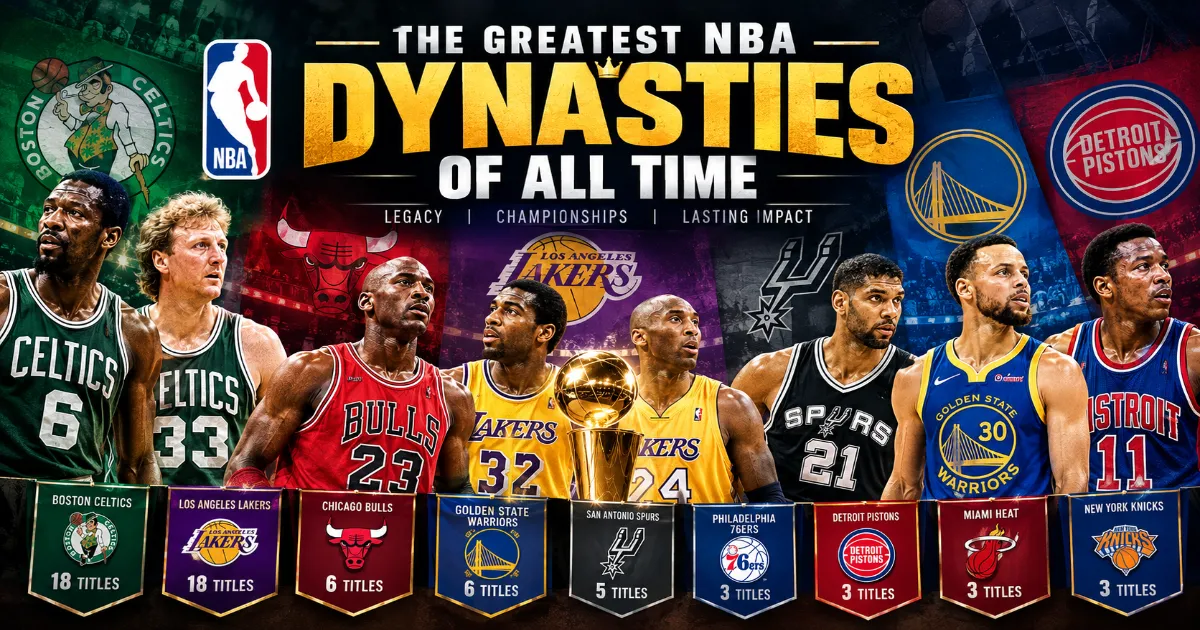
From eight straight banners in Boston to a three-point revolution in the Bay Area, these are the greatest NBA dynasties ever assembled
There’s a difference between a great team and a genuine dynasty. Great teams win a championship. Dynasties win, and win again, and keep winning until an entire era of basketball history simply gets named after them. Ranking the greatest NBA dynasties in history means looking beyond raw championship counts and asking a harder question: which teams didn’t just win, but fundamentally reshaped how the sport was played, coached, and feared by everyone else in the league during their reign?
The Fastest NBA Players Ever: Who Really Owns the Open Court?
Most NBA Championships by a Player — Why Bill Russell’s Record May Be Unbreakable
The dynasties below earned their place not just through banners raised, but through the sheer, sustained terror they inspired across the rest of the NBA.
1. The Bill Russell Celtics (1957-1969)
No dynasty in professional sports history compares to what Bill Russell’s Boston Celtics accomplished across thirteen seasons: eleven championships, including an almost unthinkable eight consecutive titles from 1959 to 1966. This wasn’t dominance built on overwhelming individual scoring — it was built on Russell’s revolutionary defensive anchor role, redefining how rim protection and rebounding could single-handedly control an entire game’s outcome. Under coach and general manager Red Auerbach’s remarkably stable organizational leadership, the Celtics maintained roster continuity that no modern team, operating under today’s free agency rules and salary cap restrictions, could ever hope to replicate. This dynasty doesn’t just top the list of greatest NBA dynasties — it exists in a category of its own that most historians consider permanently unbreakable.
2. The Michael Jordan Bulls (1991-1998)
The Chicago Bulls’ two separate three-peats, split by Michael Jordan’s mid-career retirement to pursue professional baseball, produced arguably the most culturally iconic dynasty in league history. Jordan’s perfect 6-0 Finals record, paired with Scottie Pippen’s do-everything two-way versatility and Dennis Rodman’s rebounding dominance, created a roster that combined individual brilliance with genuine complementary balance. What separates the Bulls from most other dynasties on this list is the sheer global cultural footprint they left behind — the “Air Jordan” era helped transform the NBA into a worldwide phenomenon in a way no previous dynasty, including Russell’s Celtics, had managed to achieve.
3. The Showtime Lakers (1980-1988)
Magic Johnson’s “Showtime” Lakers won five championships across the 1980s while fundamentally reshaping how fast-paced, entertainment-driven basketball could be played at the highest level. This dynasty’s rivalry with Larry Bird’s Boston Celtics is widely credited with reviving the NBA’s national television popularity after a stretch of declining ratings in the late 1970s, setting the stage for the league’s broader commercial and global expansion in the decades that followed. Johnson’s unique combination of size and point guard vision, paired with Kareem Abdul-Jabbar’s continued interior dominance well into his late 30s, gave this dynasty a rare blend of star power spanning two full generations of talent.
4. The Larry Bird Celtics (1981-1986)
Operating simultaneously with the Showtime Lakers, Larry Bird’s Boston Celtics won three championships across the 1980s, anchored by one of the most cerebral, fundamentally sound rosters in league history. Bird’s elite shooting, passing, and basketball IQ, combined with a supporting cast built around defensive toughness and physical rebounding, gave this Celtics era a distinctly different identity from the Lakers’ up-tempo style, even as the two dynasties combined to define an entire decade of NBA basketball together.
5. The Tim Duncan Spurs (1999-2014)
Few dynasties in NBA history matched the sheer organizational stability of Tim Duncan’s San Antonio Spurs, who won five championships across a remarkable fifteen-year window without ever experiencing a true rebuilding period. Under head coach Gregg Popovich’s nearly three-decade tenure, the Spurs built a culture around fundamentally sound basketball, international scouting excellence, and quiet, sustained excellence that never relied on a single dominant superstar in the way most other dynasties on this list did. This “quiet dynasty” approach makes the Spurs somewhat underrated relative to flashier eras, but their sustained championship-level competitiveness across a decade and a half remains nearly unmatched.
6. The Shaq-Kobe Lakers (2000-2002)
Though shorter than most other dynasties on this list, the three consecutive championships won by Shaquille O’Neal and Kobe Bryant’s Los Angeles Lakers from 2000 to 2002 represented one of the most physically dominant stretches in NBA history. O’Neal’s combination of size and athleticism made him nearly unguardable in the post during this stretch, while Bryant’s emergence as a co-star set the stage for his own later championship runs as the franchise’s clear leader after O’Neal’s departure in 2004.
7. The Stephen Curry Warriors (2015-2022)
The Golden State Warriors’ modern dynasty, built around Stephen Curry’s revolutionary three-point shooting, won four championships across an eight-year window while fundamentally reshaping offensive strategy throughout the entire league. This dynasty’s 2015-16 regular season, which produced a record 73 wins, remains one of the most statistically dominant single seasons in league history, even though that particular roster fell short in the Finals. The Warriors’ later addition of Kevin Durant produced back-to-back championships in 2017 and 2018, giving this dynasty a rare combination of homegrown continuity and superstar reinforcement that few other championship runs have managed to replicate.
8. The Detroit “Bad Boys” Pistons (1989-1990)
The Detroit Pistons’ back-to-back championships in 1989 and 1990 represented a different kind of dynasty entirely — one built on physical, defense-first basketball rather than individual superstar scoring. Led by Isiah Thomas and a roster fully committed to a punishing, aggressive defensive identity, the “Bad Boys” Pistons proved that a shorter but genuinely dominant dynasty could be built around collective toughness and defensive discipline rather than any single transcendent offensive talent.
What Separates a Dynasty From a Great Team
Ranking the greatest NBA dynasties requires distinguishing sustained, multi-year dominance from a single great championship season. A true dynasty typically requires at least three championships within a relatively short window, sustained roster continuity through at least one significant core-player transition, and a level of feared dominance that reshaped how opposing teams approached building their own rosters and game plans. By this standard, several excellent single-championship or two-championship teams fall short of true dynasty status, even if their individual seasons rank among the greatest in league history.
How Modern Rules Have Changed What’s Possible
Perhaps the most important context for understanding the greatest NBA dynasties list is recognizing how much harder it has become to build one under today’s rules. Modern salary cap restrictions, luxury tax penalties specifically designed to discourage roster stacking, and far greater player movement through free agency have made sustained, decade-spanning dominance significantly more difficult to achieve than it was during the Celtics’ or Lakers’ earlier dynastic runs. The Warriors’ 2015-2022 dynasty is frequently cited as perhaps the last plausible example of an extended, homegrown-core dynasty under the modern rules, making it a particularly significant entry on this list relative to its shorter championship window compared to earlier dynasties.
Coaching Legacies Behind Each Dynasty
Every entry on the greatest NBA dynasties list is inseparable from the coaching philosophy that anchored it. Red Auerbach’s dual role as head coach and later general manager gave the Celtics a rare organizational continuity that outlasted individual player careers, while Phil Jackson’s triangle offense provided the Bulls with a structural system flexible enough to maximize both Jordan’s scoring and Pippen’s all-around versatility simultaneously. Gregg Popovich’s nearly three-decade tenure with the Spurs is often cited as the single most important factor behind that franchise’s ability to sustain championship contention across a decade and a half without ever undergoing a true rebuild, while Steve Kerr’s arrival in Golden State coincided almost perfectly with the tactical revolution Curry’s shooting made possible, suggesting that even genuinely revolutionary individual talent typically needs the right coaching system to fully translate into sustained dynasty-level success.
The Role of Front Office Vision
Beyond coaching, front office decision-making played an outsized role in nearly every dynasty on this list. The Spurs’ scouting department became renowned for identifying international talent that other franchises consistently overlooked, a skill that helped supplement Duncan’s era with key complementary pieces throughout the dynasty’s long run. The Warriors’ front office made a series of unusually patient draft decisions in the early 2010s, retaining a young core through some genuinely difficult early seasons before that patience paid off with the roster’s eventual championship breakthrough in 2015. These front office decisions, often made years before a dynasty’s first championship, are frequently underappreciated relative to the on-court talent that ultimately gets most of the credit for sustained team success.
Dynasties That Fell Just Short
Several teams came remarkably close to full dynasty status without quite meeting the threshold most historians apply. LeBron James’s Miami Heat won two championships across four consecutive Finals appearances from 2011 to 2014, an extraordinary run that nonetheless falls short of true dynasty status by most definitions due to its shorter championship total relative to the runs above. Similarly, the Houston Rockets’ back-to-back titles in 1994 and 1995, won partly during Michael Jordan’s brief retirement, represented genuine excellence but lacked the sustained multi-year dominance required to be grouped alongside the era-defining runs discussed above.
Why These Rankings Still Spark Debate
Part of what keeps the greatest NBA dynasties conversation alive is that different criteria genuinely produce different rankings. Weighing pure championship volume most heavily favors the Russell-era Celtics decisively, while weighing cultural and commercial impact tends to elevate the Jordan-era Bulls above nearly every other entry on this list. Weighing tactical influence on how the sport is actually played today gives the Warriors’ shooting-based dynasty a stronger case than its shorter championship window might otherwise suggest. None of these framings are wrong — they simply reflect different, equally legitimate ways of measuring what “greatest” actually means when applied to a sustained team achievement rather than an individual career.
Final Thoughts
Ranking the greatest NBA dynasties ultimately comes down to weighing raw championship totals against cultural impact, roster continuity, and the sheer level of fear each era instilled across the rest of the league. Bill Russell’s Celtics remain the standard by pure championship volume, while Michael Jordan’s Bulls arguably left the largest global cultural footprint of any dynasty in league history. What’s clear across every entry on this list is that true dynasties require more than individual talent — they require organizational stability, cultural continuity, and a level of sustained excellence that has become increasingly rare in the modern NBA’s more competitively balanced landscape.
Frequently Asked Questions
What is generally considered the greatest NBA dynasty of all time? Bill Russell’s Boston Celtics, who won eleven championships in thirteen seasons including eight consecutive titles from 1959 to 1966, are most commonly cited as the greatest dynasty in NBA history.
Is the Golden State Warriors’ run considered a true dynasty? Yes, the Warriors’ four championships between 2015 and 2022, built around a largely homegrown core led by Stephen Curry, is widely considered the most significant modern dynasty given how much harder sustained dominance has become under today’s salary cap rules.
What qualifies a team as an NBA dynasty rather than just a great team? Most analysts require at least three championships within a relatively short window, sustained roster continuity, and a level of dominance significant enough to have reshaped how opposing teams approached roster building and game strategy during that era.
Which dynasty had the largest impact on how basketball is played today? Many analysts point to the Stephen Curry-era Warriors, since their three-point-heavy offensive approach directly influenced how modern NBA teams prioritize shooting and floor spacing at every level of roster construction.
🔹🔹 Follow us on Facebook 🔹🔹

3 Comments