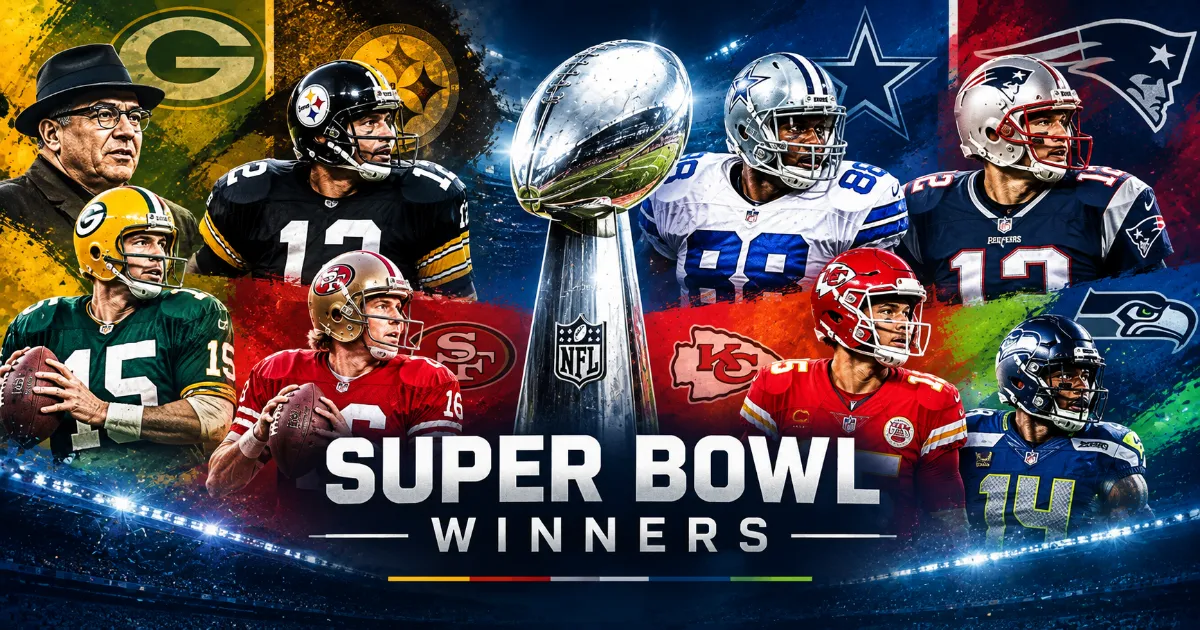
Sixty championships and six decades later, the Super Bowl winners list tells the story of the NFL’s greatest dynasties, one era at a time.
Sixty Games, Six Decades, One Continuous Story
The Super Bowl winners list is more than a record of who won which trophy — read in order, it’s essentially a timeline of professional football itself, tracking which cities, coaches, and quarterbacks defined each era of the sport. Rather than simply listing 60 champions from top to bottom, it’s far more revealing to walk through the list decade by decade, because nearly every era of the Super Bowl has been defined by one or two dominant dynasties rather than a wide-open field of champions.
NBA Championship Winners List — Every Title From 1947 Through Today
The 1960s-70s: Green Bay and Pittsburgh Set the Standard
The very first two Super Bowls belonged to Vince Lombardi’s Green Bay Packers, who beat the Kansas City Chiefs in Super Bowl I (1967) and the Oakland Raiders in Super Bowl II (1968), establishing the NFL’s dominance over the upstart AFL in the two contests that gave the game its name and trophy. The Packers wouldn’t win another Super Bowl for nearly three decades, but their early stranglehold set the template for what a football dynasty would come to mean.
The 1970s belonged almost entirely to the Pittsburgh Steelers, who won four championships in six seasons — Super Bowls IX, X, XIII, and XIV — built around the “Steel Curtain” defense and a core of Hall of Famers including Terry Bradshaw, Franco Harris, and Mean Joe Greene. No team had ever won four Super Bowls before the Steelers did it in that span, and the achievement made Pittsburgh the first true modern NFL dynasty of the Super Bowl era.
The 1980s: San Francisco’s Rise and Parity Elsewhere
The 1980s introduced the sport to Joe Montana and Bill Walsh’s San Francisco 49ers, who won Super Bowls XVI, XIX, XXIII, and XXIV across the decade, establishing the West Coast offense as a genuine dynasty blueprint rather than a passing fad. The rest of the decade was considerably more scattered by comparison, with the Oakland/LA Raiders (three titles across the late ’70s and ’80s), the Washington franchise (three titles), and the Chicago Bears’ dominant 1985 championship team all taking their turn at the top, reflecting a league without a single overwhelming power outside of San Francisco.
The 1990s: Dallas and Buffalo’s Heartbreak
The Dallas Cowboys became the decade’s defining team, winning three championships in four years (Super Bowls XXVII, XXVIII, and XXX) behind Troy Aikman, Emmitt Smith, and Michael Irvin, a core that many historians still rank among the most talented single-team trios in NFL history. San Francisco added a fifth title in Super Bowl XXIX to open the decade, extending their run into the ’90s.
The most poignant story of the decade, though, belonged to the team that never actually won it: the Buffalo Bills reached four consecutive Super Bowls (XXV through XXVIII) and lost every single one, a run of heartbreak that remains unmatched in NFL history and cemented Buffalo’s reputation as the league’s most snake-bitten franchise for a generation.
The 2000s: The Patriots Dynasty Begins
Bill Belichick and Tom Brady’s New England Patriots opened the 2000s with a stunning upset of the heavily favored St. Louis Rams in Super Bowl XXXVI, and followed it with titles in Super Bowls XXXVIII and XXXIX, establishing a dynasty that would define the entire following two decades of NFL football. The Patriots’ only blemish of the decade came in Super Bowl XLII, when the New York Giants — capping a run built on David Tyree’s iconic helmet catch — ended New England’s bid for a perfect 19-0 season in one of the greatest upsets in Super Bowl history.
The 2010s: Parity Gives Way to a Second Patriots Peak
The 2010s opened with genuine parity — the Giants, Packers, Ravens, and Seahawks all claimed titles in the decade’s first half, with Seattle’s Super Bowl XLVIII win over Denver in 2014 marking the franchise’s first championship. But the Patriots reasserted control in the second half of the decade, winning Super Bowls XLIX, LI, and LIII, including a historic 25-point comeback against Atlanta in Super Bowl LI that remains the largest deficit ever overcome in Super Bowl history. By decade’s end, Brady and Belichick had turned “the Patriots are in the Super Bowl” into an almost annual expectation rather than a surprise.
The 2020s: Kansas City’s Rise, Then a New Order Entirely
Patrick Mahomes and the Kansas City Chiefs emerged as the decade’s first true dynasty, winning Super Bowls LIV, LVII, and LVIII, including back-to-back titles that made a three-peat bid in Super Bowl LIX a genuine, widely anticipated possibility. That bid was denied emphatically, as the Philadelphia Eagles upset Kansas City 40-22 in February 2025, ending the Chiefs’ run at the top.
What followed was one of the more dramatic turns in recent Super Bowl history. Kansas City collapsed to a losing record and missed the playoffs entirely the following season, while the Seattle Seahawks — under first-year head coach Mike Macdonald and quarterback Sam Darnold, completing one of the more remarkable redemption arcs in recent NFL memory — surged to the NFC’s top seed. Seattle went on to beat the New England Patriots 29-13 in Super Bowl LX on February 8, 2026, claiming the franchise’s second championship and, in the process, denying the Patriots what would have been a record-breaking seventh Super Bowl title and sole possession of the most championships in NFL history. Kenneth Walker III was named Super Bowl MVP after Seattle’s defense — nicknamed “The Dark Side” — sacked Patriots quarterback Drake Maye six times and forced three turnovers in a performance that controlled the game from start to finish.
What Makes a Dynasty vs. a One-Off Champion
Looking across all six decades, a useful distinction emerges between two very different paths to appearing on this list. Some champions arrive as the product of a genuine sustained dynasty — Pittsburgh’s 1970s core, San Francisco’s Walsh-Montana system, and New England’s two-decade Brady-Belichick partnership all won multiple titles using largely the same foundational pieces across several years. Others arrive as a single, standout team that peaks at exactly the right moment without building a repeatable formula — the 1985 Chicago Bears, the 2000 Baltimore Ravens, and more recently the 2025-season Philadelphia Eagles all fit this pattern, winning a championship built around a historically dominant defense or a perfectly-timed roster peak that didn’t translate into sustained annual contention afterward. Seattle’s two titles, separated by twelve years and built around entirely different rosters and coaching staffs, actually sit closer to this second category than the first — a franchise capable of building a champion twice, without ever stringing together the kind of extended dynasty window that defines the true multi-title powerhouses atop this list.
The Role of Quarterback Continuity
It’s difficult to look at this list without noticing how heavily it’s shaped by quarterback stability specifically. Of the 60 champions crowned so far, an overwhelming majority were led by a quarterback who either won multiple championships with that same franchise or was in the middle of what became a multi-year run of sustained contention. Brady’s six championships alone account for exactly one-tenth of all Super Bowls ever played, an almost absurd level of individual concentration at the sport’s most important position. Even outside the true dynasty windows, one-off champions frequently still featured a quarterback playing the best stretch of an otherwise more modest career — Trent Dilfer’s 2000 Ravens and Brad Johnson’s 2002 Buccaneers are frequently cited examples of a championship built overwhelmingly around defense, with quarterback play required only to be adequate rather than exceptional. Sam Darnold’s Super Bowl LX run fits an unusual middle category: a quarterback previously written off by multiple franchises, delivering a genuinely strong statistical season as the final piece of a defense-first championship formula, blending elements of both patterns at once.
The Complete List, Decade by Decade
| Era | Dominant Team(s) | Championships Won |
|---|---|---|
| 1967-1968 | Green Bay Packers | 2 (Super Bowls I-II) |
| 1970s | Pittsburgh Steelers | 4 (IX, X, XIII, XIV) |
| 1980s | San Francisco 49ers | 4 (XVI, XIX, XXIII, XXIV) |
| 1990s | Dallas Cowboys | 3 (XXVII, XXVIII, XXX) |
| 2000s | New England Patriots | 3 (XXXVI, XXXVIII, XXXIX) |
| 2010s | New England Patriots | 3 (XLIX, LI, LIII) |
| Early 2020s | Kansas City Chiefs | 3 (LIV, LVII, LVIII) |
| 2025-2026 | Philadelphia Eagles, Seattle Seahawks | 1 each (LIX, LX) |
Why This List Reads the Way It Does
Look at the full list in order, and one pattern stands out above all others: true championship parity is rare, and true dynasties are the rule, not the exception. Across 60 Super Bowls, a remarkably small number of franchises account for the overwhelming majority of titles — the Steelers and Patriots alone have combined for 12 of the 60 championships ever awarded, nearly a fifth of the sport’s entire championship history split between just two organizations. This concentration reflects something structural about the NFL rather than pure randomness: sustained success at the quarterback and head coach positions, in particular, has historically mattered more to Super Bowl outcomes than any single season’s roster talent.
The Bottom Line
The Super Bowl winners list, read start to finish, tells the story of professional football better than any single highlight reel could — Lombardi’s Packers establishing the template, Pittsburgh’s Steel Curtain proving it could be repeated, Montana’s 49ers reinventing it through the passing game, and Brady’s Patriots stretching a single dynasty across two full decades. Super Bowl LX added the newest chapter to that story: a Seattle team built on defense and a redemption-arc quarterback denying New England the record that would have settled, once and for all, which franchise truly stands alone at the top of NFL history — a debate the list itself now keeps very much alive.
That’s ultimately what makes this particular list more compelling than a simple historical record: it’s still being actively written, and the margin between “record-breaking dynasty” and “tied at the top” can come down to a single game, as New England found out in February 2026. Every franchise chasing the top of this list — Kansas City rebuilding after its 2025 collapse, Philadelphia looking to build on its own recent title, and a growing group of teams like Seattle proving a single strong season can still produce a champion in an era increasingly defined by parity — adds another layer to a story that has never gone more than a year without a new chapter since 1967.
Frequently Asked Questions
Who won the most recent Super Bowl? The Seattle Seahawks won Super Bowl LX, defeating the New England Patriots 29-13 on February 8, 2026, at Levi’s Stadium in Santa Clara, California.
Which teams have won the most Super Bowls? The Pittsburgh Steelers and New England Patriots are tied for the most Super Bowl championships with six each, followed by the Dallas Cowboys and San Francisco 49ers with five apiece.
Did the Patriots almost set a new Super Bowl wins record in 2026? Yes — a win in Super Bowl LX would have given New England a record seventh championship and sole possession of the most Super Bowl titles in NFL history. Seattle’s 29-13 win denied that record, leaving the Patriots tied with Pittsburgh at six.
Which team has the most heartbreaking Super Bowl history? The Buffalo Bills reached four consecutive Super Bowls (XXV through XXVIII) in the early 1990s and lost all four, a run of futility that remains unmatched in NFL history.
What was the largest comeback in Super Bowl history? The New England Patriots overcame a 25-point deficit to beat the Atlanta Falcons in Super Bowl LI (2017), the largest comeback in Super Bowl history.
How many total Super Bowls have been played? As of Super Bowl LX in February 2026, 60 Super Bowls have been played since the game’s inception in January 1967.
🔹🔹 Follow us on Facebook 🔹🔹
The GOAT Debate: What the Data Actually Says About Football’s Four Icons

2 Comments