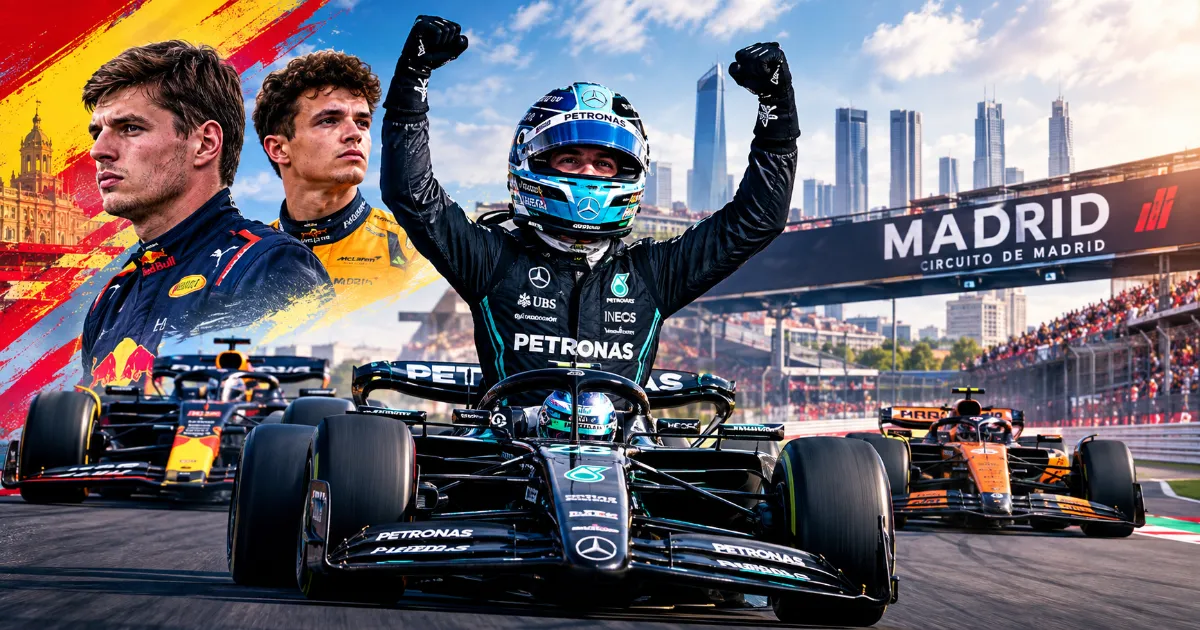
Spanish Grand Prix 2026: Kimi Antonelli Wins Historic Madrid Race as Norris Pays the Price for McLaren Pit-Stop Error
The Spanish Grand Prix 2026 will be remembered as one of the most significant races in Formula 1’s modern history. Not simply because Kimi Antonelli won, but because the event marked the first Formula 1 race at Madrid’s brand-new Madring circuit.
Antonelli delivered a composed performance to take victory ahead of Max Verstappen and Lando Norris, securing his eighth win of the 2026 season and extending his championship advantage to 81 points over Mercedes teammate George Russell.
Lando Norris Pole Position: Norris Edges Antonelli in a Thriller at Madring
The result, however, does not tell the entire story.
Lando Norris started from pole position and appeared to have the race under control during the opening phase. McLaren had the pace to challenge for victory, but a seven-second pit-stop error combined with the timing of a Virtual Safety Car transformed the complexion of the race. Antonelli took advantage, Verstappen moved into contention and Norris ultimately had to settle for third.
The inaugural Madrid race also raised questions about the Madring layout. While the circuit impressed with its unusual combination of street-circuit characteristics, elevation changes and the heavily banked Turn 12 known as La Monumental, overtaking proved extremely difficult during the race.
Spanish Grand Prix 2026 Result
Kimi Antonelli claimed the historic first Formula 1 victory at the Madring, with Max Verstappen finishing second and Lando Norris completing the podium.
Charles Leclerc finished fourth for Ferrari, while George Russell took fifth for Mercedes. Liam Lawson finished sixth, followed by Franco Colapinto and Oscar Piastri.
The top five were:
- Kimi Antonelli – Mercedes
- Max Verstappen – Red Bull
- Lando Norris – McLaren
- Charles Leclerc – Ferrari
- George Russell – Mercedes
Lewis Hamilton endured a particularly difficult afternoon. The Ferrari driver retired early with brake problems, costing him another opportunity to score valuable championship points.
Antonelli Makes History in Madrid
Kimi Antonelli arrived in Madrid as the championship leader, but the pressure was considerable.
Mercedes had established itself as one of the strongest teams during the 2026 season, and Antonelli had already collected seven victories before the Spanish Grand Prix. The Italian youngster added another win to that tally at the most important possible moment: the inaugural Formula 1 race at the Madring.
The victory was Antonelli’s eighth of the season and moved his championship total to 292 points. His advantage over Russell increased to 81 points, giving the Mercedes driver a significant cushion with nine races still remaining.
Antonelli’s performance was particularly impressive because he did not have the cleanest strategic path to victory. Norris initially looked capable of controlling the race from the front, but circumstances changed when McLaren’s pit-stop problems coincided with a Virtual Safety Car.
Antonelli was ready to capitalize.
The result demonstrated one of the defining characteristics of championship-winning campaigns: taking maximum advantage when rivals make mistakes.
Norris Had the Pace to Win
For Lando Norris, third place felt like a missed opportunity rather than a successful podium.
The McLaren driver had secured pole position in qualifying, narrowly beating Antonelli by only 0.011 seconds. That tiny margin demonstrated just how competitive the front of the grid was at the Madring.
Norris also had the pace during the opening portion of the race.
The problem came when McLaren’s pit-stop execution went wrong. A seven-second delay proved extremely costly, particularly because the timing of the Virtual Safety Car created an opportunity for Mercedes to gain track position.
Once Antonelli moved ahead, Norris found himself unable to recover.
The Madring’s layout made the problem even worse. Drivers had warned before the race that overtaking could be difficult, and the race largely confirmed those concerns. Once cars settled into position, there were limited opportunities to make decisive passes.
For McLaren, the race therefore became a classic example of how Formula 1 victories can be lost through strategy and execution rather than outright lack of pace.
Verstappen Finishes Second
Max Verstappen finished second, adding another strong result to his 2026 campaign.
The Red Bull driver started the inaugural Madring race from third on the grid and ultimately gained one position. While victory remained out of reach, Verstappen’s podium finish ensured that he continued to apply pressure to the leading Mercedes and McLaren drivers.
His experience also proved valuable on a circuit that was completely new to the Formula 1 calendar.
The Madring is not a conventional permanent racing circuit. Its design combines public-road sections with purpose-built areas, creating a hybrid layout that demands precision and adaptability. Formula 1 described the circuit as featuring 22 corners, dramatic elevation changes and straights where cars can reach approximately 340 km/h.
Verstappen’s second place therefore represented a strong result on a track where qualifying and track position were expected to be particularly important.
A New Era for the Spanish Grand Prix
The biggest story surrounding the 2026 Spanish Grand Prix was not simply the result.
It was the location.
For decades, the Spanish Grand Prix had been associated with Barcelona and the Circuit de Barcelona-Catalunya. In 2026, however, the Formula 1 calendar introduced Madrid’s Madring as the new Spanish Grand Prix venue.
That made the race historically significant before the lights even went out.
Madrid had not hosted a Formula 1 race since 1981, when the Spanish Grand Prix era at the Jarama circuit came to an end. The return to the Madrid area therefore represented a major moment for Spanish motorsport.
The new Madring is located around the IFEMA exhibition centre and the Valdebebas area, close to Madrid’s airport. The circuit measures approximately 5.4 kilometres and contains 22 corners.
The venue was designed to give Formula 1 a distinctly modern setting, combining permanent and street-style sections rather than following the traditional definition of a street circuit.
What Makes the Madring Different?
The Madring immediately attracted attention because of its unusual design.
One of its most distinctive features is Turn 12, known as La Monumental.
The corner is heavily banked, with banking reaching approximately 24 percent. It is also one of the longest banked corners featured on the modern Formula 1 calendar.
The corner gives the circuit a visual identity unlike almost any other venue on the F1 calendar.
The track also contains elevation changes, fast sections and technical corners. Cars must therefore balance aerodynamic performance with mechanical stability, while drivers need confidence under braking and through the circuit’s faster changes of direction.
Formula 1’s official circuit information describes the Madring as a 22-corner layout with significant variation, while reports from the race weekend highlighted the circuit’s mixture of public roads and permanent sections.
The Overtaking Problem
The major criticism of the inaugural Spanish Grand Prix was clear: overtaking was difficult.
That issue had been anticipated before the race.
Several drivers suggested that qualifying would be especially important because the track’s characteristics made it difficult to follow another car closely enough to create passing opportunities. Charles Leclerc, Lewis Hamilton and others had already discussed the importance of track position before the weekend.
The race reinforced those concerns.
Although the Madring looks spectacular, visual excitement does not automatically translate into wheel-to-wheel racing.
That distinction will be important for Formula 1 officials and circuit designers.
The first race provides valuable information about where cars can run closely, where braking zones need to be extended and whether changes to certain corners could create more overtaking opportunities.
The circuit has already been viewed as promising, but some drivers believe modifications could improve the racing spectacle in future editions.
Why Qualifying Was So Important
The Spanish Grand Prix demonstrated that qualifying can be particularly valuable at circuits where overtaking is limited.
Norris’ pole position gave McLaren the ideal starting point.
Antonelli began just behind him, while Verstappen occupied third.
With so few opportunities to overtake naturally on track, starting position became strategically important.
That meant the race could potentially be decided by three factors:
qualifying performance, pit-stop execution and safety-car timing.
That is precisely what happened.
Norris had the strongest starting position, but McLaren’s pit-stop problem opened the door for Mercedes. Antonelli then converted that opportunity into victory.
Lewis Hamilton’s Difficult Spanish Grand Prix
Lewis Hamilton experienced a frustrating weekend in Madrid.
The seven-time world champion had been expected to be one of the major names to watch at the first Spanish Grand Prix at the Madring, but his race ended early because of brake problems.
The retirement was particularly costly because Hamilton was already chasing valuable championship points.
It also underlined the unpredictability of the new circuit. Teams had relatively limited real-world Formula 1 experience on the layout before the race, meaning reliability and setup decisions carried additional significance.
For Ferrari, the result was mixed.
Charles Leclerc finished fourth and collected a strong points haul, but Hamilton’s retirement prevented Ferrari from maximizing its opportunity.
Carlos Sainz’s Home Race Disappointment
Carlos Sainz had an especially difficult Spanish Grand Prix weekend.
The Madrid-born driver was competing in his home race, but a qualifying penalty dropped him to the back of the grid.
Sainz was handed a three-place grid penalty after stewards determined that he had impeded Valtteri Bottas during the opening phase of qualifying. The incident occurred when Sainz failed to give way to Bottas, who was on a flying lap.
The stewards also noted that Williams had failed to properly inform Sainz that Bottas was approaching.
The penalty meant Sainz started 20th.
That was a disappointing outcome for a driver who had been one of the major Spanish attractions surrounding Madrid’s return to the Formula 1 calendar.
Fernando Alonso’s Homecoming
Fernando Alonso also had a difficult weekend.
The two-time world champion remains one of Spain’s biggest Formula 1 stars, and the return of the Spanish Grand Prix to Madrid created another major home event for him.
However, Alonso was eliminated during the first part of qualifying and did not have the competitive machinery needed to fight at the front.
The contrast between Spain’s enormous enthusiasm for Formula 1 and the struggles of its two most prominent current drivers was striking.
Antonelli, meanwhile, became the driver associated with the first chapter of the Madring’s Formula 1 history.
Championship Implications
The biggest competitive consequence of the Spanish Grand Prix was Antonelli’s growing championship advantage.
The Mercedes driver entered the weekend with a substantial lead and left Madrid with an even stronger position.
His advantage over teammate George Russell increased to 81 points, while Mercedes maintained a significant lead in the constructors’ championship.
With nine races remaining, the championship is far from mathematically decided.
However, Antonelli has created the kind of points cushion that allows a driver to approach the final part of a season with greater strategic freedom.
Russell remains his closest Mercedes challenger, while Verstappen and the McLaren drivers remain important factors in the broader championship picture.
The pressure is therefore beginning to shift toward the chasing pack.
What the Spanish Grand Prix Means for McLaren
McLaren leaves Madrid with one of the biggest “what if?” questions of the season.
Norris had pole position.
He had strong early-race pace.
And the team appeared capable of challenging for victory.
Yet a pit-stop error ultimately changed the race.
This is exactly the kind of mistake that becomes increasingly expensive during a championship battle.
McLaren cannot afford to throw away opportunities when Mercedes is operating at such a high level.
The positive is that the underlying pace was competitive.
The negative is that Formula 1 championships are often decided by small operational details.
A seven-second delay can be enough to turn a potential victory into third place.
The Future of the Madrid Spanish Grand Prix
The first Madring race provided both encouragement and a clear list of areas that could be improved.
The event received positive feedback for its organization, infrastructure and facilities, while attendance reportedly exceeded 120,000 spectators per day.
The circuit also delivered a visually distinctive product.
La Monumental, the Madrid setting and the mixture of street and permanent sections give the Spanish Grand Prix a new identity.
The major challenge will be improving the racing.
If future modifications can create additional overtaking opportunities without destroying the character of the circuit, the Madring could become one of Formula 1’s most recognizable venues.
That process will take time.
Every new circuit requires a learning period, and teams now have valuable real-world data that can be used for future setup work and circuit analysis.
Barcelona’s Changing Role in Spanish F1
The arrival of Madrid does not erase Barcelona’s importance to Formula 1.
The Circuit de Barcelona-Catalunya remains one of the sport’s most established venues and has historically been considered an excellent all-round test of a Formula 1 car because of its mixture of long straights, high-speed corners and technical sections.
The 2026 calendar therefore created an unusual situation for Spanish motorsport.
Barcelona hosted the Barcelona-Catalunya Grand Prix earlier in the season, while Madrid became the home of the Spanish Grand Prix.
Lewis Hamilton won the Barcelona race for Ferrari in June, taking his first victory for the Italian team after a dramatic race.
The two Spanish events offer very different experiences.
Barcelona represents Formula 1 tradition and a circuit that teams know extremely well.
Madrid represents the future, experimentation and a new generation of circuit design.
Final Verdict
The Spanish Grand Prix 2026 was historically important even before Kimi Antonelli crossed the finish line.
Madrid successfully brought Formula 1 back to the capital region after more than four decades, introduced the unusual Madring circuit and created a new chapter in the history of the Spanish Grand Prix.
On the sporting side, Antonelli was the ultimate beneficiary.
His eighth victory of the season extended his championship lead and demonstrated the consistency that has defined his campaign.
Norris will look back at the race as a missed opportunity. McLaren had the speed to win but failed to execute perfectly when it mattered most.
Verstappen’s second place strengthened his campaign, while Leclerc’s fourth place gave Ferrari useful points after Hamilton’s early retirement.
The Madring itself remains the biggest question.
It is spectacular, technically demanding and visually distinctive. But Formula 1 needs overtaking opportunities, and the first race suggested that the circuit may require changes to deliver the kind of wheel-to-wheel racing fans expect.
Nevertheless, the inaugural Madrid Spanish Grand Prix achieved its most important objective: it created a new Formula 1 event with a personality of its own.
Kimi Antonelli will forever be recorded as the first winner at the Madring.
For Madrid, that is the beginning of a new Formula 1 era.
🔹🔹 Follow us on Facebook 🔹🔹
LeBron James vs Kobe Bryant — Rings, Scoring, and the Mamba Mentality Factor
The GOAT Debate: What the Data Actually Says About Football’s Four Icons






One Comment