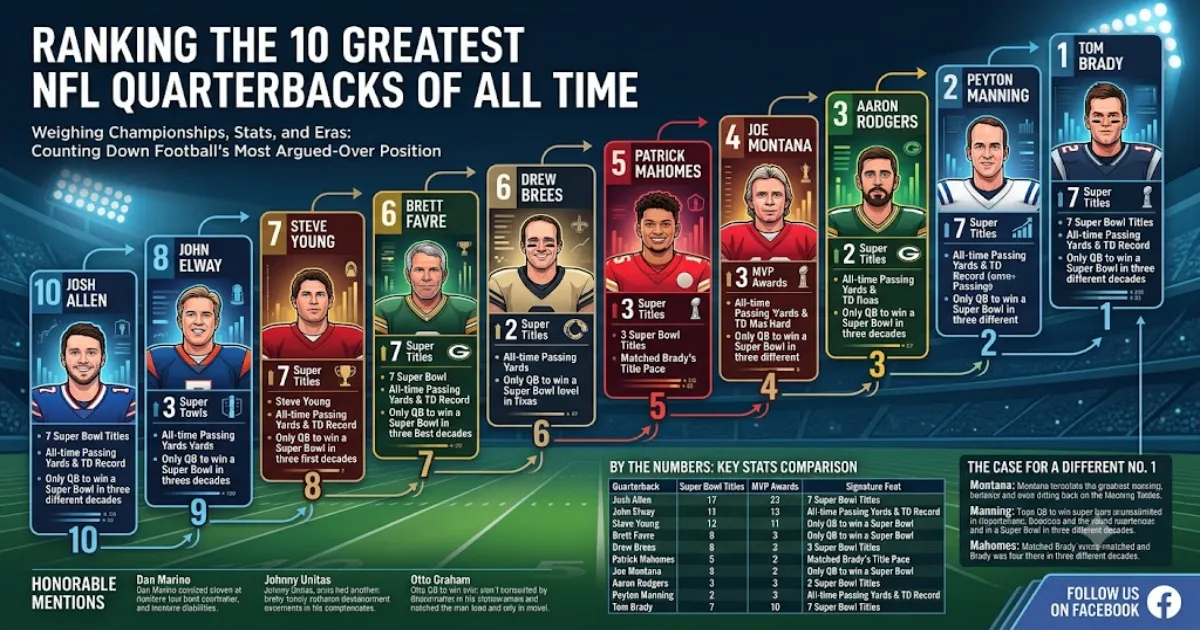
Weighing rings, records and eras, this ranking of the greatest quarterbacks of all time settles on a clear No. 1 — and a fascinating fight for the rest of the top 10.
Counting Down Football’s Most Argued-Over Position
No position in professional sports generates more “greatest ever” debate than NFL quarterback, and for good reason — no other position combines individual statistical output, team success, and cultural weight quite the same way. A running back’s greatness can be measured almost entirely in yards and touchdowns. A quarterback’s greatness gets measured in yards, touchdowns, wins, championships, clutch throws, leadership, and a dozen intangibles that resist easy quantification. That complexity is exactly why this list, more than almost any other in football, refuses to settle — and why it’s worth counting down properly, stat by stat, rather than simply naming names.
10. Josh Allen
Josh Allen is the only quarterback on this list still building his championship résumé, and his inclusion reflects just how much he’s already accomplished without one. Allen enters his ninth NFL season having reached the same career point at which Peyton Manning first broke through for his championship — a comparison that isn’t accidental, given how often evaluators now mention the two in the same breath for pocket presence married to physical dual-threat ability. On the NFL’s own 2026 Top 100 player list, voted on by his peers, Allen landed at No. 2 overall, trailing only Myles Garrett across the entire league regardless of position. His case for climbing this list further rests almost entirely on what happens in the Super Bowls still ahead of him.
9. John Elway
John Elway’s case rests on two pillars: an era-defining highlight and a redemption arc. “The Drive” — a 98-yard, game-tying march late in the 1987 AFC Championship Game — remains one of the most replayed clutch sequences in NFL history, and it came years before Elway finally broke through with back-to-back Super Bowl titles to close his career. Among the quarterbacks on this list, Elway also stands out for his legs as much as his arm, racking up more rushing touchdowns than any other passer in this group except one — a testament to how much of his game plan relied on extending plays before the concept of a “running quarterback” was fashionable.
8. Steve Young
Steve Young occupies an unusual historical position: the man who had to follow Joe Montana in San Francisco and somehow thrived anyway. Young’s combination of accuracy and mobility made him one of the most statistically efficient passers of his generation, and he delivered his own Super Bowl title and MVP performance rather than simply managing Montana’s leftover system. His case is frequently underrated precisely because it required following a legend and still building an independent, dominant identity — a much harder task than it sounds.
7. Brett Favre
Brett Favre’s per-season passing volume remains remarkable even by modern standards — he averaged 5,987 passing yards per season across his career, the highest mark among this entire group, reflecting both his longevity and his willingness to sling the ball downfield in an era before rules tilted so heavily toward the passing game. Favre’s ironman consecutive-starts streak became as much a part of his legend as his statistics, and his gunslinger mentality — for better and occasionally for worse — defined an entire era of NFC football centered in Green Bay.
6. Drew Brees
Drew Brees retired as the NFL’s all-time leader in completions, with 7,142 across his career, a number that reflects the surgical, high-percentage passing attack he ran in New Orleans for nearly two decades. Brees averaged 280 passing yards per game for his career — a figure that actually edges out both Brady and Manning on a per-game basis — and his Super Bowl title with the Saints, paired with a level of touch-passing precision still used as a coaching model today, cements his place firmly inside the top tier of this list.
5. Patrick Mahomes
Patrick Mahomes has already accomplished, by his mid-career point, what took most legends on this list far longer: three Super Bowl championships, matching the pace Tom Brady himself had set at the same career stage. Even in what evaluators considered a down statistical year by his own lofty standard in 2025, Mahomes still landed inside the top 20 of the NFL’s 2026 player rankings — a reflection of the equity and respect he’s built among his peers even when the box score wasn’t at its usual historic level. His case for climbing higher on this all-time list is arguably the strongest of any active player, contingent almost entirely on continued championship-level play across the rest of his prime.
4. Joe Montana
Joe Montana remains, for a huge portion of NFL historians, the unofficial standard-bearer for quarterback greatness in the years before Tom Brady’s career reset the conversation entirely. Montana went a perfect 4-0 in Super Bowls, a mark matched by no one else on this list, and his “Joe Cool” nickname was earned through a string of iconic late-game drives — most famously “The Catch,” a touchdown pass to Dwight Clark that sent the 49ers to their first Super Bowl and helped shift the balance of NFC power away from Dallas for a generation. Montana’s raw passing statistics look modest next to the modern names on this list, but few quarterbacks in history have matched his ability to elevate his performance specifically when a game’s outcome was on the line.
3. Aaron Rodgers
Aaron Rodgers enters his 2026 season — already announced as his final one — still holding the NFL’s all-time single-season passer rating record at a staggering 122.5, alongside the league’s lowest career interception percentage at just 1.4%, a combination of efficiency and risk management unmatched anywhere else on this list. Heading into the season, Rodgers sits just 13 touchdown passes from passing Peyton Manning for third place all-time, and less than 4,000 yards from becoming just the fifth quarterback in history to clear 70,000 career passing yards, joining Manning, Brady, Brees, and Favre in that club. His four career MVP awards trail only Manning’s five among all quarterbacks in NFL history.
2. Peyton Manning
Peyton Manning’s case rests on a rare combination of individual dominance and direct history against the man ranked just above him. Manning holds the single-season records for both passing yards (5,477) and passing touchdowns (55), both set during his historic 2013 campaign, and his five career MVP awards remain the most any player at any position has ever won. He was the first starting quarterback in NFL history to win Super Bowls with two different franchises, sits third all-time in both career passing yards (71,940) and touchdown passes (539), and — in the head-to-head rivalry that defined a decade of AFC football — went 3-1 against Tom Brady specifically in AFC Championship Games, a genuinely remarkable record against the only quarterback ranked ahead of him on this list.
1. Tom Brady
Tom Brady’s position at the top of this list is close to the only truly uncontested placement in the entire ranking. He owns nearly every meaningful career passing record in NFL history, including the all-time marks for both passing yards and touchdown passes, built across an NFL-record 23 professional seasons. His seven Super Bowl championships stand alone atop the list — no other quarterback in history has more than four — and he remains the only passer to win a Super Bowl in three different decades. What separates Brady’s case from every other name on this list isn’t a single statistic or a single iconic play; it’s the sheer comprehensiveness of the résumé, spanning peak dominance, sustained excellence deep into his 40s, and championship success that simply has no equal at the position.
By the Numbers: How the Top 10 Actually Compares
Raw rankings can obscure just how differently these quarterbacks accumulated their greatness. A side-by-side look at a few defining statistics makes the contrast clearer:
| Quarterback | Super Bowl Titles | Career Passing Yards | MVP Awards | Signature Statistical Feat |
|---|---|---|---|---|
| Tom Brady | 7 | All-time record | 3 | Only QB to win a Super Bowl in three different decades |
| Peyton Manning | 2 | 71,940 (3rd all-time) | 5 (most ever) | Single-season records: 5,477 yards, 55 TDs (2013) |
| Aaron Rodgers | 1 | Approaching 70,000 | 4 | All-time single-season passer rating record (122.5) |
| Joe Montana | 4 | Modest by modern standards | 2 | Perfect 4-0 Super Bowl record |
| Patrick Mahomes | 3 | Still active | 2 | Matched Brady’s title pace through same career stage |
| Drew Brees | 1 | Former all-time leader | 1 | All-time record for career completions (7,142) |
| Brett Favre | 1 | Historic volume passer | 3 | Highest average passing yards per season (5,987) |
| Steve Young | 1 | Efficient dual-threat | 2 | Highest career passer rating of his playing era |
| John Elway | 2 | Strong for his era | 1 | Most rushing touchdowns among this group except one |
| Josh Allen | 0 (active) | Still climbing | 0 | No. 2 overall on NFL’s 2026 player-voted Top 100 |
What stands out immediately is that no single column produces the same order as any other. Brady dominates championships but doesn’t lead in MVPs. Manning leads in MVPs but trails Brady head-to-head in their biggest postseason meetings. Montana’s ring count rivals Brady’s on a per-decade basis but his raw passing totals lag well behind the modern names. This is precisely why “greatest ever” rankings resist a single clean formula — each quarterback essentially built a different kind of case file, and reasonable evaluators can weigh those categories differently and land on defensible, if divergent, conclusions.
Honorable Mentions Just Outside the Top 10
Any list like this inevitably leaves out names with genuine historical weight. Dan Marino retired holding nearly every major career passing record despite never winning a Super Bowl, and remains a common answer whenever the “best quarterback never to win it all” debate comes up. Johnny Unitas is frequently cited by an older generation of historians as the original blueprint for pocket-passer greatness, having helped popularize the modern passing game itself during the 1950s and ’60s. Otto Graham holds a statistic that surprises most modern fans — the most rushing touchdowns of any quarterback across this entire historical conversation, at 44, a reminder that early-era quarterbacks often carried a much heavier rushing workload than the pocket-passer stereotype suggests. Ben Roethlisberger, Eli Manning, and Philip Rivers all have credible cases for the next tier down, each backed by multiple deep playoff runs, if not quite the statistical or championship weight of the top 10.
The Case for a Different No. 1
Even with Brady’s case being close to unanimous, it’s worth acknowledging the strongest counter-arguments seriously. Montana’s perfect Super Bowl record and flair for the biggest moments still make him the “eye test” answer for many older football historians who watched both eras. Manning’s head-to-head edge over Brady in their most direct postseason meetings, combined with his all-time-record five MVPs, gives him the strongest single-category case against the top spot. And Mahomes, still active and already pacing Brady’s own historic timeline, represents the only realistic future threat to reshape this entire list before the decade is out.
What Actually Separates the Top Tier From Everyone Else
Looking at this list as a whole, the quarterbacks who reach the very top share a specific combination of traits rather than excelling in just one area: championship success (Brady, Montana), historic single-season statistical peaks (Manning, Rodgers), sustained efficiency over a full career (Brees, Rodgers), and the ability to author signature, era-defining moments when the stakes were highest (Montana, Elway). No quarterback on this list, including Brady, dominates every single one of those categories simultaneously — which is precisely why the conversation around who ranks second, third, and fourth remains so much livelier than the conversation about who sits at No. 1.
Frequently Asked Questions
Who is considered the greatest quarterback of all time? Tom Brady is the near-universal answer among analysts and historians, based on his record seven Super Bowl championships and his ownership of nearly every major career passing record, including career passing yards and touchdown passes.
Who is the biggest challenger to Tom Brady’s GOAT status? Peyton Manning and Joe Montana are the two most commonly cited alternatives — Manning for his record five MVP awards and single-season passing records, and Montana for his perfect 4-0 Super Bowl record and flair for clutch, game-defining drives.
Where does Patrick Mahomes rank among the greatest quarterbacks of all time? Mahomes is widely viewed as the strongest active challenger to eventually crack the very top tier of this list, having already won three Super Bowl titles at a similar career stage to where Brady stood with his own three championships.
What criteria are used to rank the greatest quarterbacks ever? Most rankings weigh a combination of championship success, career and single-season statistical records, longevity, head-to-head performance against other elite quarterbacks, and the ability to deliver in high-pressure postseason moments.
Is Aaron Rodgers considered one of the greatest quarterbacks of all time? Yes — Rodgers holds the NFL’s all-time single-season passer rating record and the lowest career interception percentage in league history, and enters 2026 closing in on becoming just the fifth quarterback ever to reach 70,000 career passing yards.
Why is Josh Allen included on some greatest-quarterbacks lists without a Super Bowl win? Allen’s inclusion reflects his statistical production and the respect he’s earned from fellow players — he ranked No. 2 overall on the NFL’s 2026 player-voted Top 100 list — though most rankings note his case will strengthen considerably if he wins a championship.
🔹🔹 Follow us on Facebook 🔹🔹


One Comment