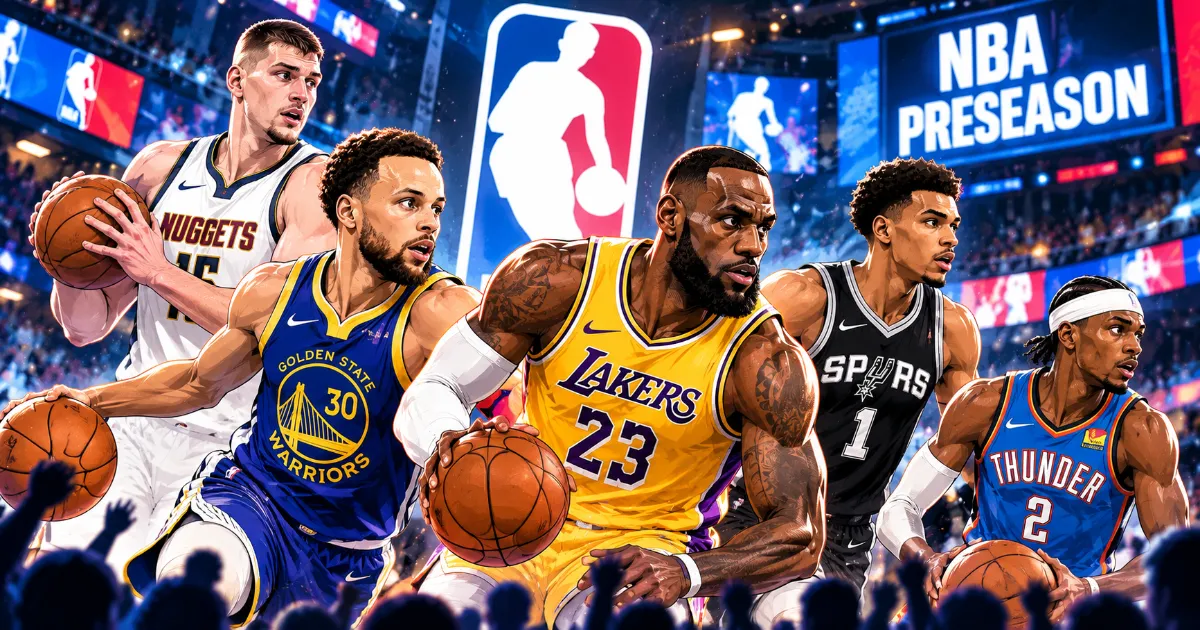
From 21-man camp rosters to limited star minutes, here is what the NBA preseason means for teams, rookies and fans before Opening Night on Oct. 20
By the GridironHoops Analysis Desk | Monday, Oct. 5, 2026
The NBA preseason is a series of exhibition games that teams play after training camp and before the regular season. The results do not count in the standings, and individual stats do not count toward season or career totals. What the games do provide is a live-action testing ground for new rosters, rookies, rotations and injured players working their way back.
This year, the preseason runs from Saturday, Oct. 3, through Friday, Oct. 16. Opening Night is Tuesday, Oct. 20. In between, 67 preseason games will be played, and every team will play between four and six of them.
Most 400-Yard Passing Games in NFL History: Brees’ Record 16
What the NBA preseason actually is
Think of it as the bridge between camp and the real thing. Camp opened on Sept. 29, and teams spend that first week in practices and intrasquad scrimmages. Preseason games are the first time those teams face an opponent in a real arena, with referees, a scoreboard and a crowd.
The games follow the same basic format as the regular season. They are played in four 12-minute quarters, with the same court, ball and basic rules. What changes is the purpose. In the regular season, the goal is to win. In the preseason, the goal is to learn.
A few examples from the first weekend show how that plays out:
- Utah 109, Denver 97 (Sunday, Oct. 4): Nikola Jokić finished with three points and seven assists in a game where Denver was missing Jamal Murray. Nobody around the league treated the result as a statement.
- LA Clippers 104, Golden State 101 (Sunday, Oct. 4): Stephen Curry played only the first half. The Warriors used the rest of the night to look at younger players, while the Clippers got an early read on their rebuilt roster, with rookie Keaton Wagler hitting the winning shot.
How the preseason differs from the regular season
| Preseason | Regular season | |
|---|---|---|
| Games per team | 4 to 6 | 82 |
| Counts in standings? | No | Yes |
| Player stats count? | No | Yes |
| Roster size | Up to 21 players (including two-way) until the cutdown | 15 standard contracts plus up to 3 two-way |
| Star minutes | Often limited, sometimes zero | Determined by competition and health |
| Injury reports | Not required to be released | Official reports required |
| Main goal | Rotations, roster spots, conditioning | Wins, seeding, playoffs |
| Special competitions | None | NBA Cup group play and the play-in tournament |
Roster rules: the biggest difference of all
The most important technical difference is roster size. During the offseason and training camp, teams can carry up to 21 players, and two-way players count toward that number. That is why preseason rosters look so crowded.
By the deadline, every team has to get down to 15 players on standard contracts plus up to three on two-way deals. This year, that deadline is Monday, Oct. 19, at 5 p.m. ET, the day before the season opens.
That means a large share of the preseason is, in effect, a tryout. Players on Exhibit 10 deals and other non-guaranteed contracts are competing for the last standard spot or a two-way slot. Some will earn a job. Others will be waived and, in many cases, assigned to the team’s G League affiliate.
There is also a financial angle. Players on fully non-guaranteed contracts can be waived by Oct. 17 without counting against the team’s 2026-27 salary cap, which gives front offices a reason to use every preseason minute to evaluate depth.
What is a two-way contract? It lets a player split time between an NBA team and its G League affiliate. Each team can carry up to three, and a two-way player can be active for up to 50 NBA games. They do not count against the 15-man limit.
Minutes, rest and why stars sit
Coaches use the preseason to prepare players, not to win games. That shapes how minutes are handed out.
Veterans typically play limited minutes, and some do not play at all, especially if they are returning from an injury or a heavy summer of international play. Younger players, rookies and fringe roster candidates often get the fourth quarter. A 20-point margin in mid-October rarely carries over to the regular season.
The Lakers are a good illustration. Head coach JJ Redick has said the priority is getting players into rhythm, finding lineup balance and building conditioning, rather than playing a star for 36 minutes to win an exhibition. The Lakers also open their preseason on the front end of a back-to-back, with three games in four days, which makes full-strength rosters unlikely in every game.
Injuries and information
In the regular season, teams must submit official injury reports before each game. In the preseason, they are not required to. That is why you will often see conflicting information about who is playing, with players labeled doubtful or questionable by different outlets until close to tip-off.
For fans, the practical advice is simple: confirm availability about an hour before the game. If you have tickets to see a specific star, check the team’s social media or the official team site before heading to the arena.
International and neutral-site games
The preseason is also when the NBA takes its product on the road. The 2026 slate includes:
- Canada games: Miami at Toronto in Quebec City on Oct. 3, and a Raptors-Clippers game in Vancouver.
- Hawaii: Warriors vs. Clippers in Honolulu on Oct. 4.
- China games: Mavericks vs. Rockets in Macao on Oct. 9 and 11.
These games build the league’s global audience, and they are often the only chance fans in those markets have to see NBA stars in person.
Do preseason results mean anything?
Not much. A team can go 5-0 in the preseason and struggle in November, or go 0-4 and finish with 55 wins. The score is secondary to what coaches and front offices can observe.
Here is what the preseason can tell you:
- Rotations. Who starts, who comes off the bench and which combinations the coach likes.
- Fit. How new players mesh with the existing group, especially on teams with big offseason changes.
- Rookie readiness. Whether a top pick can handle NBA speed and physicality.
- Health. Whether a returning player moves the way he did before the injury.
- Roster battles. Who is likely to win the last spot on the roster.
And here is what it cannot tell you: who will win the championship.
What to watch as a fan
If you tune in, a few things are worth tracking:
- Starting lineups. Coaches often use the first preseason game to test their preferred five, even if only for a few minutes.
- Minutes distribution. A star playing 15 minutes is normal. A rookie playing 28 might mean something.
- End-of-bench players. The people battling for the 15th roster spot tend to play with extra energy.
- New-look teams. With big roster changes across the league this summer, chemistry is the main storyline.
- Defensive effort. Offense tends to look sharper than defense early, so a team that defends well in October is worth noting.
Frequently asked questions
When does the 2026 NBA preseason start and end? It starts Saturday, Oct. 3, and ends Friday, Oct. 16.
When does the regular season begin? Opening Night is Tuesday, Oct. 20.
How many preseason games does each team play? Between four and six. The Lakers and Kings play five, while the Celtics and Nets play four.
Is the preseason the same as Summer League? No. Summer League is held in July and features rookies, second-year players and roster hopefuls. The preseason features full NBA rosters.
Do preseason games count toward the standings? No. They do not affect a team’s regular-season record.
The bottom line
The NBA preseason is the league’s version of a dress rehearsal. The scores are forgettable, but the information is valuable: who is healthy, which rookies are ready and how new rosters fit together. With a wave of big offseason moves and a short runway to Opening Night on Oct. 20, this year’s exhibition schedule may matter more than usual for the teams reshaping their identities.
🔹🔹 Follow us on Facebook 🔹🔹




2 Comments