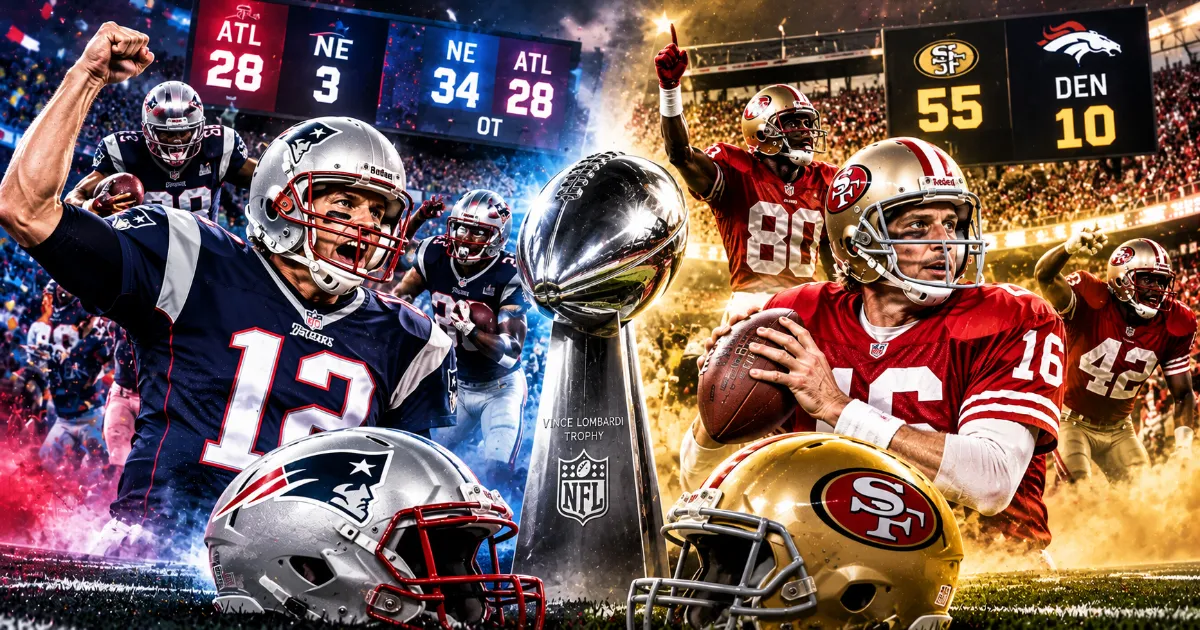
The Biggest Super Bowl Comebacks & Blowouts showcase the most dramatic rallies, dominant victories and unforgettable championship performances in NFL history.
The Super Bowl has produced almost every kind of championship-game drama imaginable. Some games have come down to the final play, while others were effectively decided before halftime. Among the most memorable are the games that sit at opposite ends of the spectrum: extraordinary comebacks and overwhelming blowouts.
The greatest comeback remains Super Bowl LI, when the New England Patriots erased a 28-3 deficit against the Atlanta Falcons to win 34-28 in overtime. At the other end, Super Bowl XXIV remains the biggest blowout in Super Bowl history, with the San Francisco 49ers defeating the Denver Broncos 55-10.
Those two games represent a 73-point swing between the largest comeback and largest margin of victory in the history of the NFL championship game.
Best NFL Offenses & Defenses Ever: 2013 Broncos, 1985 Bears & More
The Biggest Super Bowl Comeback: Patriots Erase 28-3 Deficit
No Super Bowl comeback has matched what the New England Patriots accomplished against the Atlanta Falcons in Super Bowl LI.
Atlanta appeared to be in complete control after taking a 28-3 lead in the third quarter. The Falcons had built their advantage through explosive offensive plays and a defense that had repeatedly pressured Tom Brady and the Patriots.
But New England slowly changed the game.
The Patriots scored 19 points in the fourth quarter, cutting Atlanta’s lead to 28-22 before a late touchdown drive brought them within two points. New England then converted a two-point attempt to tie the game at 28-28 with 57 seconds remaining.
Neither team scored during the remaining regulation time, sending the Super Bowl to overtime for the first time.
New England won the toss and immediately moved down the field. Brady converted several crucial plays before James White scored the winning touchdown, completing the largest comeback in Super Bowl history.
The final score was Patriots 34, Falcons 28.
The Patriots had overcome a 25-point deficit, surpassing the previous Super Bowl comeback record by a significant margin.
Tom Brady’s Record-Setting Performance
Tom Brady played a central role in the comeback.
The Patriots quarterback completed 43 of 62 passes for 466 yards, setting Super Bowl records for completions, attempts and passing yards at the time.
Brady also threw two touchdown passes and finished the game with a passing performance that helped New England overcome one of the most difficult situations a team can face on the biggest stage.
James White was equally important.
White scored three touchdowns and finished with 14 receptions for 110 yards, along with 29 rushing yards. His overtime touchdown gave New England its fifth Super Bowl championship.
Brady was named Super Bowl LI MVP, adding another major achievement to his already historic postseason résumé.
Atlanta’s Collapse Changed Super Bowl History
The Falcons had appeared to be heading toward their first Super Bowl championship.
Quarterback Matt Ryan had played efficiently, Atlanta’s defense had pressured Brady and the Falcons had built a 28-3 advantage.
But the Patriots’ comeback exposed how quickly a Super Bowl can change.
Atlanta stopped producing points after its third-quarter touchdown. New England, meanwhile, began sustaining longer drives and repeatedly converting third downs.
The Patriots scored 25 unanswered points to force overtime.
The result became one of the most famous comebacks in professional sports and remains the largest deficit overcome in Super Bowl history.
Super Bowl XLIV: Saints Overcome Early 10-0 Deficit
The New Orleans Saints produced another memorable comeback four years earlier when they defeated the Indianapolis Colts 31-17 in Super Bowl XLIV.
The Colts opened the game strongly and took a 10-0 lead.
New Orleans responded before halftime, but the turning point came immediately after the break.
Saints coach Sean Payton called for a surprise onside kick to start the second half, allowing New Orleans to recover possession and immediately put its offense back on the field.
The Saints capitalized on the opportunity and eventually took control of the game.
Quarterback Drew Brees completed 32 of 39 passes for 288 yards and two touchdowns. New Orleans’ defense then sealed the championship when Tracy Porter intercepted Peyton Manning and returned the pass for a touchdown late in the fourth quarter.
The Saints won their first Super Bowl championship.
Super Bowl XLIX: Patriots Rally Against Seattle
The New England Patriots also produced a significant fourth-quarter comeback against the Seattle Seahawks in Super Bowl XLIX.
Seattle led 24-14 in the fourth quarter before Brady led New England on two touchdown drives.
The Patriots cut the deficit to three points before Brady connected with Julian Edelman for a 3-yard touchdown that gave New England a 28-24 lead with just over two minutes remaining.
Seattle still had an opportunity to win.
The Seahawks moved inside New England’s 5-yard line and appeared to be in position for a potential championship-winning touchdown.
Instead, quarterback Russell Wilson’s pass intended for Ricardo Lockette was intercepted by Patriots cornerback Malcolm Butler at the goal line.
New England held on for a 28-24 victory.
While the game did not involve a comeback from anything close to Atlanta’s 25-point deficit, it remains one of the most dramatic fourth-quarter turnarounds in Super Bowl history.
Super Bowl XXII: Washington’s 35-Point Quarter
One of the most extraordinary offensive comebacks came in Super Bowl XXII between Washington and the Denver Broncos.
Denver jumped out to a 10-0 lead after the first quarter.
Washington then produced an offensive explosion that remains one of the most remarkable quarters in Super Bowl history.
Quarterback Doug Williams and the Washington offense scored 35 unanswered points in the second quarter.
Williams threw four touchdown passes during the quarter and finished the game with 340 passing yards and four touchdowns.
Washington entered halftime leading 35-10 and eventually won 42-10.
The second-quarter explosion remains one of the defining offensive stretches in Super Bowl history.
The Biggest Super Bowl Blowout: 49ers Beat Broncos 55-10
While Super Bowl LI represents the largest comeback, Super Bowl XXIV represents the opposite extreme.
The San Francisco 49ers defeated the Denver Broncos 55-10, producing the largest margin of victory in Super Bowl history.
The 45-point difference remains the record.
San Francisco’s offense was almost unstoppable throughout the game.
Quarterback Joe Montana threw five touchdown passes and completed 22 of 29 attempts for 297 yards.
The 49ers also produced a dominant defensive performance against Denver quarterback John Elway.
San Francisco intercepted Elway twice and held Denver to only 167 total yards.
By the second half, the game had effectively become a celebration of San Francisco’s superiority.
The 49ers’ 55 points remain the most scored by one team in a Super Bowl.
Joe Montana’s Historic Super Bowl Performance
Montana was named Super Bowl XXIV MVP after leading San Francisco’s offensive demolition.
His five touchdown passes were a Super Bowl record at the time.
Montana connected with Jerry Rice twice for touchdowns and also found John Taylor, Brent Jones and Roger Craig for scores.
Rice finished with seven receptions for 148 yards and three touchdowns, adding another spectacular performance to his growing Super Bowl legacy.
The 49ers entered the championship game as one of the NFL’s strongest teams, but few expected the game to become a 45-point rout.
San Francisco led 27-3 at halftime and continued scoring after the break.
Super Bowl XX: Bears Crush Patriots 46-10
The Chicago Bears produced another historic Super Bowl blowout when they defeated the New England Patriots 46-10 in Super Bowl XX.
Chicago’s defense dominated from the opening minutes.
The Bears intercepted Tony Eason three times and recorded seven sacks.
New England managed only seven rushing yards, while Chicago’s defense repeatedly disrupted the Patriots’ offense.
Richard Dent was named Super Bowl MVP after recording 2.5 sacks and forcing two fumbles.
Chicago’s defense became one of the defining units of the 1980s, and its performance in Super Bowl XX remains one of the clearest examples of a defense completely controlling a championship game.
Super Bowl XLVIII: Seahawks Destroy Record-Setting Broncos
Super Bowl XLVIII produced another 35-point margin when the Seattle Seahawks defeated the Denver Broncos 43-8.
The matchup had been billed as a battle between Denver’s record-setting offense and Seattle’s elite defense.
Instead, Seattle dominated almost immediately.
The Seahawks scored on the opening safety and continued forcing mistakes throughout the game.
Seattle’s defense intercepted Peyton Manning twice and prevented Denver from finding any consistent rhythm.
Manning’s Broncos had scored 606 points during the regular season, an NFL record at the time, but Seattle held them to only eight points in the Super Bowl.
Linebacker Malcolm Smith was named MVP after recording an interception and a fumble recovery.
The game remains one of the most decisive defensive performances in Super Bowl history.
Super Bowl XXVII: Cowboys Rout Bills
The Dallas Cowboys defeated the Buffalo Bills 52-17 in Super Bowl XXVII, producing another 35-point victory.
Buffalo had reached the Super Bowl for the third consecutive season, but Dallas’ defense and offense overwhelmed the Bills.
The Cowboys forced nine Buffalo turnovers, including four interceptions and five fumbles.
Quarterback Troy Aikman threw four touchdown passes and was named Super Bowl MVP.
Running back Emmitt Smith also played a major role as Dallas controlled the game on the ground.
The victory gave the Cowboys their third Super Bowl championship and began another championship era for the franchise.
The Biggest Super Bowl Margins of Victory
The largest blowouts in Super Bowl history include several dominant performances from teams that went on to become defining champions of their eras.
| Rank | Super Bowl | Winner | Score | Margin |
|---|---|---|---|---|
| 1 | XXIV | San Francisco 49ers | 55-10 Broncos | 45 |
| 2 | XX | Chicago Bears | 46-10 Patriots | 36 |
| 3 | XLVIII | Seattle Seahawks | 43-8 Broncos | 35 |
| 3 | XXVII | Dallas Cowboys | 52-17 Bills | 35 |
| 5 | XXXV | Baltimore Ravens | 34-7 Giants | 27 |
| 6 | XXII | Washington | 42-10 Broncos | 32 |
The list shows how frequently historically dominant defenses have been involved in the largest Super Bowl victories.
Seattle’s 2014 performance is particularly notable because Denver entered the game with the NFL’s most productive regular-season offense.
Why Were Super Bowl Blowouts More Common in Earlier Eras?
The distribution of Super Bowl margins has changed over time.
The 1980s and early 1990s produced several extremely one-sided championship games. San Francisco, Chicago, Washington and Dallas all recorded major Super Bowl victories during that period.
Several factors can help explain why the modern NFL has produced fewer extreme mismatches.
The salary cap, free agency and greater league-wide parity have made it more difficult for teams to maintain overwhelming advantages for long periods.
Coaching and scouting have also become increasingly sophisticated, while the modern passing game has created more opportunities for teams to remain competitive even when they fall behind.
That does not mean blowouts have disappeared.
Seattle’s 43-8 victory over Denver demonstrated that a dominant defense can still completely disrupt an elite offense. But the frequency of enormous margins has generally declined compared with some earlier stretches of Super Bowl history.
Comebacks and Blowouts Can Both Define a Super Bowl
The contrast between the biggest comeback and biggest blowout illustrates why the Super Bowl remains such a unique sporting event.
In Atlanta-New England, the game appeared virtually decided at 28-3.
Instead, New England scored 25 unanswered points and won in overtime.
In San Francisco-Denver, the opposite happened.
The 49ers established control early and never allowed Denver to recover, eventually winning by 45 points.
One game demonstrated the extreme unpredictability of football. The other demonstrated what happens when one team completely controls every phase of a championship game.
The Role of Quarterbacks in Super Bowl Turnarounds
Quarterback play has been central to many of the most famous Super Bowl comebacks.
Brady’s performance against Atlanta is the clearest example. His ability to continue operating the offense despite the enormous deficit allowed New England to gradually change the game’s momentum.
Brees’ performance against Indianapolis was similarly important, particularly after New Orleans’ defense began creating opportunities.
Doug Williams’ second-quarter explosion against Denver showed another side of quarterback impact. His four touchdown passes helped Washington transform a 10-point deficit into a 25-point halftime advantage.
These performances demonstrate why quarterbacks receive so much attention during championship comebacks, although successful rallies almost always require contributions from the offensive line, defense, special teams and coaching staff.
The Bottom Line
The Biggest Super Bowl Comebacks & Blowouts represent two completely different forms of championship drama.
The New England Patriots’ comeback from 28-3 down against Atlanta remains the largest comeback in Super Bowl history. New England overcame a 25-point deficit, forced overtime and eventually won 34-28.
At the other end, the San Francisco 49ers’ 55-10 victory over Denver remains the biggest Super Bowl blowout, with a 45-point margin.
Other games have added their own chapters to the history: New Orleans’ comeback against Indianapolis, Washington’s extraordinary 35-point second quarter against Denver, Seattle’s demolition of Denver’s record-setting offense and Chicago’s defensive masterpiece against New England.
Some Super Bowls are remembered because a team refused to lose.
Others are remembered because one team simply overwhelmed the other.
Together, they represent the two extremes that have made the Super Bowl one of the most dramatic championship events in American sports.
Most Successful NFL Teams of All Time: Packers Lead With 13 Titles