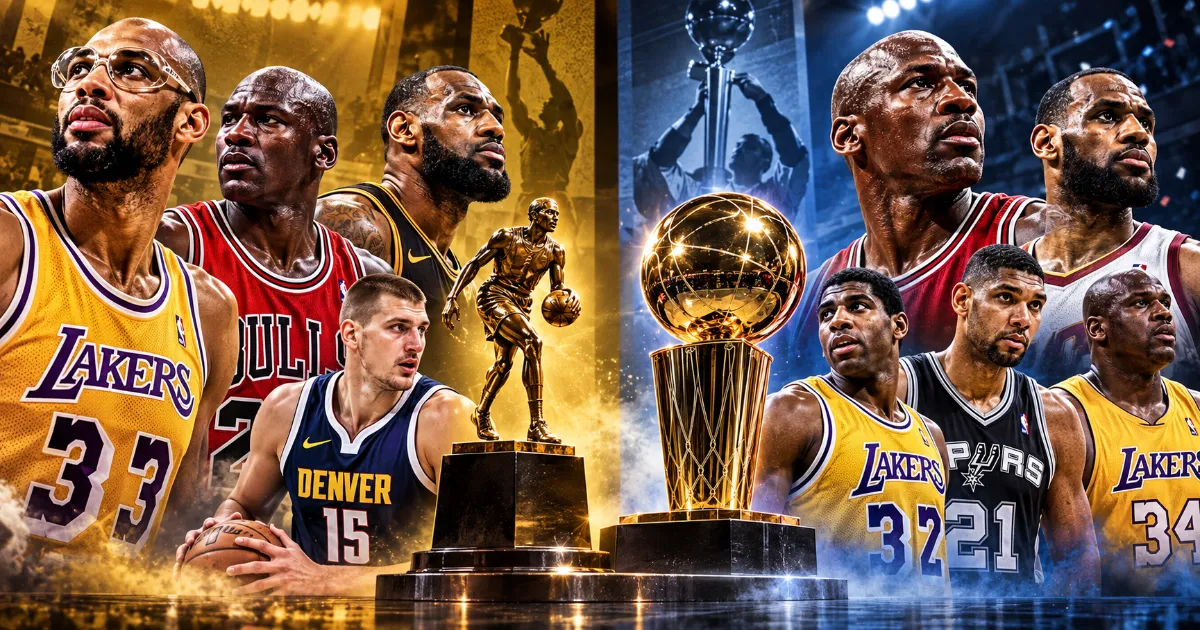
Kareem Abdul-Jabbar leads regular-season MVPs, Michael Jordan leads Finals MVPs — why these two leaderboards rarely feature the same names at the top
Regular-season MVP and Finals MVP measure genuinely different things — one rewards the best individual season across 82 games, the other rewards the best individual performance across a single championship series. That the two leaderboards feature different names at the top isn’t a coincidence; it reflects what each award is actually designed to capture.
The Highest-Scoring Team Games in NBA History, Ranked
Most Regular-Season MVP Awards
| Rank | Player | MVP Awards |
|---|---|---|
| 1 | Kareem Abdul-Jabbar | 6 |
| 2 (tie) | Michael Jordan | 5 |
| 2 (tie) | LeBron James | 4 |
| 2 (tie) | Bill Russell | 5 |
| 5 (tie) | Wilt Chamberlain | 4 |
| 5 (tie) | Nikola Jokic | 3+ (active) |
Kareem Abdul-Jabbar’s six regular-season MVP awards remain the most in NBA history, spread across both his Milwaukee and Los Angeles Lakers tenures, reflecting sustained individual dominance across nearly two decades rather than a concentrated peak.
Bill Russell’s Case Within the MVP Conversation
Bill Russell’s five regular-season MVP awards place him in a tie for the second-most in league history, a total that becomes even more remarkable given how thoroughly his eleven championships might suggest his individual recognition should be even higher. Russell’s relatively modest Finals MVP total — the award didn’t exist during most of his championship run, having only been introduced in 1969 — means his final season, in which the Celtics won a title with Russell serving as player-coach, remains the only Finals MVP opportunity his career overlapped with, and he did not win it that year, with Jerry West instead becoming the only Finals MVP in NBA history to win the award despite playing for the losing team. This historical quirk means Russell’s case, despite his unmatched championship volume, is almost entirely absent from Finals MVP conversations purely due to the award’s timing relative to his career.
Wilt Chamberlain’s Case for Additional Recognition
Wilt Chamberlain’s four regular-season MVP awards, tied for fifth on the all-time list, arguably understate his individual statistical dominance relative to the rest of the league during his career, given how many additional seasons he posted historically extreme scoring and rebounding numbers without capturing the award. Voting patterns during his era sometimes favored team success and narrative considerations alongside pure statistical dominance, meaning several of Chamberlain’s most individually extreme statistical seasons, including his 50.4-point-per-game campaign, did not result in an MVP award specifically because his Philadelphia Warriors did not have the same level of team success that season as competing candidates.
Most Finals MVP Awards
| Rank | Player | Finals MVP Awards |
|---|---|---|
| 1 | Michael Jordan | 6 |
| 2 (tie) | LeBron James | 4 |
| 2 (tie) | Magic Johnson | 3 |
| 4 (tie) | Tim Duncan | 3 |
| 4 (tie) | Shaquille O’Neal | 3 |
Michael Jordan’s six Finals MVP awards match his six championships exactly, reflecting his perfect record of being named the best player in every single title run he ever completed, a distinction that separates his Finals MVP total from every other player on either list.
Magic Johnson’s Balanced Case Across Both Lists
Magic Johnson stands out as one of the few players whose regular-season MVP total (three) and Finals MVP total (three) match exactly, reflecting a career where his individual recognition remained remarkably consistent between the regular season and the playoffs. This balance distinguishes his case from most other names on these two lists, where a significant gap between the two totals is the norm rather than the exception, whether that gap favors regular-season dominance, as with Abdul-Jabbar and Russell, or Finals-specific brilliance, as with Jordan.
Tim Duncan and Shaquille O’Neal’s Shared Total
Tim Duncan and Shaquille O’Neal are tied with three Finals MVP awards each, though the paths to that shared total differ meaningfully. O’Neal’s three came consecutively, from 2000 to 2002, during the peak of his physical dominance alongside a young Kobe Bryant. Duncan’s three were spread across a much longer window, from 1999 to 2005, reflecting his more gradual, sustained excellence across the Spurs’ championship dynasty rather than a single concentrated peak stretch. Both players’ totals also share something else in common: each won at least one additional championship without capturing Finals MVP, with a teammate receiving the honor instead in those specific series.
Why Abdul-Jabbar Leads MVPs but Trails in Finals MVPs
Abdul-Jabbar’s six regular-season MVP awards reflect individual dominance sustained across two decades, several of which came during seasons when his Milwaukee Bucks or Lakers teams, while good, weren’t necessarily the league’s clear championship favorite. His Finals MVP total of two, by contrast, reflects that even during his championship seasons, teammates like Magic Johnson often received individual recognition as the series’ most impactful player, a reasonable outcome given how much credit that “Showtime” era rightly distributed toward Johnson’s playmaking rather than concentrating it entirely on Abdul-Jabbar’s continued excellence.
Why Jordan’s Perfect Finals MVP Record Is Statistically Unique
No other player in NBA history has combined a perfect championship-to-Finals-MVP ratio at Jordan’s volume. Players like Tim Duncan and Shaquille O’Neal won multiple championships without winning Finals MVP every single time, since teammates occasionally received the honor instead — Tony Parker won Finals MVP over Duncan in 2007, for instance, despite Duncan anchoring that Spurs championship as much as any other title in his career. Jordan’s six-for-six record reflects both individual brilliance and a level of offensive centrality within Chicago’s system that left little room for a teammate to plausibly be considered the series’ most valuable player instead.
How These Two Awards Measure Different Kinds of Value
Regular-season MVP voting historically rewards a combination of individual statistics and team success across a full 82-game sample, meaning it can favor a dominant player on a very good, but not necessarily championship-winning, team. Finals MVP, by contrast, only exists in the context of an actual championship series, meaning it inherently rewards players who both reached the Finals and performed at the highest level once there. This structural difference explains why several players with modest regular-season MVP totals, including Magic Johnson’s three regular-season awards against his own three Finals MVPs, show much closer alignment between the two categories than a player like Abdul-Jabbar, whose regular-season dominance didn’t always translate into being his own team’s best postseason performer.
Active Players Still Building Their Cases
Nikola Jokic’s ongoing MVP accumulation, already sitting at three or more awards depending on the season being referenced, positions him as a genuine threat to eventually challenge Abdul-Jabbar’s regular-season record if his current level of dominance continues for several more seasons. On the Finals MVP side, no currently active player outside LeBron James has won multiple Finals MVP awards, reflecting how difficult it remains to both reach multiple championship series and be recognized as the series’ best individual performer each time.
Final Thoughts
Most MVP and Finals MVP awards in NBA history reflect two genuinely different forms of individual recognition. Kareem Abdul-Jabbar’s six regular-season MVPs reward sustained dominance across an unusually long, consistently excellent career. Michael Jordan’s six Finals MVPs, matching his six championships exactly, reward a level of concentrated postseason brilliance that left no room for ambiguity about who deserved the honor in any of his title runs. Both records have stood for decades, and both illustrate that “most valuable” means something different depending on whether the question is being asked about a full season or a single decisive series.
Frequently Asked Questions
Who has won the most regular-season MVP awards in NBA history? Kareem Abdul-Jabbar, with six awards across his Milwaukee and Los Angeles Lakers tenures, the most in league history.
Who has won the most Finals MVP awards in NBA history? Michael Jordan, with six Finals MVP awards, matching his six championships exactly for a perfect record across every title run he completed.
Has any player ever won a championship without winning Finals MVP? Yes, this happens whenever a teammate is judged to have been the series’ most valuable player instead — Tim Duncan, for example, won five championships but only three Finals MVP awards, with Tony Parker winning the honor in 2007.
Did Jerry West ever win Finals MVP despite losing the series? Yes, West remains the only player in NBA history to win Finals MVP while playing for the losing team, an honor he received in 1969 against Bill Russell’s Boston Celtics, the same year the award was first introduced.


2 Comments