The three-point record, the unanimous MVP season, and the specific games that built basketball’s most statistically unusual scoring career
Stephen Curry Career Stats: The Complete Numbers Behind the Shooting Revolution
Stephen Curry’s statistical profile doesn’t resemble any other player in NBA history, built almost entirely around a single shot type taken at a volume and accuracy no one had previously attempted. This is a straight reference breakdown: career totals, the three-point records in detail, the awards ledger, and the specific games that built his statistical legacy.
Greatest NBA Dynasties — What Made Each Era Truly Unstoppable
Stephen Curry vs Kobe Bryant, Kevin Durant and Magic Johnson: Where He Stands
Career Totals at a Glance
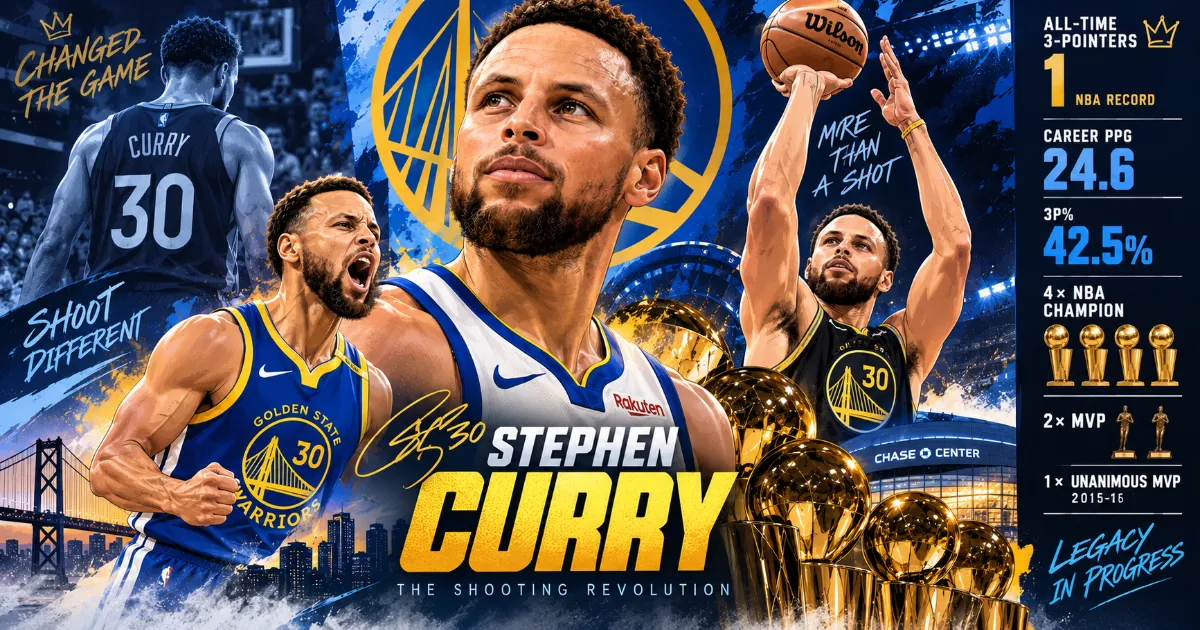
Curry holds the NBA’s all-time record for career three-pointers made, a mark he continues to extend with every game he plays. His career scoring average sits around 24.6 points per game, with career shooting splits of roughly 47 percent from the field, 42.5 percent from three-point range, and 91 percent from the free-throw line — splits that place him among the small handful of players ever to reach the “50-40-90” efficiency threshold in a single season, which he has done multiple times across his career.
He ranks among the NBA’s all-time assist leaders as well, a frequently overlooked part of his statistical profile given how much attention his shooting draws, reflecting genuine point guard playmaking underneath the scoring record.
The Three-Point Record, In Detail
Curry became the first player in NBA history to make more than 300 three-pointers in a single season, then became the first to surpass 400 in a season, both marks that remain unmatched by any other player’s single-season total. His 2015-16 season, in which he made 402 three-pointers, remains the standard against which every subsequent high-volume shooting season gets measured.
His career three-point total surpassed Ray Allen’s previous all-time record, a mark that had itself once been considered a career-defining, unlikely-to-be-broken achievement. Curry’s ongoing active career means the final total remains a moving target, extending further with every three-pointer he adds.
How His Shot Selection Reshaped What “Good Shot” Means
Curry’s statistical profile is inseparable from a broader shift in how the sport evaluates shot quality. Before his rise, a well-contested three-pointer from 28 feet would have been considered a poor shot selection by most coaching staffs, regardless of the shooter’s career percentage. Curry’s sustained accuracy at that range, combined with advanced analytics demonstrating that even a moderately contested three-pointer often produces more expected points than a contested long two, helped legitimize shot selection philosophy that would have been considered reckless a decade earlier. His individual shooting statistics, in other words, didn’t just set records — they helped rewrite the analytical framework used to judge what a good shot even is league-wide.
Deep-Range Shooting: A Statistical Category He Created
Beyond standard three-point statistics, Curry’s willingness to attempt and convert shots from well beyond the three-point line at a functional rate has effectively created a new informal statistical category that didn’t meaningfully exist before his career. Tracking data on shots attempted from 30 feet or further shows Curry not only leading the league by significant margin in both volume and makes at that specific range, but doing so at an accuracy rate that most players can’t match even closer to the basket. This specific skill — logo-range shooting as a repeatable, reliable weapon rather than a desperation heave — has no meaningful statistical precedent in league history prior to his career.
Playoff Statistical Record
Beyond his individual signature games, Curry’s broader postseason statistical record includes some of the highest career playoff three-point totals in NBA history, accumulated across four championship runs and numerous additional postseason appearances. His playoff three-point percentage has remained close to his regular-season number across a large sample size, addressing an early-career narrative that questioned whether his shooting would hold up under increased playoff defensive attention — a question his sustained postseason accuracy has answered fairly definitively over multiple championship runs.
Season Milestone Snapshot
| Season | Team Role | PPG | Notable |
|---|---|---|---|
| 2012-13 | Emerging scorer | 22.9 | Broke the single-season three-point record for the first time |
| 2014-15 | Primary option | 23.8 | First regular-season MVP, first championship |
| 2015-16 | Peak season | 30.1 | Unanimous MVP, 73-win season, 402 threes |
| 2016-17 | Alongside Durant | 25.3 | Second championship |
| 2021-22 | Post-Durant era | 25.5 | Fourth championship, first Finals MVP |
| 2022-23 | Active | 29.4 | Continued extending three-point record |
Individual Awards Ledger
Curry has won two regular-season MVP awards, including the first unanimous selection in NBA history in 2016, one Finals MVP award (2022), and multiple three-point contest championships. He has been named to numerous All-NBA teams and All-Star selections across his career, along with leading the league in scoring, three-pointers made, and free-throw percentage in various individual seasons.
The unanimous 2016 MVP vote remains a uniquely significant statistical achievement — no player before or since has received every single first-place vote in the award’s history, reflecting a level of consensus dominance that season that goes beyond what typical MVP voting margins usually show.
The 73-Win Season in Statistical Context
Curry’s 2015-16 Golden State Warriors won a then-record 73 regular-season games, surpassing the Chicago Bulls’ 72-win mark from 1995-96. Curry’s individual numbers that season — 30.1 points, 6.7 assists, and a 50.4/45.4/90.8 shooting split — anchored the most statistically dominant regular season in NBA history at that point, even though the Warriors fell short in the Finals against Cleveland, adding a layer of complexity to how that specific season gets remembered relative to his championship seasons.
Signature Games and Career-High Performances
Curry’s career-high of 62 points, scored against Portland in 2021, came during a season when he was 33 years old, well past the age when most players’ primary scoring role typically diminishes. His playoff career includes several individual games with 10 or more made three-pointers, a feat that remains rare enough league-wide that any single instance typically becomes a notable individual storyline, while Curry has done it multiple times across his postseason career.
His Game 4 performance in the 2022 Finals against Boston, in which he scored 43 points to help Golden State take a commanding series lead, is frequently cited as the signature performance of the championship run that finally earned him his first career Finals MVP award, addressing a long-standing gap in an otherwise decorated résumé.
The 2016 Finals Collapse: A Statistical Footnote
Curry’s statistical legacy includes one significant blemish worth addressing directly: the 2016 Finals loss to Cleveland after Golden State held a 3-1 series lead, following the record-breaking 73-win regular season. Curry’s individual numbers across that series remained strong, but the collapse, combined with a Game 6 performance that included his first career playoff ejection for excessive fouls, remains a frequently cited counterpoint whenever his statistical dominance from that specific season comes up in broader historical conversations.
Career Comparison to Other Elite Shooters
| Player | Career 3PT Made | Career 3PT% | 50-40-90 Seasons |
|---|---|---|---|
| Stephen Curry | 3,700+ (active) | ~42.5% | Multiple |
| Ray Allen | 2,973 | ~40.0% | 0 |
| Reggie Miller | 2,560 | ~39.5% | 0 |
| Klay Thompson | 2,700+ | ~41.5% | 0 |
Injury History and Its Statistical Impact
Curry’s early career was significantly affected by recurring ankle injuries, which raised genuine questions at the time about his long-term durability and led to multiple offseason surgeries before he established himself as an MVP-caliber player. Since resolving those issues, he has remained remarkably durable relative to those early-career concerns, sustaining elite statistical production well into his mid-thirties. This durability turnaround is a meaningful part of his overall statistical story, since the three-point records and MVP-caliber seasons that followed were far from a guaranteed outcome given how his career began.
The Splash Brothers Statistical Partnership
Curry’s statistical record is closely intertwined with Klay Thompson’s, and the pairing’s combined three-point production across their shared seasons remains the most prolific shooting partnership in NBA history. Games in which both Curry and Thompson each made five or more three-pointers occurred with a frequency no other teammate pairing has approached, and their combined single-game three-point totals on several occasions have exceeded what many entire opposing teams managed collectively. This partnership statistic is worth noting separately from Curry’s individual records, since it reflects a genuinely unique two-man statistical phenomenon rather than simply two players who happened to share a roster.
How Coaching Systems Amplified His Statistical Output
Steve Kerr’s arrival as Golden State’s head coach in 2014 coincided almost perfectly with Curry’s ascent into the league’s statistical elite, and the motion-heavy, ball-movement-focused offensive system Kerr installed is widely credited as a significant contributing factor. Rather than relying primarily on isolation plays, Kerr’s system used constant off-ball screening and movement to generate open looks for Curry within the flow of the offense, a structural advantage that helped him sustain his shooting volume and accuracy at levels that a more isolation-heavy system might not have produced to the same degree.
Final Thoughts
Stephen Curry’s career statistics reflect an offensive profile with no direct historical precedent: the most three-pointers ever made, multiple 50-40-90 efficiency seasons, a unanimous MVP award unmatched in league history, and a record-breaking 73-win season anchoring one of the most statistically dominant regular-season rosters ever assembled. Combined with the specific signature games — the 402-three-pointer season, the 62-point outburst at 33, the 2022 Finals breakthrough — these numbers tell the story of a genuinely unprecedented offensive career still adding to its own record book.
Frequently Asked Questions
How many three-pointers did Stephen Curry make in his record-breaking season? He made 402 three-pointers during the 2015-16 season, the first player in NBA history to surpass 400 in a single season.
Is Stephen Curry the only unanimous MVP in NBA history? Yes, his 2016 MVP award remains the only unanimous selection in the award’s history, with every voter naming him their first-place choice.
What is Stephen Curry’s career-high in a single game? 62 points, scored against the Portland Trail Blazers in 2021, at age 33.
How many championships has Stephen Curry won, and when did he win his first Finals MVP? He has won four championships with the Golden State Warriors, and captured his first career Finals MVP award in 2022, after previously winning three championships without the individual honor.
🔹🔹 Follow us on Facebook 🔹🔹