From George Mikan’s Minneapolis dynasty to LeBron James’s modern Lakers, here’s how the franchise’s greatest players connect across nearly eight decades
Los Angeles Lakers Greatest Players Ever: A Franchise Told Through Six Eras
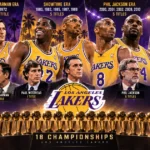
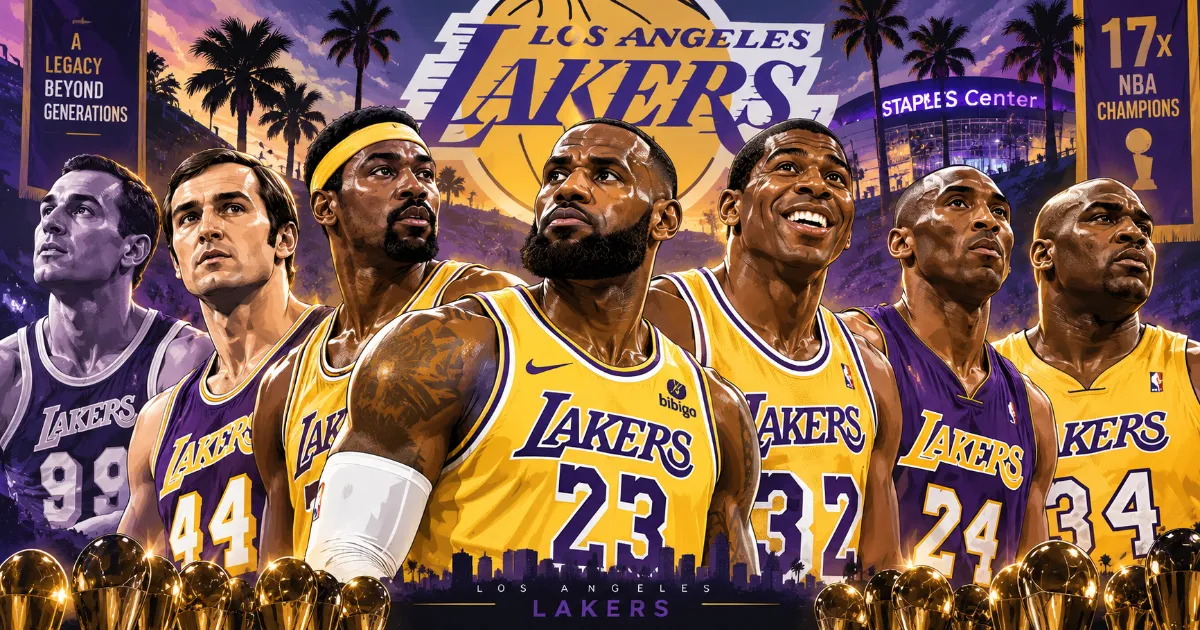
No NBA franchise has stayed championship-relevant across as many distinct eras as the Lakers, and that continuity is best understood not as a single ranked list, but as six overlapping generations of stars, each one inheriting a franchise that the previous generation had already made great. This is the Lakers’ history told through those six eras.
Kobe Bryant’s Case Among the All-Time Greats, Explained
Michael Jordan Career Stats, Records and Six Championships Explained
Era One: The Minneapolis Dynasty (1948-1957)
George Mikan established the franchise’s first dynasty before it ever moved to Los Angeles, anchoring five championships in six seasons with the Minneapolis Lakers and forcing the league to widen the free-throw lane specifically in response to his interior dominance. Mikan’s teammates Jim Pollard and Vern Mikkelsen rounded out a roster that, while operating in a very different competitive landscape than the modern NBA, established the winning culture the franchise would carry into its Los Angeles relocation in 1960.
Era Two: West, Baylor and the Championship Drought (1960-1971)
Jerry West’s combination of clutch scoring and two-way excellence made him one of the most complete guards of his generation, and his image remains the basis for the NBA’s own logo. Alongside him, Elgin Baylor’s revolutionary athleticism helped establish the small forward position’s offensive potential years before the modern dunk era. Together, West and Baylor reached the Finals repeatedly during this stretch, only to lose to Bill Russell’s Celtics dynasty on nearly every occasion, a frustration that became one of the defining storylines of both players’ otherwise legendary careers.
Wilt Chamberlain’s arrival via trade in 1968 added a third all-time great to the roster, and his statistical dominance helped the Lakers finally break through for a championship in 1972, delivering West his only title after a career defined largely by near-misses.
Era Three: Showtime (1979-1991)
Magic Johnson’s arrival in 1979 launched the most stylistically influential era in franchise history. His unusual size and playmaking vision, paired with Kareem Abdul-Jabbar’s continued interior dominance well into his late 30s, anchored five championships across the decade. James Worthy’s transition scoring and Byron Scott’s perimeter shooting rounded out a roster built specifically to maximize Johnson’s open-court vision, while coach Pat Riley’s up-tempo system became one of the most commercially and stylistically influential approaches in league history.
Era Four: The Shaq-Kobe Three-Peat (2000-2002)
Shaquille O’Neal’s combination of size and athleticism made him nearly unstoppable in the post, while a young Kobe Bryant developed into a genuine co-star during three consecutive championships from 2000 to 2002. The pairing’s on-court success was matched by well-documented off-court tension, and O’Neal’s eventual trade to Miami in 2004 opened the door for Bryant to become the franchise’s undisputed leader for the next decade.
Era Five: Kobe’s Second Act (2008-2010)
Bryant’s final two championships, in 2009 and 2010, came as the clear franchise cornerstone rather than a co-star, alongside Pau Gasol’s skilled interior play and Derek Fisher’s steady perimeter shooting and leadership. This era answered a specific criticism that had trailed Bryant since O’Neal’s departure — that he couldn’t win without a dominant co-star — with Gasol proving an excellent complementary piece without ever approaching O’Neal’s individual dominance.
Era Six: LeBron James and the Modern Franchise (2018-Present)
LeBron James’s 2018 arrival brought the franchise’s most statistically complete player in its history, and his 2020 championship, won alongside Anthony Davis inside the pandemic-era Orlando bubble, extended the Lakers’ championship tradition into a sixth distinct era. James’s combination of longevity and multi-franchise success gives this era a different statistical shape than any before it — a superstar who arrived already carrying championships from two other organizations, rather than one developed entirely within the Lakers system.
Complementary Stars Who Rarely Get Top Billing
Beyond the marquee names anchoring each era, several complementary Lakers stars deserve recognition for how directly they enabled specific championship runs. Gail Goodrich’s scoring anchored the franchise’s record-setting 33-game winning streak during the 1971-72 championship season, still the longest winning streak in North American major professional sports history. Michael Cooper’s defensive versatility during the Showtime era allowed Magic Johnson and the roster’s other offensive-minded stars to play a more aggressive style without significant defensive liability. Metta World Peace’s physical, disruptive defense played a genuinely important role in the Lakers’ 2010 championship, providing a reminder that not every significant contributor to this franchise’s success needs to be a top-tier offensive name to matter to the overall history.
How Coaching Continuity Shaped Each Era
Coaching stability played a meaningfully different role across the six eras discussed above. Phil Jackson’s arrival for both the Shaq-Kobe three-peat and later Bryant’s second championship act gave the franchise a coaching continuity that spanned two otherwise distinct eras, making him the only figure besides the Lakers’ front office itself to bridge multiple generations of this history directly. Pat Riley’s Showtime-era tenure, by contrast, was entirely specific to that single generation of talent, while the modern LeBron James era has featured more coaching turnover than most previous championship windows, reflecting a broader league-wide trend toward less coaching continuity across the sport generally.
Greatest Lakers Players Ever — Quick Reference Table
| Player | Era | Lakers Championships |
|---|---|---|
| George Mikan | Minneapolis Dynasty | 5 |
| Jerry West | West-Baylor Era | 1 |
| Elgin Baylor | West-Baylor Era | 0 |
| Wilt Chamberlain | West-Baylor Era | 1 |
| Magic Johnson | Showtime | 5 |
| Kareem Abdul-Jabbar | Showtime (Lakers portion) | 5 |
| James Worthy | Showtime | 3 |
| Shaquille O’Neal | Shaq-Kobe Three-Peat | 3 |
| Kobe Bryant | Shaq-Kobe / Second Act | 5 |
| Pau Gasol | Kobe’s Second Act | 2 |
| LeBron James | Modern Franchise | 1 |
The Statistical Gap Between Eras
Comparing statistics directly across these six eras requires real caution, since the pace, rules, and competitive depth of each period differ substantially. Mikan’s Minneapolis-era numbers came in a league with a dramatically smaller talent pool and different rules around lane width and defensive positioning. West and Baylor’s era predated the three-point line entirely. Johnson’s Showtime numbers came before hand-checking rules were loosened in the mid-2000s, meaning his assist totals were generated against considerably more physical perimeter defense than modern point guards typically face. This context matters when any retrospective list is tempted to rank these players purely by raw statistical output rather than accounting for how dramatically the sport itself has changed across the franchise’s nearly eight-decade history.
Why the Lakers Have Sustained Relevance Across So Many Eras
Understanding the greatest Los Angeles Lakers players ever also means understanding why this specific franchise has managed to remain championship-relevant across nearly eight decades when most organizations experience much longer stretches of irrelevance between championship windows. The Lakers have repeatedly succeeded in either developing or acquiring a true franchise cornerstone almost immediately after the previous era’s cornerstone declined — West gave way to the arrival of Johnson and Abdul-Jabbar, Johnson’s career-ending diagnosis was followed by the eventual arrival of O’Neal and Bryant, and Bryant’s retirement preceded James’s arrival by only two seasons. This continuity is arguably as much a testament to the organization’s institutional ability to attract star talent, given the market and franchise history, as to any single player’s individual greatness.
The Role of Los Angeles as a Market
Part of the Lakers’ sustained ability to attract superstar talent across six distinct eras relates directly to the city itself. Los Angeles’s entertainment industry presence, favorable climate, and status as one of the league’s largest media markets have made the franchise an especially attractive destination for players considering business and lifestyle factors alongside pure basketball considerations. This market advantage doesn’t diminish any individual player’s on-court greatness, but it does help explain why the Lakers specifically, rather than a comparably successful small-market franchise, have managed to reload with genuine superstar talent as consistently as they have across so many different decades.
Retired Numbers and the Franchise’s Own Recognition
The Lakers have retired more jersey numbers than almost any other franchise in professional sports, a reflection of just how many genuinely significant players have worn the uniform across these six eras. Kobe Bryant holds the unusual distinction of having two separate numbers retired by the franchise — 8 and 24 — representing the two distinct statistical eras of his own career discussed above. This level of formal organizational recognition, spanning George Mikan’s number from the Minneapolis era through Bryant’s two numbers and continuing to honor more recent contributors, reflects an institutional approach to franchise history that few other organizations have matched, reinforcing just how many players across this list the organization itself considers foundational to its identity.
Final Thoughts
The greatest Los Angeles Lakers players ever can’t be fully understood through a single flat ranking, because the franchise’s history is really six overlapping stories, each generation of stars inheriting a winning culture the previous generation had already established. From George Mikan’s Minneapolis dominance through Jerry West’s near-misses, Magic Johnson’s Showtime revolution, the Shaq-Kobe three-peat, Bryant’s second act, and LeBron James’s modern arrival, this franchise’s continuity across nearly eight decades remains unmatched by almost any other organization in professional sports.
Frequently Asked Questions
Who is considered the greatest Los Angeles Lakers player of all time? Magic Johnson and Kobe Bryant are the two names most frequently cited, given Johnson’s five championships and position-redefining playmaking, and Bryant’s five championships and twenty-season loyalty to the franchise.
How many championships have the Lakers won across their entire history, including Minneapolis? The franchise has won seventeen total championships, tied with the Boston Celtics for the most in NBA history, spanning both the Minneapolis and Los Angeles eras.
Did Jerry West ever win a championship with the Lakers? Yes, West won a single championship in 1972, after years of Finals losses to Bill Russell’s Boston Celtics dynasty during the 1960s.
Which Lakers championship team holds the longest winning streak in NBA history? The 1971-72 championship roster, featuring Jerry West, Wilt Chamberlain, and Gail Goodrich, won 33 consecutive games during the regular season, a record that remains unmatched across North American major professional sports.
🔹🔹 Follow us on Facebook 🔹🔹
What Made Magic Johnson’s Lakers Legacy Impossible to Replicate