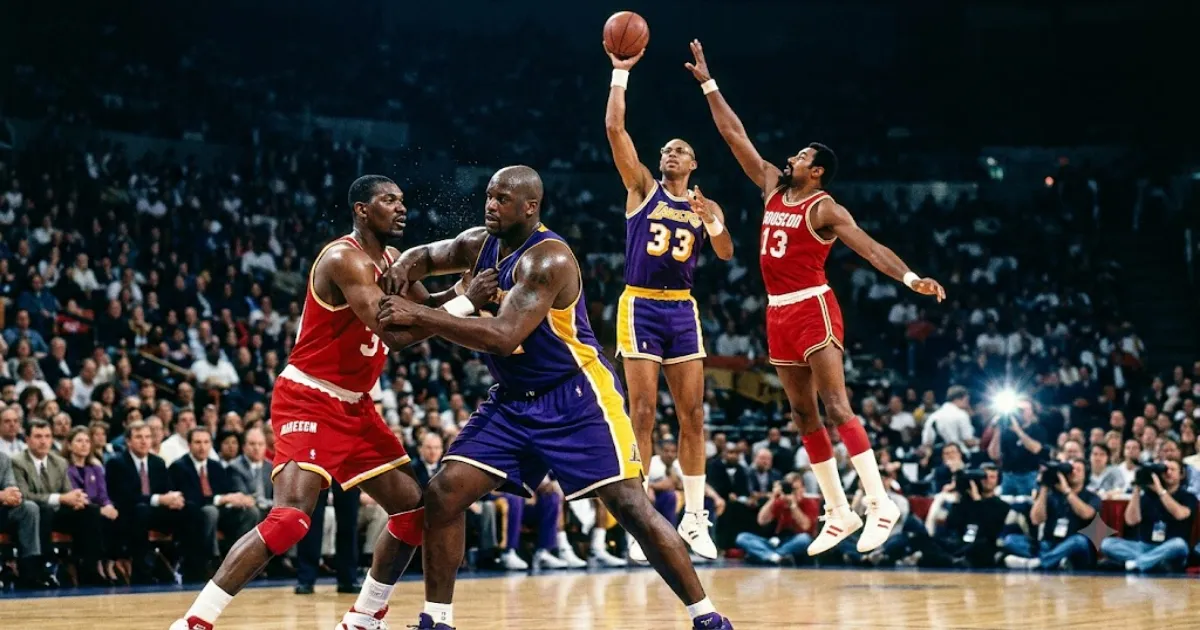
Footwork against force, longevity against peak power, statistical extremes against physical overwhelm — how Shaquille O’Neal’s case for most dominant center holds up against the position’s other legends
Shaquille O’Neal’s Case as the Most Dominant Center Ever, Tested Against Hakeem, Kareem and Wilt
“Most dominant” and “greatest” aren’t quite the same question when it comes to NBA centers. Shaquille O’Neal’s case rests specifically on the first framing — an argument about pure physical overwhelm rather than career-long statistical accumulation or skill refinement. Measured against Hakeem Olajuwon’s footwork, Kareem Abdul-Jabbar’s longevity, and Wilt Chamberlain’s statistical extremes, O’Neal’s claim to being the position’s most physically dominant player holds up differently against each one.
Michael Jordan Career Stats, Records and Six Championships Explained
Against Hakeem Olajuwon: Force vs. Footwork
Few individual matchups in NBA history get discussed as often as O’Neal against Olajuwon, largely because their statistical showdown in the 1995 Finals settled very little about who the better player actually was, even though Houston swept Orlando in that series. Olajuwon’s “Dream Shake” — a combination of spin moves, up-and-under fakes, and footwork that remains a coaching reference point for post players decades later — represented pure skill refinement. O’Neal’s game represented pure physical force: a combination of size and athleticism that made simple post catches into nearly automatic scoring opportunities regardless of footwork sophistication.
Statistically, O’Neal holds clear edges in career scoring average and total championships (four to Olajuwon’s two), while Olajuwon holds the edge in Defensive Player of the Year awards (one, plus a level of shot-blocking versatility O’Neal never matched) and in overall offensive skill refinement. The 1995 sweep is frequently cited as evidence for Olajuwon, but a single series is a thin sample against O’Neal’s much longer track record of individual statistical dominance across a full career.
Against Kareem Abdul-Jabbar: Force vs. Longevity
This comparison is really a question about which form of dominance matters more: O’Neal’s peak physical overwhelm across a shorter effective prime, or Abdul-Jabbar’s ability to remain a genuinely productive, if less physically overwhelming, center for twenty consecutive seasons. Abdul-Jabbar’s skyhook required minimal athletic explosiveness, allowing him to remain effective into his late 30s in a way O’Neal’s much more physically demanding post game never could have sustained at the same age.
O’Neal’s peak seasons — particularly his three consecutive Finals MVP awards from 2000 to 2002 — represent a level of single-season physical dominance most analysts consider unmatched at the center position. But Abdul-Jabbar’s six regular-season MVP awards, still the most in NBA history, and his six championships across two franchises and multiple team contexts, reflect a case built on sustained excellence that O’Neal’s more injury-affected, shorter-prime career never quite matched in total volume.
Against Wilt Chamberlain: Force vs. Statistical Extremity
Wilt Chamberlain’s statistical output remains so far outside normal parameters that comparing him to any modern center, including O’Neal, requires significant era-adjustment. A 100-point game and multiple seasons averaging over 50 points per game came against a league with dramatically less sophisticated defensive schemes and a much shallower talent pool than O’Neal ever faced.
Where O’Neal’s case gains real ground is competitive context: his four championships came against a significantly deeper, more athletically advanced league than Chamberlain’s era offered, and his three consecutive Finals MVP awards were earned against defenses specifically designed with decades more accumulated basketball knowledge about how to attempt to slow down a dominant center. Chamberlain’s rebounding numbers remain untouchable by any standard, but O’Neal’s peak dominance, translated into the context of a much more competitive era, represents its own form of statistical achievement that raw numbers alone understate.
Scoring Efficiency Across the Four Centers
Beyond raw dominance, O’Neal’s scoring efficiency deserves specific attention within this comparison. His career field-goal percentage of 58.2 percent remains one of the highest ever recorded for a high-usage scorer at any position, reflecting how close to the basket the overwhelming majority of his attempts came from. Olajuwon’s career mark of 51.2 percent, while lower, came from a more varied shot diet that included face-up jumpers and turnaround fadeaways that O’Neal rarely attempted. Abdul-Jabbar’s 55.9 percent career mark sits between the two, a product of the skyhook’s remarkable consistency even as his overall shot selection diversified somewhat compared to O’Neal’s more concentrated near-basket attempts.
Chamberlain’s career 54.0 percent mark is the hardest of the four to properly contextualize, since it came in a considerably faster-paced era with less sophisticated interior defense, meaning direct efficiency comparisons across that specific era gap require real caution.
Rebounding as a Point of Differentiation
Rebounding is where these four centers separate most clearly from one another statistically. Chamberlain’s career rebounding average remains untouchable, sitting well above every other player in NBA history at any position, a mark widely considered a product of both his individual dominance and the significantly faster pace and higher shot-attempt volume of his specific era. O’Neal’s rebounding, while excellent by modern standards, never approached that level, reflecting how much rebounding opportunity itself has changed as pace has slowed and shot efficiency has improved league-wide since Chamberlain’s playing days.
Olajuwon and Abdul-Jabbar both rank as strong rebounders relative to their own eras without matching either O’Neal’s raw physical presence on the boards or Chamberlain’s statistical extremity, reinforcing that rebounding dominance depends heavily on both individual ability and the pace environment a player competed within.
Head-to-Head Comparison Summary
| Category | Shaquille O’Neal | Hakeem Olajuwon | Kareem Abdul-Jabbar | Wilt Chamberlain |
|---|---|---|---|---|
| Championships | 4 | 2 | 6 | 2 |
| Regular-Season MVPs | 1 | 1 | 6 | 4 |
| Finals MVPs | 3 (consecutive) | 2 | 2 | 1 |
| Defensive Player of the Year | 0 | 1 | 0 | 0 |
| Career Length | 19 seasons | 18 seasons | 20 seasons | 14 seasons |
| Signature Trait | Physical overwhelm | Footwork and skill | Skyhook longevity | Statistical extremity |
How Each Player’s Era Shaped the Comparison
Part of what makes this four-way comparison genuinely difficult is that each center played in a meaningfully different defensive environment. Chamberlain competed in a league with dramatically less sophisticated interior defense and a much smaller, less physically prepared talent pool. Abdul-Jabbar’s career spanned the transition from that earlier era into a more athletic 1980s league. Olajuwon and O’Neal both competed primarily in the 1990s and early 2000s, a genuinely physical era known for allowing significant hand-checking and interior contact, which arguably makes their head-to-head statistical comparison the fairest of any pairing in this piece, since both faced roughly comparable defensive rule environments and roughly comparable competitive depth.
The Coaching Systems Behind Each Center’s Peak
Each player’s statistical peak was also shaped significantly by the offensive system surrounding him. O’Neal’s Lakers peak came within Phil Jackson’s triangle offense, which fed him consistent post touches while Kobe Bryant’s perimeter scoring drew defensive attention away from double-teams. Olajuwon’s Houston peak came within a more read-and-react offensive system built specifically around his footwork and passing out of double-teams. Abdul-Jabbar’s Lakers years benefited enormously from Magic Johnson’s ability to deliver the ball in ideal post position on nearly every possession. These system dependencies are worth acknowledging, since none of the four centers’ statistical peaks occurred in a vacuum independent of the specific offensive infrastructure surrounding them.
Why “Most Dominant” Isn’t the Same as “Greatest”
This entire comparison hinges on a distinction worth stating explicitly: dominance measures peak physical impact on a given night or season, while greatest-of-all-time arguments typically weight career totals, championships, and sustained excellence more heavily. By the dominance framing, O’Neal’s case is genuinely strong — few players at any position have ever been as difficult to stop with straightforward physical tools alone. By the broader greatest-center framing, Abdul-Jabbar’s six championships and six MVPs, or Olajuwon’s more complete two-way skill set, both present stronger overall résumés.
The Physical Toll of Playing This Way
O’Neal’s shorter effective prime relative to Abdul-Jabbar’s two full decades is partly explained by how much more physically taxing his style of play was on his own body. Relying on pure force rather than the touch-based, lower-impact skyhook that extended Abdul-Jabbar’s career meant O’Neal absorbed significantly more physical punishment per possession, particularly given how frequently opposing teams fouled him deliberately, aware that his free-throw shooting — a career mark below 53 percent — represented a genuine statistical weakness worth exploiting. This “Hack-a-Shaq” strategy, named specifically for him, became such a common tactic that it eventually prompted rule discussions about intentional off-ball fouling league-wide.
What Opposing Players Have Said About Guarding Each Center
Defenders who faced these four centers across different eras have offered a useful, if informal, way to compare them beyond pure statistics. Players who faced O’Neal consistently describe a physical toll unlike anything else in the league at the time, with entire game plans built around simply surviving his post touches rather than genuinely stopping them. Those who faced Olajuwon describe a different kind of difficulty — the unpredictability of his footwork meant a defender rarely knew which direction he’d actually attack from one possession to the next, a mental exhaustion distinct from O’Neal’s purely physical toll. Abdul-Jabbar’s opponents most frequently cite the skyhook’s release point as simply un-blockable regardless of positioning, while accounts of defending Chamberlain, filtered through a much smaller surviving pool of firsthand testimony given the era, consistently describe an overwhelming size and strength advantage that defenders of that specific decade had genuinely never encountered before.
Final Thoughts
Shaquille O’Neal’s case as the most dominant center ever holds up strongly against Hakeem Olajuwon and Wilt Chamberlain when the question is framed around peak physical impact specifically, and holds up more weakly against Kareem Abdul-Jabbar when the question shifts to sustained career-long excellence. Where O’Neal’s case is genuinely unmatched is the specific combination of size and athleticism translated into three consecutive Finals MVP awards — a level of concentrated peak dominance that, whatever the broader greatest-center debate concludes, few players at the position have ever approached.
Frequently Asked Questions
Who won the head-to-head matchup between Shaquille O’Neal and Hakeem Olajuwon? Olajuwon’s Houston Rockets swept O’Neal’s Orlando Magic in the 1995 Finals, though most analysts consider that a thin sample given O’Neal’s much longer track record of individual dominance.
How many championships did Shaquille O’Neal win? Four championships — three consecutively with the Los Angeles Lakers from 2000 to 2002, capturing Finals MVP each time, and a fourth with the Miami Heat in 2006.
Why was Shaquille O’Neal fouled so often intentionally? His career free-throw percentage sat below 53 percent, making him a statistically favorable player to foul deliberately, a tactic that became so associated with him it’s commonly referred to as “Hack-a-Shaq.”
Which of the four centers has the highest career field-goal percentage? Shaquille O’Neal, at 58.2 percent, the highest of the four, reflecting how concentrated his shot attempts were near the basket compared to Olajuwon’s, Abdul-Jabbar’s, or Chamberlain’s more varied shot profiles.
🔹🔹 Follow us on Facebook 🔹🔹



One Comment