Jerry Rice sits alone at the top of the greatest wide receivers in NFL history, but the fight for second place has never been settled.
A Position That’s Never Short on Debate
Few positions in football generate as much passionate, tier-shifting argument as wide receiver. Unlike quarterback, where win totals and championships tend to anchor most rankings, greatness at wide receiver has always been judged through a messier mix of raw numbers, physical dominance, longevity, and the specific, often indescribable difficulty of the catches a player made look routine. Rather than force a rigid 1-through-20 countdown, the fairest way to rank the greatest wide receivers in NFL history is by tier — because the gaps within some tiers are razor-thin, while the gap separating tiers is often enormous.
Week 2 Defense Rankings Fantasy Football: Best D/ST Starts & Streamers
Tier 1: The Inner Circle
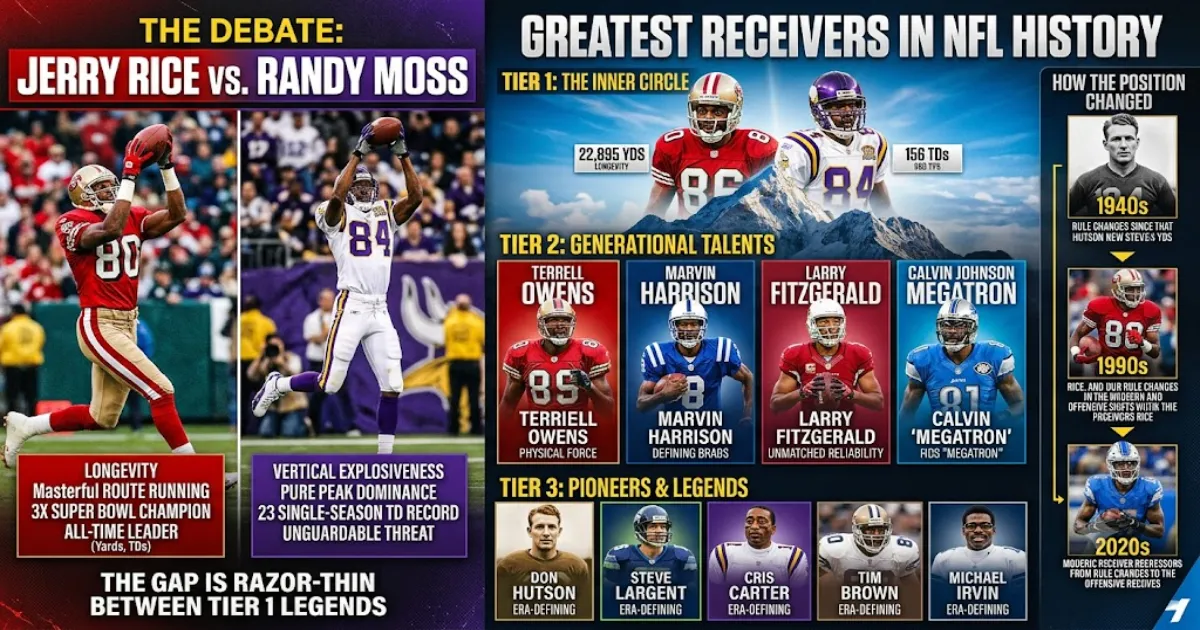
Jerry Rice isn’t just the best wide receiver in NFL history — he’s arguably the least debatable No. 1 at any position in the sport. His career totals remain almost absurdly far ahead of the field: 22,895 receiving yards, 1,549 receptions, and 197 touchdowns, each an all-time record by a comfortable margin. He led the NFL in receiving yards six times and touchdowns six times, posted 14 individual 1,000-yard seasons, and won three Super Bowl championships alongside Joe Montana and Steve Young in San Francisco. Even a devastating ACL and MCL tear in 1997 barely slowed him down — he came back the following season and reeled off six more 800-plus-yard years. Rice is 5,000-plus yards ahead of second place on the career receiving list and outpaced the next-closest touchdown total by more than 40 scores, gaps considered essentially unbreakable by most statistical analysts.
Randy Moss is the only receiver in NFL history with a serious claim to sit alongside Rice in the sport’s top tier, even without matching his career totals. Moss redefined what a receiver’s catch radius and vertical explosiveness could do to a defense, and his 23 touchdown receptions in 2007 remain the single-season record nearly two decades later. His case isn’t built on career accumulation — he played seven fewer seasons than Rice — but on pure per-game dominance and a level of physical threat that reshaped how defenses had to scheme against a single receiver.
The Rice vs. Moss Debate
This specific rivalry deserves its own closer look, since it’s the most enduring argument at the position. In December 2020, Moss told Terrell Owens’ podcast that he considered himself the greatest receiver ever, ranking Rice third or fourth. Rice responded on Instagram with a side-by-side career stat comparison, closing with Moss’s own signature broadcast phrase: “You just got Mossed.”
Breaking the comparison down by skill rather than bravado tells a more complete story. Rice wins decisively on route running, career longevity (21 seasons to Moss’s 14), and championship success (3 rings and 1 Super Bowl MVP to Moss’s 0). Moss actually edges Rice in yards per catch (15.6 to 14.8) and touchdowns per game (0.71 to 0.65), reflecting a game built more around explosive, field-flipping plays than Rice’s more complete, every-route mastery. The statistical and championship case overwhelmingly favors Rice — but at his absolute peak, a reasonable argument exists that no receiver in history, Rice included, was more physically terrifying to defend than Moss.
Tier 2: Generational Talents With a Real Case for No. 1 in Any Other Era
Terrell Owens retired third all-time in both receiving yards (15,934) and touchdowns (153), a résumé built on a rare combination of power, speed, and toughness that let him dominate after the catch as much as before it. Owens never won a Super Bowl and his career was frequently defined by locker-room friction, but on pure talent and production, his case for a top-five spot is difficult to dismiss.
Marvin Harrison built his Hall of Fame case largely in tandem with Peyton Manning in Indianapolis, forming one of the most statistically dominant quarterback-receiver duos in NFL history. His route precision and reliability in the short-to-intermediate passing game made him a matchup nightmare for over a decade, and he remains one of the most efficient high-volume receivers the position has ever produced.
Larry Fitzgerald sits second all-time in career receiving yards (17,492), a total made more remarkable by the fact he built it entirely with the Arizona Cardinals across 17 seasons, frequently catching passes from unstable or below-average quarterback play. His 30-catch, three-touchdown performance in a losing Super Bowl XLIII effort remains one of the greatest individual receiving performances in Super Bowl history, and his sure hands and route precision kept him elite well into his late 30s.
Calvin Johnson, known as “Megatron,” combined a rare blend of size, speed, and vertical leaping ability that made him nearly impossible to cover one-on-one at his peak. His 1,964 receiving yards in 2012 remain the single-season record, and his career, while cut shorter by an early retirement at 30, produced a peak that many evaluators still consider the most physically dominant stretch any receiver has ever put together.
Tier 3: Position Pioneers and Underrated Legends
Don Hutson is the receiver most casual fans overlook, and the one most historians insist belongs in any serious conversation. Playing in the 1930s and ’40s, Hutson was so far ahead of his era statistically that his numbers looked more like modern totals than anything else being produced at the time — he’s widely credited as the player who proved a receiver could be a offense’s primary weapon, laying the groundwork for everyone who came after him.
Steve Largent set the receiving standard for an entire generation before Rice arrived, retiring as the NFL’s all-time leader in catches, yards, and touchdowns at the time — records that seem modest by today’s standards but represented genuine, unmatched dominance for the era in which he played. Cris Carter and Tim Brown both built Hall of Fame careers on volume and reliability rather than pure explosiveness, with Carter in particular renowned for his red-zone precision and toughness at the catch point. Michael Irvin, part of the Dallas Cowboys’ 1990s “triplets,” brought a physical, alpha-receiver presence that helped anchor three Super Bowl championship rosters. Antonio Brown deserves mention for pure peak dominance — across a five-year stretch in Pittsburgh, few receivers in history have matched his per-season production — even though his career ultimately unraveled amid off-field turmoil that likely cost him a higher spot on this list.
How the Position Itself Has Changed
Part of what makes cross-era comparisons at this position so difficult is how dramatically the job itself has evolved. Hutson and Largent played in offensive systems where a 70-catch season was considered a monster year, and defenses were legally allowed to contact receivers far more aggressively downfield than today’s rules permit. By the time Rice, Owens, and Moss entered the league, rule changes limiting downfield contact and a leaguewide shift toward pass-heavy offenses had already begun inflating receiving numbers across the board — part of why career-yardage comparisons between eras require real context rather than a flat, side-by-side reading of the record book. The most recent generation, built around players like Jefferson and Chase, has pushed this even further, with modern offenses designed specifically to manufacture easy completions and yards after the catch through motion, spacing, and scheme — a genuinely different receiving environment than the one Rice or Hutson played in, even if the fundamental skills being evaluated (separation, hands, route precision) have stayed largely the same.
The Active Case-Builders
A handful of currently active receivers are already building résumés serious enough to eventually enter this conversation. Justin Jefferson and Tyreek Hill currently sit atop active receiver rankings, both combining rare per-season efficiency with the kind of game-breaking speed that recalls peak Moss more than peak Rice. Ja’Marr Chase and DeAndre Hopkins round out the next tier of active names with a credible long-term Hall of Fame trajectory, though none is yet within realistic range of threatening Rice’s career totals — a gap so large that, as with several other “unbreakable” records across NFL history, most analysts don’t expect it to be seriously challenged within the next decade, if ever.
What Actually Separates the Tiers
Looking at this list as a whole, a few criteria consistently separate one tier from the next: career longevity and sustained production (Rice, Fitzgerald), statistical peak dominance relative to the era played (Moss, Johnson, Hutson), championship success (Rice, Irvin), and pure physical difficulty to defend (Moss, Owens, Johnson). Very few receivers in history check every one of these boxes simultaneously — which is exactly why Rice’s case remains so uniquely uncontested at the very top, while the rest of the position’s greatest names each carry a slightly different, genuinely compelling version of the argument.
Postseason Performance: A Separate Conversation Entirely
It’s worth noting that playoff production tells its own, sometimes surprising story at this position. Fitzgerald’s 93 career playoff receptions rank second only to Rice, and his postseason performances — including that Super Bowl XLIII masterclass — arguably exceed his own regular-season reputation for pure consistency over explosiveness. Rice, unsurprisingly, dominates this category as thoroughly as he dominates the regular-season books, having played in four Super Bowls and produced repeatedly on the sport’s biggest stage across a 20-year career. Owens and Moss, by contrast, have thinner postseason résumés relative to their regular-season dominance — a reflection of the teams they played for as much as any decline in their own performance level once games mattered most, and a reminder that “greatest ever” rankings built purely on regular-season numbers can miss an important part of the full picture.
The Bottom Line
The greatest wide receivers in NFL history don’t reduce to a single clean countdown so much as a series of overlapping arguments about what “greatness” should even mean at the position — career volume versus peak explosiveness, quiet consistency versus physical dominance, championship success versus individual brilliance on a lesser team. Jerry Rice remains the only name essentially immune from that debate. Everyone else on this list, from Moss’s peak terror to Fitzgerald’s two-decade reliability to Hutson’s era-defining head start, represents a genuinely different, equally valid case for greatness — which is exactly why this remains one of the most enjoyable positions in football to argue about, year after year.
Frequently Asked Questions
Who is considered the greatest wide receiver in NFL history? Jerry Rice is almost universally regarded as the greatest wide receiver ever, holding the all-time records in receiving yards (22,895), receptions (1,549), and touchdowns (197), along with three Super Bowl championships.
Who is the biggest challenger to Jerry Rice’s status? Randy Moss is the most commonly cited alternative, based on his unmatched per-game explosiveness and the still-standing single-season touchdown record of 23, set in 2007.
Who ranks second all-time in career receiving yards? Larry Fitzgerald ranks second all-time with 17,492 receiving yards, built entirely over 17 seasons with the Arizona Cardinals.
Which wide receiver holds the single-season receiving yards record? Calvin Johnson holds the single-season record with 1,964 receiving yards in 2012.
Are any active players considered among the greatest wide receivers ever? Justin Jefferson and Tyreek Hill currently lead active receiver rankings and are considered strong future Hall of Famers, though neither is yet within realistic range of Jerry Rice’s career totals.
Why is Don Hutson included among the greatest wide receivers despite playing decades ago? Hutson, who played in the 1930s and ’40s, is credited with proving a receiver could be an offense’s primary weapon, posting statistical dominance so far ahead of his era that it laid the groundwork for the modern passing game.
🔹🔹 Follow us on Facebook 🔹🔹