Four straight Finals meetings, one all-time comeback, and a rivalry that reshaped how championship rosters get built — the full Warriors vs Cavaliers head-to-head record
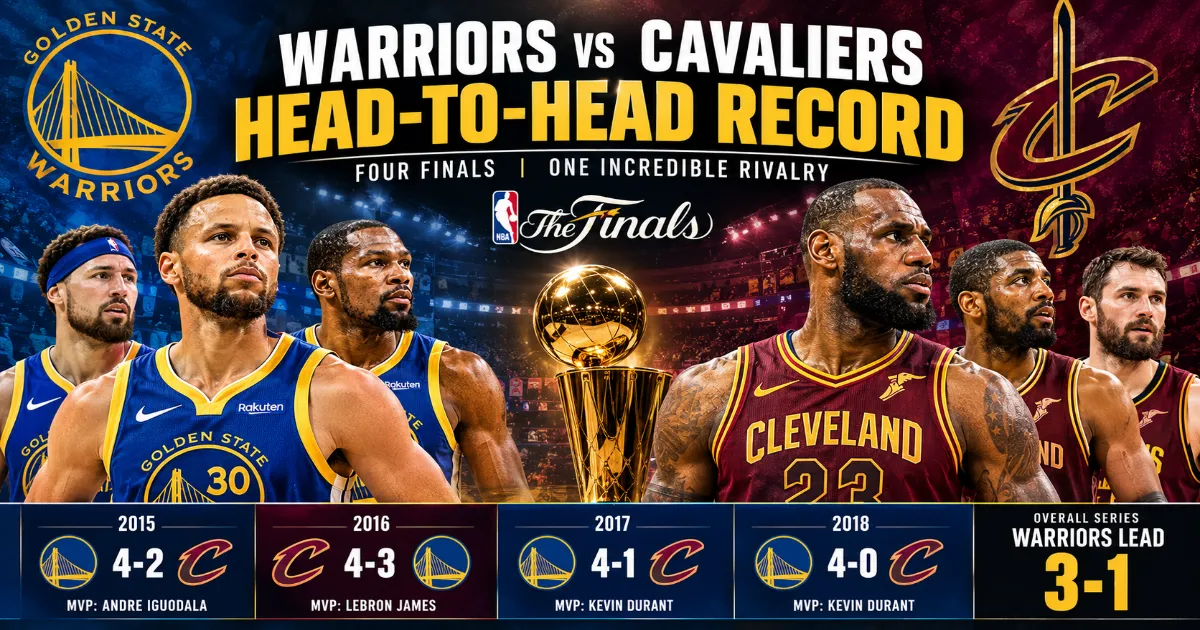
Few rivalries in NBA history have been as concentrated, or as consequential, as the Warriors vs Cavaliers head-to-head record built between 2015 and 2018. Unlike historic rivalries that unfolded gradually across multiple decades, this one played out entirely within a single four-year window, as the two franchises met in four consecutive NBA Finals — a level of repeated championship-stakes competition matched by very few pairings in league history. What makes this rivalry so significant isn’t just its frequency, but the fact that it produced one of the single greatest comebacks in Finals history and directly reshaped how front offices across the league think about roster construction.
The Fastest NBA Players Ever: Who Really Owns the Open Court?
Most Triple-Doubles in NBA History — How Russell Westbrook Rewrote a 47-Year-Old Record
Year One: 2015 — Golden State’s Breakthrough
The rivalry began in earnest during the 2015 Finals, when Stephen Curry’s Golden State Warriors defeated LeBron James’s Cleveland Cavaliers in six games. James, playing without significant injured co-stars Kyrie Irving and Kevin Love for most of the series, delivered one of the most statistically dominant losing Finals performances in league history, but Golden State’s depth and Andre Iguodala’s Finals MVP-winning defensive versatility proved decisive. This opening chapter established Golden State as the league’s new dominant power while setting up a rematch that both franchises would spend the following year building specifically toward.
Year Two: 2016 — The Greatest Comeback in Finals History
The 2016 Finals rematch produced what many analysts consider the single greatest comeback in NBA Finals history. Golden State, fresh off a record-breaking 73-win regular season widely regarded as one of the greatest single-season rosters ever assembled, built a commanding 3-1 series lead over Cleveland. James’s Cavaliers responded by winning three consecutive elimination games, capped by a Game 7 victory in Oakland that included James’s iconic chase-down block on Andre Iguodala, one of the most replayed defensive plays in NBA history, alongside a decisive late-game three-pointer from Kyrie Irving. This victory delivered Cleveland’s first major professional sports championship in over five decades and remains the signature moment of the entire Warriors vs Cavaliers head-to-head record.
Year Three: 2017 — Golden State’s Response
Stung by the previous year’s collapse, Golden State responded during the 2017 offseason by adding Kevin Durant, one of the league’s most talented scorers, to an already championship-caliber core. The resulting Warriors roster is frequently cited as one of the most talented single-season teams ever assembled, and the 2017 Finals rematch reflected that overwhelming talent gap, with Golden State winning in five games behind Durant’s Finals MVP-winning performance. This series effectively reestablished Golden State’s dominance over the rivalry and demonstrated how directly the previous year’s Finals loss had reshaped the Warriors’ roster-building priorities.
Year Four: 2018 — A Lopsided Conclusion
The rivalry’s fourth and final Finals meeting in 2018 proved to be its most one-sided, as Golden State swept Cleveland in four games. By this point, the talent gap between the two rosters had become significant, with Cleveland’s supporting cast around James having thinned considerably compared to the deeper, more complete Cavaliers roster that had won in 2016. James’s departure from Cleveland for the Los Angeles Lakers that following offseason effectively closed the book on this specific chapter of the Warriors vs Cavaliers head-to-head record, as neither franchise has met in the Finals since.
Warriors vs Cavaliers — Complete Finals Meeting History
| Year | Winner | Series Result | Finals MVP |
|---|---|---|---|
| 2015 | Golden State Warriors | 4-2 | Andre Iguodala |
| 2016 | Cleveland Cavaliers | 4-3 | LeBron James |
| 2017 | Golden State Warriors | 4-1 | Kevin Durant |
| 2018 | Golden State Warriors | 4-0 | Kevin Durant |
Overall Series Record: Warriors Lead 3-1
Across the full four-year Finals trilogy, the Warriors vs Cavaliers head-to-head record favors Golden State decisively, with the Warriors winning three of the four meetings. Cleveland’s lone victory in 2016, however, remains disproportionately significant relative to its single win, both for the historic nature of the comeback itself and for the way it briefly interrupted what many analysts otherwise consider one of the most dominant four-year stretches by any single franchise in modern NBA history.
How This Rivalry Reshaped Roster Construction League-Wide
Perhaps the most lasting legacy of the Warriors vs Cavaliers head-to-head record isn’t found in the win-loss column at all, but in how directly it influenced roster-building strategy across the rest of the league. Golden State’s decision to add Kevin Durant after the 2016 Finals loss demonstrated, in dramatic fashion, how a single superstar addition could definitively swing a championship-caliber rivalry, accelerating a broader league-wide trend toward superstar player empowerment and player-driven “super team” roster construction that had already begun with James’s own free agency decisions earlier in his career. Front offices across the league subsequently placed even greater emphasis on maintaining enough salary cap flexibility to pursue similar star additions, a strategic shift frequently traced directly back to this specific four-year rivalry.
The Individual Rivalry Within the Team Rivalry
Beyond the broader team-level competition, the Warriors vs Cavaliers head-to-head record also produced one of the most compelling individual rivalries of the era between LeBron James and Stephen Curry. James’s 2016 Finals performance, in which he averaged a near triple-double across the decisive final three games, is frequently cited as the finest individual playoff stretch of his career, delivered specifically against a Curry-led roster that had just completed a record-breaking regular season. Curry, for his part, responded to the disappointment of 2016 by helping lead Golden State to two more championships in the two Finals rematches that followed, ensuring that the individual rivalry between the two superstars remained just as central to this history as the broader team-level competition.
Why the Rivalry Never Continued Past 2018
Unlike the Lakers-Celtics rivalry, which has been renewed across multiple distinct eras separated by decades, the Warriors vs Cavaliers head-to-head record remains confined entirely to this single four-year window. James’s 2018 free agency departure to the Los Angeles Lakers effectively ended Cleveland’s championship-caliber roster window, while Golden State’s own core gradually aged out of championship contention in the years that followed, interrupted further by significant injuries to Klay Thompson and Kevin Durant’s eventual departure in 2019. This concentrated timeline is part of why the rivalry, despite lasting only four seasons, remains one of the most intensely analyzed pairings in modern NBA history.
The Supporting Casts Behind Each Finals Run
The Warriors vs Cavaliers head-to-head record was also shaped significantly by the complementary talent surrounding each team’s respective superstar. Golden State’s “Death Lineup,” featuring Draymond Green at center alongside four shooters, became one of the most influential tactical innovations of the era, forcing opposing defenses into impossible spacing dilemmas that Cleveland’s more conventional roster construction struggled to solve across most of the four meetings. Cleveland countered with Kyrie Irving’s elite shot-creation ability and, in later series, veteran additions like Kevin Love, but the Cavaliers were never able to fully replicate the positional versatility that made Golden State’s smaller, shooting-heavy lineups so difficult to defend during crucial playoff stretches.
Coaching Adjustments Across the Four Series
Each Finals rematch within the Warriors vs Cavaliers head-to-head record also featured meaningful coaching adjustments from both sides. Cleveland head coach Tyronn Lue’s decision to insert Richard Jefferson and Kevin Love into a smaller, more switchable lineup during the pivotal stretch of the 2016 Finals is widely credited as a key tactical adjustment that helped neutralize Golden State’s own small-ball advantages during that specific comeback. Golden State head coach Steve Kerr, meanwhile, continued refining his own rotations and lineup combinations across the subsequent two series, particularly after adding Kevin Durant, ensuring the Warriors’ tactical approach evolved specifically in response to lessons learned from their sole Finals loss to Cleveland.
Individual Statistical Trends Across the Series
Looking at the Warriors vs Cavaliers head-to-head record purely through an individual statistical lens reveals some striking trends across all four Finals meetings. LeBron James actually posted higher per-game scoring, rebounding, and assist averages across the combined four-series sample than any player on the Golden State roster, reflecting the sheer offensive burden he carried for a Cleveland roster that generally lacked the same depth of complementary scoring options. Stephen Curry’s efficiency numbers, particularly his three-point shooting percentage across the four series, remained remarkably consistent regardless of the series outcome, suggesting that Golden State’s ultimate success in three of the four meetings had as much to do with roster depth and complementary shooting as with any single individual statistical advantage over James himself.
Legacy Impact on Both Franchises
The long-term impact of the Warriors vs Cavaliers head-to-head record extended well beyond the four seasons in which it played out. Cleveland’s 2016 championship remains the defining achievement in franchise history, a title that ended one of the longest championship droughts among the city’s major professional sports teams. Golden State’s three championships across the same broader window cemented the franchise’s status as a genuine modern dynasty, with the roster’s core group of homegrown talent — Curry, Thompson, and Green — becoming forever associated with one of the most tactically influential eras the sport has ever seen, regardless of Cleveland’s singular interruption to that broader run of dominance.
How the Rivalry Is Remembered Today
Looking back, the Warriors vs Cavaliers head-to-head record is often remembered less as a balanced rivalry and more as a single dramatic interruption within an otherwise dominant Golden State era. Historians and analysts frequently frame the four-year span as “the Warriors dynasty, with one asterisk,” acknowledging Cleveland’s 2016 triumph as a genuinely historic achievement while still recognizing Golden State’s broader three-out-of-four series dominance as the defining storyline of this specific matchup. This framing reflects how difficult it remains, even years later, to fully separate an individual rivalry’s most dramatic single moment from its overall statistical outcome.
Final Thoughts
The Warriors vs Cavaliers head-to-head record stands as one of the most concentrated, consequential rivalries in NBA history, four Finals meetings packed into a single four-year window that produced both the greatest comeback in Finals history and a definitive demonstration of superstar-driven roster construction reshaping a championship rivalry in real time. While Golden State ultimately won the series three games to one, Cleveland’s singular 2016 triumph remains one of the most significant individual championships in modern league history, ensuring this rivalry’s legacy extends well beyond its relatively brief four-year timeline.
Frequently Asked Questions
How many times did the Warriors and Cavaliers meet in the NBA Finals? The two franchises met in four consecutive NBA Finals from 2015 to 2018, with Golden State winning three of the four series.
Which Warriors vs Cavaliers Finals is considered the greatest comeback in NBA history? The 2016 Finals, in which Cleveland overcame a 3-1 series deficit to win in seven games, is widely regarded as the greatest comeback in NBA Finals history.
Why did Golden State add Kevin Durant after the 2016 Finals? Following their historic loss to Cleveland despite a record-breaking 73-win regular season, the Warriors added Kevin Durant in free agency to reinforce their championship-caliber core, a move that helped them win the two subsequent Finals rematches in 2017 and 2018.
Did the Warriors and Cavaliers ever meet in the playoffs outside the Finals? No, all four meetings between these two franchises during this rivalry’s peak years came exclusively in the NBA Finals, since they played in different conferences and therefore could not meet in earlier playoff rounds under the league’s postseason bracket structure.
🔹🔹 Follow us on Facebook 🔹🔹