From draft order and seven-round selections to trades, compensatory picks and undrafted free agents, this NFL Draft Explained guide breaks down how all 32 teams find and develop the next generation of players.
The NFL Draft is the league’s primary mechanism for distributing new talent, and it’s built around a simple guiding principle: the worst teams from the previous season get the best opportunity to improve first. Every spring, all 32 franchises take turns selecting eligible college players across seven rounds, and the order in which they pick is deliberately designed to help competitive balance across the league. Here’s how the full process actually works.
NFL Overtime Rules Explained (2025 Update): How It Really Works
The Basic Format: Seven Rounds, 32 Teams
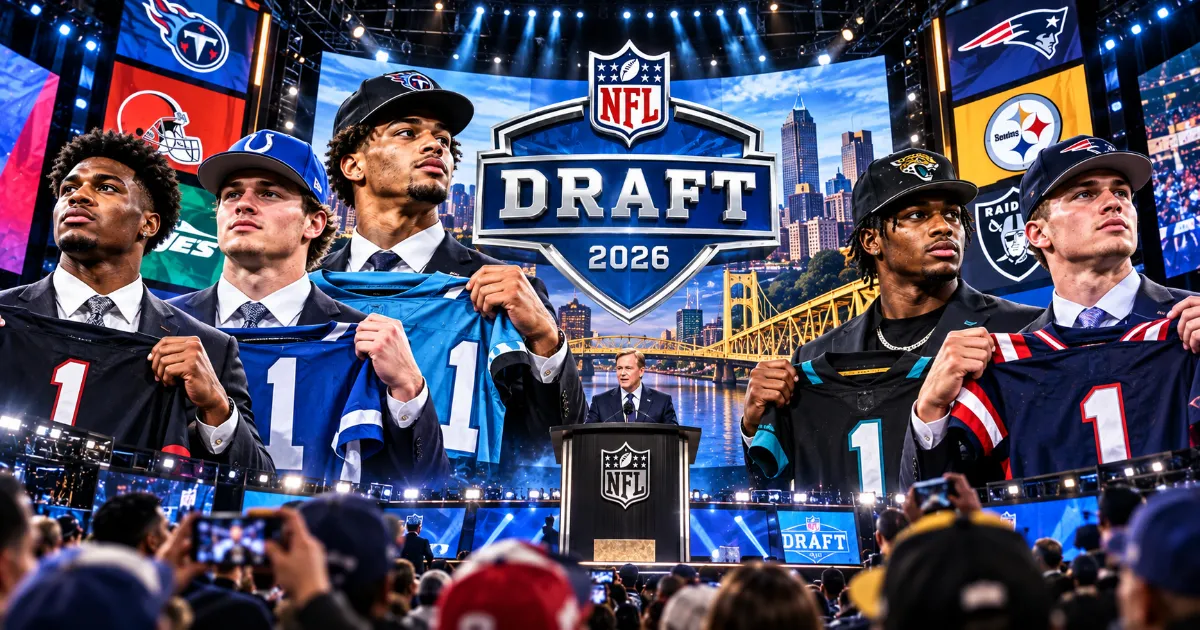
The modern NFL Draft consists of seven rounds, with more than 250 players typically selected across the full event. Each round runs through all 32 teams in a predetermined order before moving to the next round, and the draft is spread across three days: the first round on a Thursday night, the second and third rounds on Friday, and the remaining four rounds on Saturday. The 2026 NFL Draft, for example, ran from April 23 through April 25, held at Acrisure Stadium in Pittsburgh — a reminder that while the draft was once held annually in New York, the NFL now rotates the event to a different host city most years, turning it into a multi-day, city-wide event similar in scale to the Super Bowl’s host-city buildup.
How the Draft Order Is Determined
The basic principle behind draft order is straightforward: teams are ranked in reverse order of the previous season’s standings, meaning the team with the worst regular-season record picks first, and the Super Bowl champion picks last in the first round. Ties between teams with identical records are broken using strength of schedule, with the team that faced a weaker slate of opponents generally picking ahead of the team that faced a tougher one, on the theory that its record was earned against less resistance.
This order applies specifically to the first round and largely carries through subsequent rounds, though it can shift somewhat round to round based on trades. Draft picks are one of the most heavily traded assets in the sport — teams routinely trade picks for other picks, for established players, or move up and down the board to target specific prospects, meaning the team holding, say, the 15th overall pick on draft day isn’t always the team that originally earned that slot through its record the previous season.
Compensatory Picks: The League’s Free Agency Balancing Mechanism
Beyond the standard 32 picks per round, the NFL awards compensatory draft picks to teams that lost more notable free agents than they signed in the previous offseason, based on a formula the league keeps largely under wraps but that factors in contract value, playing time and postseason honors. These picks are tacked onto the end of rounds three through seven and give teams that lose top free agents a form of draft-pick compensation beyond what a division rival might receive for simply having a worse record. In any given year, the compensatory formula can add roughly 30 extra selections to the draft, on top of the standard allotment.
Who’s Eligible to Be Drafted
A player becomes draft-eligible three years after his high school class graduated, a rule the league adopted following a legal challenge in the mid-2000s and one that’s remained a defining, if occasionally controversial, structural feature of the sport compared to some other major leagues. In practice, this typically means college juniors or redshirt sophomores can declare for the draft, though the large majority of drafted players are college seniors. Underclassmen who want to enter the draft early must formally declare, a decision point that plays out every January as players around the country weigh their draft stock against the value of returning to school for another season.
The Draft-Day Clock
Each team is given a set amount of time to make its selection once it’s on the clock, and that time shrinks as the draft progresses. First-round picks get 10 minutes to make a decision, second-round picks get 7 minutes, and the time continues to shrink in later rounds, down to just 4 or 5 minutes by the final rounds. Teams that fail to submit a pick within their allotted window don’t lose the pick — they simply risk being skipped over if another team is ready to make its selection first, a scenario that occasionally happens and creates one of the draft’s more chaotic, unscripted moments.
The Scouting Combine and Pro Days
Before the draft itself, prospects go through an extensive evaluation process, most visibly at the NFL Scouting Combine, typically held in late February and early March. The combine gathers the draft class’s top prospects for standardized physical testing — the 40-yard dash, vertical jump and bench press among the most publicized — along with medical evaluations and formal interviews with team personnel. Prospects who skip the combine or want to improve specific test numbers often participate in their college’s individual “pro day,” where team scouts can evaluate them in a more controlled, school-specific setting.
Undrafted Free Agents
Not every prospect gets selected across the draft’s roughly 260 picks, and players who go unselected become undrafted free agents, able to sign with any team immediately after the draft concludes. While undrafted free agents face longer odds of making a roster than drafted players, plenty of notable NFL careers — including several Pro Bowl and All-Pro-caliber players — began as undrafted signings, a reminder that draft slot, while a strong predictor of career outcomes on average, is far from a guarantee of NFL success or failure.
Why the Draft Matters So Much
The draft remains the league’s most cost-controlled way to acquire talent, since rookie contracts are now largely standardized by a rookie wage scale tied directly to draft position, removing the lengthy holdout negotiations that used to accompany top picks in earlier draft eras. That predictability, combined with the sheer volume of long-term roster building it enables, is part of why teams invest so heavily in scouting infrastructure year-round, and why a single draft class can reshape a franchise’s outlook for the better part of a decade.
The Bottom Line
At its core, the NFL Draft is a talent-distribution system built around competitive balance — worst record picks first, compensatory picks reward teams that lose free agents, and a three-day, seven-round structure gives all 32 franchises a chance to add players from every relevant experience level, from projected first-round stars to late-round developmental prospects. Understanding the order, the eligibility rules and the trading dynamics that shape draft day is the clearest way to follow along with how NFL rosters actually get built each offseason.
🔹🔹 Follow us on Facebook 🔹🔹